Calendering vs. Knife-Coating: Core Process Differences
| Item | Calendering | Knife-coating / Plastisol |
|---|---|---|
| Raw-material form | Dry blend or plasticized melt (suspension PVC, plasticizers, stabilizers, fillers) | Liquid PVC paste (emulsion/paste resin, plasticizers, stabilizers, pigments, blowing agents) |
| Forming mechanism | Internal mixing → open milling → extrusion → multi-roll calendering into continuous film or foamable sheet | Doctor-blade metering of wet film thickness; gelation, fusion, and optional foaming |
| Typical layer strategy | Pre-calendered skin and foam layers laminated to fabric, then oven-foamed and embossed | Skin paste coated on release paper, followed by foam paste, back-coat, and fabric lamination at controlled stages |
| Surface texture | Obtained during calendering, post-embossing, or milling; suited to high-volume continuous sheet | Most commonly transferred from textured release paper to the PVC skin; paper is stripped after fusion |
| Thickness control | Roll gap, roll temperature, tension, and line speed | Blade gap, coat weight, paste rheology, and oven thermal history |
| Key process risks | Thermal degradation, roll sticking, thickness variation, plasticizer exudation, uneven foam | Pinholes, cratering, incomplete fusion, release-paper transfer defects, VOC/odor |
Verified patent examples confirm the calendering sequence as high-speed mixing → internal mixing → open milling → extrusion → four-roll calendering → fabric lamination → foaming at 170–180 °C. Knife-coating patents describe skin coating on release paper → gelation → foam-layer coating → gelation → back-coat/fabric attachment → final foaming and fusion. CN104164788A US4349597A
Actionable recommendation: When you issue an RFQ, require the supplier to state which route will be used for the quoted construction and to supply the corresponding process-flow diagram with temperature and residence-time windows; otherwise thickness, grain definition, and VOC results cannot be compared on equal terms.
Multi-Layer Structure of Automotive PVC Leather
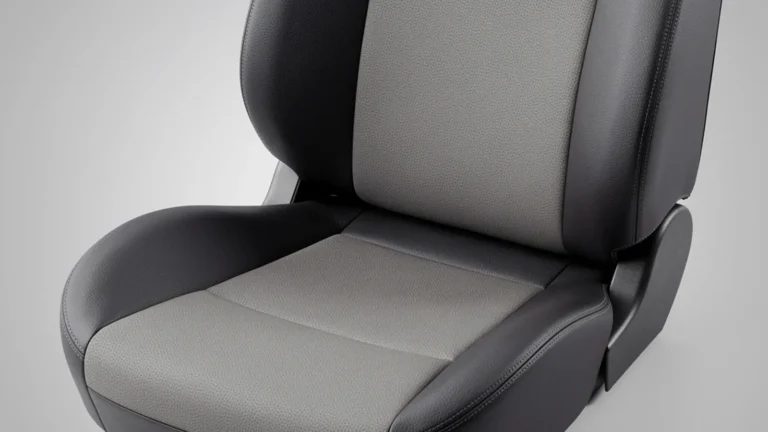
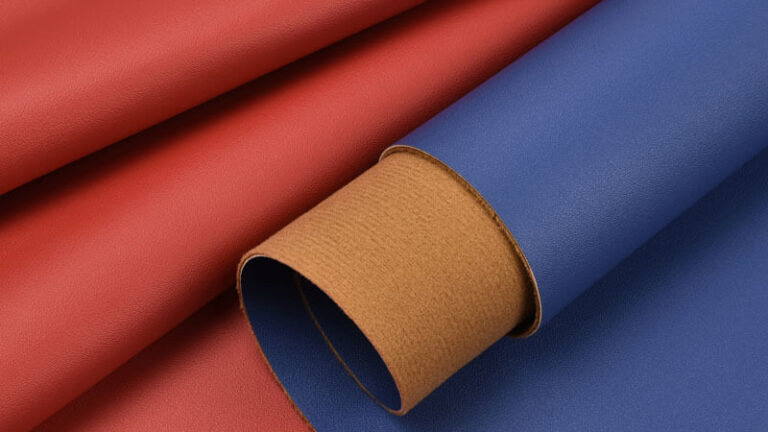
Automotive seating and door-panel PVC leather refers to a multi-layer composite rather than a simple “PVC-plus-fabric” bilayer.
A representative construction is:
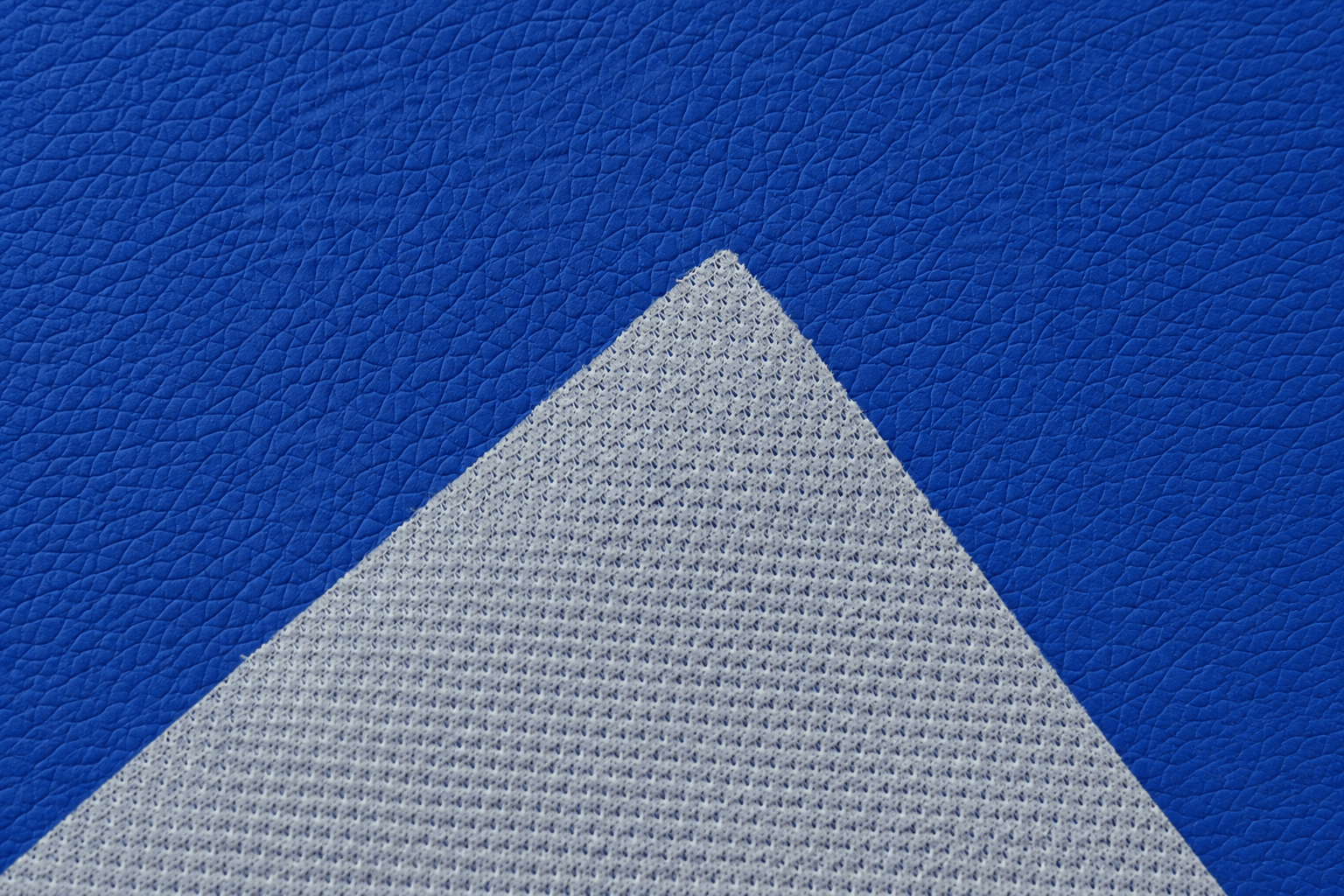
Topcoat / ink | PVC dense skin | PVC foam | back-coat / adhesive | textile substrate
Low-odor automotive patents describe products built from a water-borne surface lacquer, PVC skin layer, PVC foam layer, and back-coat; the textile may be laminated on either the skin or foam side depending on the seat position. CN111058294A
Seat-cover materials typically assign mechanical load-bearing, dimensional stability, and sewability to a knitted, woven, or non-woven substrate while the skin and topcoat deliver grain, abrasion resistance, stain resistance, and tactile feel. Fabric mass fraction is therefore not a fixed percentage; it varies with fabric weight, foam thickness, total target mass, and application zone.
Verified data from a plastisol-composite patent show that the substrate can be woven, non-woven, or knitted; one historical example used a vinyl-coated glass-fiber scrim at 16 × 18 thread count, 14 mil thickness, and 3.6 oz/yd². That specification is an illustration only and does not represent typical automotive seating fabric. US4349597A
Actionable recommendation: In your material specification, lock the complete layer stack (skin thickness, foam thickness, fabric type and weight, topcoat chemistry) rather than a single total thickness or mass; otherwise peel strength, cold-flex, and sewing performance will drift from lot to lot.
Step-by-Step Calendering Manufacturing Process
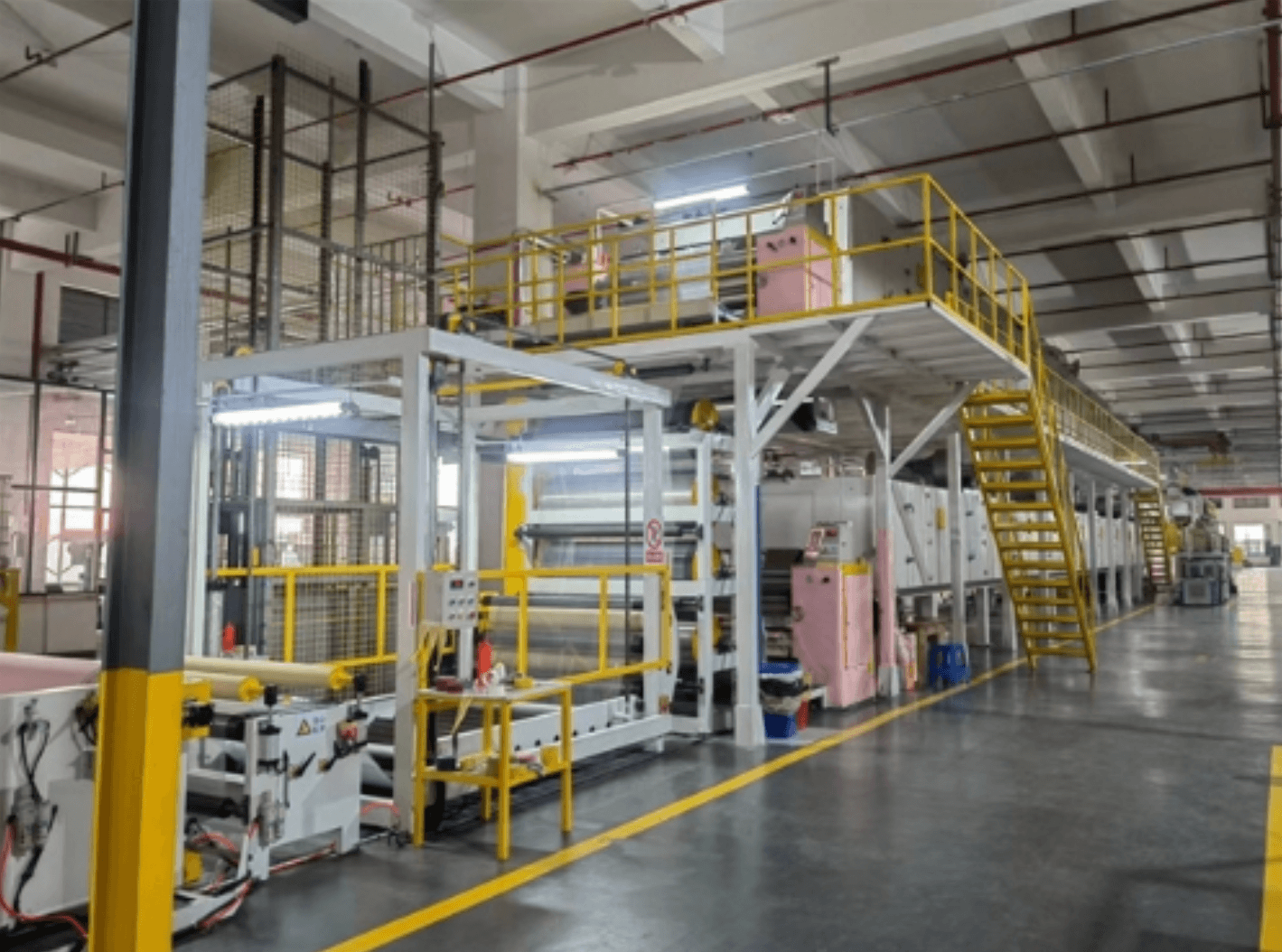
Calendering of automotive-grade foamed PVC leather refers to a continuous melt-process sequence that converts dry-blended compounds into laminated sheet, followed by controlled foaming and surface finishing.
The verified sequence drawn from a published foamed-PVC patent is as follows.
1. Raw-material preparation and layered formulation
Skin and foam layers are compounded separately. Skin typically contains PVC resin, plasticizer, heat stabilizer, and pigments. Foam contains PVC resin, plasticizer, epoxidized soybean oil (ESO), CaCO₃, heat stabilizer, blowing agent, activator, and pigments. The patent example uses non-woven fabric; commercial seating materials may also employ knitted or woven fabrics. CN104164788A
2. High-speed mixing
Each layer is mixed for 5–12 min. Low-temperature foam activators and azodicarbonamide (AC) blowing agent can be added before internal mixing. CN104164788A
3. Internal mixing (Banbury)
The dry blend is plasticized for 2–4 min. Thermal history must be controlled to avoid dehydrochlorination, discoloration, and melt-rheology drift. CN104164788A
4. Open milling and extrusion homogenization
The mixed stock is sheeted on an open mill, then fed to an extruder. Verified die temperature range is 120–150 °C; barrel steam pressure is listed as 0.1–0.5 MPa in the same patent. Actual set-points must be adjusted for PVC K-value, plasticizer type, filler loading, and shear history. CN104164788A
5. Four-roll calendering
Skin and foam compounds are calendered into continuous sheets. Verified roll-temperature windows are: roll 1 160–180 °C, roll 2 165–185 °C, roll 3 165–185 °C, roll 4 160–180 °C. Roll gap determines thickness; temperature, line speed, and tension control surface flatness and orientation. CN104164788A
6. Fabric lamination
Foam and skin layers are stacked in sequence onto the textile substrate and enter the foaming oven. Pre-lamination checks of fabric pretreatment, anchorage, peel strength, and thermal-shrinkage match are essential to avoid delamination or wrinkling after foaming. CN104164788A
7. Final foaming, fusion, and surface finishing
The laminate is foamed at 170–180 °C for 2–3 min. Subsequent milling (softening) conditions disclosed in the same patent are 60–85 °C for 20–40 min, followed by forced-air cooling at 45–55 m³/min for 5–10 min. These milling data apply to a specific high-softness route and should not be treated as universal. CN104164788A
In one production-trial observation we conducted while matching a seat-cover construction, we measured skin-thickness variation of ±0.05 mm across a 1.4 m width when roll-gap feedback was closed-loop versus ±0.12 mm under open-loop control; the tighter window reduced subsequent foam-thickness scatter and improved sewing-edge consistency. That measurement was specific to the equipment and compound used and is not a general industry figure.
Actionable recommendation: Request the supplier’s actual roll-temperature profile, foam-oven residence time, and post-milling conditions for the exact construction being quoted; generic “calendered PVC” claims without these numbers are not comparable.
The process steps below combine verified patent examples and a peer-reviewed foaming study.
1. Plastisol preparation
Paste resin, plasticizer, stabilizer, pigments, fillers, and functional additives are dispersed under vacuum to remove entrained air. One automotive-foam study examined DPHP plasticizer at 60–80 phr, ADC blowing agent at 10–30 phr, processing aid at 1–4 phr, and Ca/Zn stabilizer at 1 phr (PVC = 100 phr). The same work formed a 0.3 mm wet layer on release paper after vacuum de-aeration. MDPI Materials 17(5) 1076
2. Release-paper unwind and grain transfer
Textured release paper is unwound continuously. Skin plastisol is knife- or roller-coated onto the embossed face and heated to a tacky gel state. US4349597A
3. Skin-layer gelation
A low-odor patent example gels the skin at 180 °C for 30 s, then cools before the next coat. An older U.S. patent lists first- and second-oven temperatures around 250 °F (≈121 °C) for tack development; that historical set-point is not a modern automotive default. CN111058294A US4349597A
4. Foam-layer coating and pre-gel
Foam plastisol is applied to the reverse of the gelled skin. The same low-odor patent repeats 180 °C / 30 s pre-gel. In the peer-reviewed study, foam thickness peaked at 3.63 mm with 65 phr DPHP under the specific laboratory conditions reported. CN111058294A MDPI Materials 17(5) 1076
5. Back-coat, adhesive, and fabric lamination
A water-borne polyurethane back-coat is applied to the foam surface in the low-odor patent. Traditional plastisol routes may embed fabric into a tacky first layer and coat a second layer from the opposite side to fill interstices. Fabric is specified by mass (g/m²), construction, tensile/tear, thermal shrinkage, and peel strength—not by a fixed “percentage of the formula.” CN111058294A US4349597A
6. Final fusion and foaming
Verified conditions include 200 °C / 60 s (low-odor patent) and 210 °C / 60 s (peer-reviewed ADC/DPHP/Ca-Zn system). An older patent cites a final oven near 400 °F (≈204 °C). None of these values is a universal standard. CN111058294A MDPI Materials 17(5) 1076 US4349597A
7. Paper stripping, topcoat, and embossing
After cooling, the release paper is stripped, transferring the grain. The low-odor patent then applies three water-borne PU topcoats with intermediate drying at 90 °C / 10 s, final drying at 140 °C / 40 s, and embossing at 200 °C. Surface performance is therefore controlled by the topcoat as much as by the PVC bulk. CN111058294A
Actionable recommendation: Specify both the release-paper grain code and the topcoat chemistry in the purchase order; grain definition and abrasion/stain results will otherwise vary even when the PVC bulk formulation is identical.
Formulation Ratios and Process Parameters from Verified Sources
Formulation ratios for automotive PVC leather refer to the publicly disclosed weight-part or phr windows published in patents and peer-reviewed studies; they are starting points for development, not OEM-released production recipes.
All figures below are taken directly from the cited sources and retain the original units (weight parts or phr).
Low-odor skin layer (patent range)
Basis: PVC resin + plasticizer = 100 weight parts.
| Component | Range | Notes |
|---|---|---|
| PVC resin | 50–70 weight parts | Skin or foam resin share |
| Plasticizer | 30–50 weight parts | Preferred C9–C13 linear dialkyl phthalates; C10/C12 systems mentioned |
| Organic epoxy-type stabilizer | 1–5 weight parts | Preferably free of diethylene glycol monobutyl ether |
| Pigment | 0–5 weight parts | Optional inorganic or color paste |
The same patent states that odor grade ≤3.5 (PV3900C3) was achieved on its samples; this is a source-specific result, not a universal OEM guarantee. CN111058294A
Low-odor foam layer (same patent basis)
| Component | Range |
|---|---|
| PVC resin | 50–70 weight parts |
| Plasticizer | 30–50 weight parts |
| Stabilizer | 1–5 weight parts |
| Blowing agent | 1–3 weight parts (physical preferred) |
| Pigment | 0–2 weight parts |
Resin >70 parts or plasticizer <30 parts is stated by the applicant to reduce processability and increase hardness; the opposite extremes are claimed to reduce strength. These are applicant assertions, not independent limits. CN111058294A
Automotive interior plastisol (authorized patent)
| Component | Weight parts |
|---|---|
| PVC paste resin | 50–60 |
| Plasticizer | 40–50 |
| Organotin stabilizer | 1.5–2.0 |
| Pigment | 10–12 |
K-value 70–80, paste viscosity 1,500–4,500 cps, VCM <10 ppm are also listed. Three concrete examples are given: 50/40/1.5/10, 55/45/1.7/11, and 60/50/2.0/12. Organotin and certain phthalates require case-by-case review against current OEM restricted-substance lists. CN102250433B
Calendered skin and foam (weight-part ranges)
Skin example: PVC 60–68, DOP 65–75, Ba-Zn stabilizer 0.5–1.5, rutile TiO₂ 3–8, colorant 0.01–0.07. One concrete instance is PVC 63 / DOP 70 / Ba-Zn 1.3 / TiO₂ 5 / colorant 0.04. CN104164788A
Foam example: PVC 40–45, DOP 35–42, ESO 8–12, light CaCO₃ 20–28, Ba-Zn 1–2, low-temperature foam activator 3–6, blowing agent 3–10, anatase TiO₂ 1–5. Concrete instance: PVC 42 / DOP 40 / ESO 10 / CaCO₃ 25 / Ba-Zn 1.5 / activator 4 / blowing agent 6 / TiO₂ 3. CN104164788A
These formulations contain DOP; they are historical patent data and do not constitute a compliance recommendation for current automotive interior projects.
Peer-reviewed foam-layer study (phr)
Optimized laboratory recipe (PVC paste resin = 100 phr): DPHP 65 phr, ADC 25 phr, foam activator 1 phr, acrylate processing aid 1 phr, Ca/Zn stabilizer 1 phr. Average areal density of the trial material was 765 g/m² (773 g/m² with chopped carbon fiber); the study target was below 800 ± 80 g/m². Tensile, tear, and VOC results were measured against GMW 3010N, ISO 13937-2, and GMW 3205 respectively—values apply only to that experimental system. MDPI Materials 17(5) 1076
Actionable recommendation: Treat every published phr or weight-part table as a development starting point only. Require the supplier to declare the actual CAS numbers of plasticizers and stabilizers, then verify them against your OEM’s restricted-substance list and the finished construction’s odor/VOC/fogging results.
FAQ
A: No. Publicly disclosed ranges exist in patents and one peer-reviewed study, but each OEM, seat position, and performance package requires its own layered design for low odor, VOC, heat aging, grain, and hand feel. The numbers cited above are source-specific windows, not universal production recipes.
A: Calendering favors high-volume continuous sheet with good thickness uniformity. Knife-coating on release paper favors fine grain transfer, independent layer design, and low-odor constructions. Choice depends on grain definition, foam softness, and VOC targets rather than a universal ranking.
A: No. Fabric is purchased by mass (g/m²), construction, tensile/tear, and thermal shrinkage. Its contribution to total mass varies with foam thickness and design target weight; the correct specification language is layer-by-layer thickness and fabric properties, not a single percentage.
A: Those values are taken from specific patent examples and one laboratory study. Actual set-points must be validated for the PVC K-value, plasticizer package, blowing-agent decomposition profile, and equipment thermal history of the production line being used.
A: Historical patents list them, but current acceptability is governed by the target OEM’s restricted-substance list, IMDS/GADSL, REACH, and interior VOC/odor specifications. Presence in an old patent does not equal current compliance approval.
A: Require the supplier to declare the process route (calendering or knife-coating), the complete layer stack with nominal thicknesses, the release-paper or emboss grain code, the topcoat chemistry, and the actual temperature/residence-time windows for gelation, fusion, and foaming. Without these data, quotations cannot be compared on equal technical grounds.
“`