Service Life of Automotive PVC Leather
Service life of automotive PVC leather refers to the period during which the material continues to meet the functional and appearance requirements of the vehicle interior under the combined stresses of temperature cycling, UV exposure, humidity, body oils, cleaning agents and mechanical flexing.
Public standards do not publish a single “must last X years / Y kilometres” number for PVC leather. Instead they define the test methods and pass/fail criteria that OEMs use to prove the material will survive the vehicle’s design life. Industry estimates that appear in open market analyses place typical passenger-car service in the range of 5–10 years or roughly 80 000–200 000 km under normal use; these figures are experience-based, not hard regulatory limits, and they widen or shrink sharply with climate, seating position and maintenance. Industry market analysis
The dominant degradation routes are well documented. Elevated temperature drives plasticiser migration, surface hardening and eventual cracking. Low temperature raises the risk of brittle fracture at fold lines. UV plus heat produces fading and surface embrittlement. Sweat and sebum accelerate colour change and surface tack. Aggressive cleaners extract plasticiser or attack the top-coat. Repeated ingress/egress concentrates wear on the front edge of the seat cushion and side bolsters. Corresponding laboratory methods include ISO 5402-1 (flex), ISO 17076 / VDA 230-211 (abrasion), ISO 11641 (perspiration), ISO 15701 (colour migration), SAE J1756 (fogging), SAE J2020 and SAE J2230 (accelerated weathering). ISO 5402-1 SAE J1756 SAE J2020 SAE J2230
OEM owner manuals reinforce the same practical limits: prolonged wetting, steam, strong solvents or silicone/wax products can permanently alter appearance and hand. GM owner manual guidance
The opportunity side is equally clear. When the plasticiser system, heat stabilisers, UV package and top-coat are correctly specified, the same material that fails early under abuse can still meet the full vehicle life in moderate climates and lower-contact zones. The gap between “generic PVC” and “automotive-grade PVC” is therefore a formulation and validation gap, not an inherent material ceiling.
Cleaning, Maintenance, and Actual Stain Resistance
The non-porous surface of automotive PVC leather is one of its most practical advantages. Spilled liquids, body oils, food residue, and most cosmetics remain on the topcoat and can usually be wiped away using a soft cloth and mild soapy water. However, strong solvents, silicone sprays, wax polishes, and prolonged steam cleaning must still be avoided, as they can leach plasticizers or dull the finish—consistent with warnings found in OEM owner’s manuals.
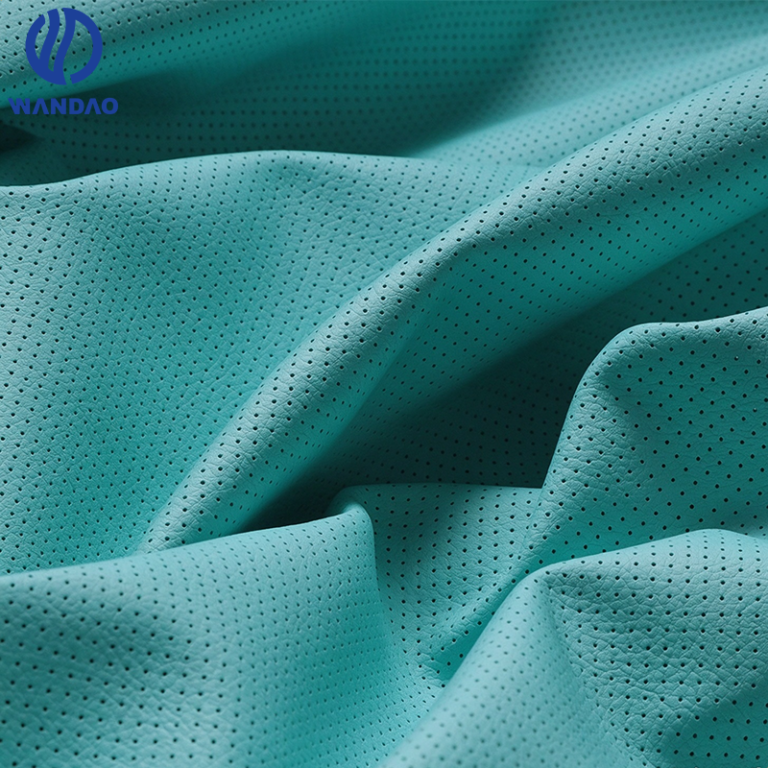
For fleet and family vehicles, the benefit of low maintenance often outweighs the issue of slightly higher heat buildup—compared to perforated versions—in high-temperature conditions. When ventilation is required, a specification ensuring clear airflow through perforations (typically 1.0 mm in diameter with 5 mm × 5 mm spacing) should be selected, ensuring the holes remain open after lamination to the foam backing.
Thickness and Layer Structure by Interior Component
Thickness and layer structure of automotive PVC leather refers to the total caliper and the relative thicknesses of the compact PVC skin, the foam interlayer and the textile backing that together determine hand, formability, seam strength and long-term integrity for a given part.
Open patent literature and supplier technical data show that total thickness for most soft-trim applications falls in the 0.5–1.5 mm band. A representative automotive PVC construction cites a compact face layer of approximately 0.2 mm, a foam layer of 0.28–0.34 mm and a knitted or non-woven backing of 200–400 g/m² (backing thickness 700–1 100 µm). CN110373912A
| Component | Typical total thickness | Priority |
|---|---|---|
| Seat cover | 0.8–1.2 mm | Soft hand + repeated flex + sewing |
| Door panel | 0.7–1.1 mm | Conformability + edge stability |
| Instrument panel | 0.8–1.5 mm | Heat stability + low VOC + soft-touch |
| Armrest | 0.8–1.3 mm | Local compression recovery |
Too much total thickness raises weight, makes tight radii difficult to wrap and increases sewing resistance. Too little thickness exposes the backing texture, reduces abrasion life and can produce “see-through” of underlying foam or substrate. The foam layer is the main lever for soft-touch; the compact skin governs abrasion and cleanability; the backing governs tensile strength and tear after sewing or perforation.
Instrument-panel applications further demand dimensional stability under heat and low fogging, so the foam density and plasticiser package become more critical than absolute thickness. Seat applications prioritise the balance between surface wear and residual strength after perforation for ventilation. BASF interior application notes
The practical opportunity is that a single PVC family can be tuned across these four zones by adjusting only the relative layer thicknesses and backing construction, provided the validation matrix covers the worst-case environment for each part.
Typical automotive PVC leather consists of the following components:
1. Textile backing (knitted or non-woven polyester/cotton, 200–400 g/m²)
2. Foamed or compact PVC layer (containing plasticizers, heat stabilizers, UV absorbers, and pigments)
3. Optional topcoat (controlling abrasion resistance, gloss, and cleanability)
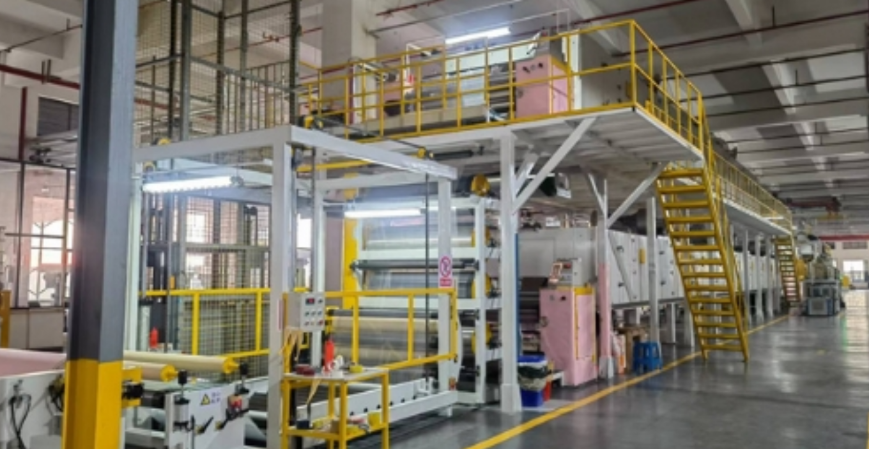
Common production processes include reverse roll coating, calendering, or transfer coating, followed by embossing. By adjusting the formulation, the same chemical system can meet the requirements for either low-VOC/low-fogging dashboard grades or high-flexibility seating grades.
Surface Grain, Gloss and Perforation Choices
Surface grain, gloss and perforation design of automotive PVC leather refers to the embossed or etched texture depth, the measured gloss level and the hole geometry that together control visual quality, tactile feel, abrasion visibility, slip resistance, cleanability and ventilation performance.
Texture depth data published by texture-technology suppliers place common “coarse leather” grains in the 80–150 µm range and fine grains below 80 µm. Gloss is routinely measured at 60°. Perforation parameters that have been publicly disclosed for a seat-grade PVC construction are 1.0 mm hole diameter on a 5 mm × 5 mm pitch. Mold-Tech texture data sheet CN110373912A
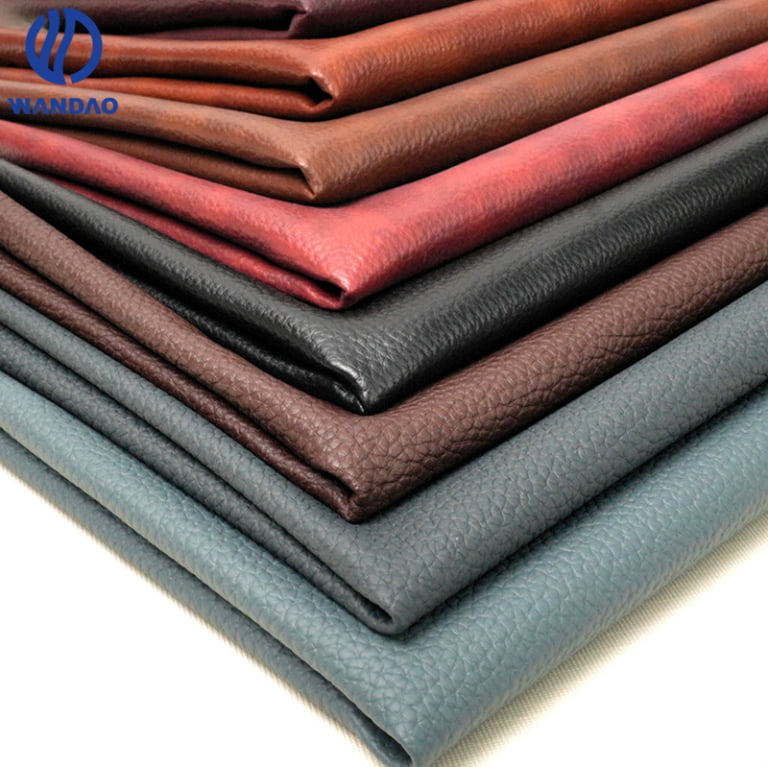
Deeper, higher-contrast grains improve the “natural leather” appearance and hide minor scratches, but they also trap dirt and make cleaning slower. Fine, low-gloss nappa-style grains give a cleaner, more premium visual and a smoother hand, yet they show pressure marks more readily. Perforation improves air flow only when the holes remain open after lamination and seat assembly; residual strength after punching must still meet the seat-cover tensile and tear requirements. Surface roughness and compressibility themselves influence perceived quality, as confirmed by SAE interior-material perception studies. SAE 2009-01-0017 SAE 2010-01-0682
The manufacturing route—release-paper embossing, roller embossing or mould etching—determines how consistently the grain can be reproduced across large panels and how much draft angle is required. Conservative texture guidelines recommend approximately 12.5–15 µm of depth per degree of draft for complex tooling. Mold-Tech texture data sheet
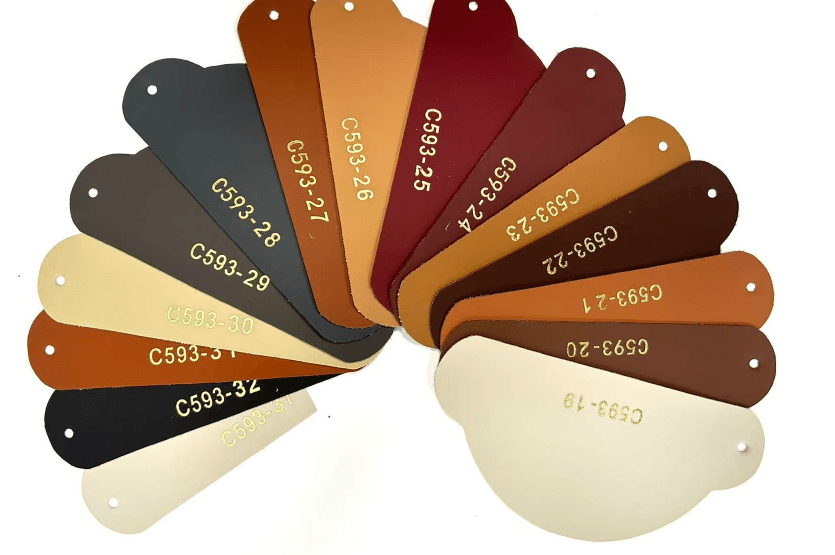
When it comes to the grain, what you like matters most. However, please note that if you require custom PVC leather with specific textures and colors, the minimum order quantity is 1,000 meters; this is due to the large size of our PVC production machinery, and it is a detail that all customers planning to order PVC leather should be aware of.
Common Misconceptions and How to Test Them
Common misconceptions about automotive PVC leather refer to the set of over-simplified statements that treat the material family as uniformly inferior or superior rather than as a formulation- and application-dependent system.
Six statements appear repeatedly in sourcing discussions. Each can be tested rather than accepted on reputation.
- “PVC always lasts less than PU.” Lifetime is governed by plasticiser permanence, stabiliser package and use conditions, not by the polymer name. Formulations exist on both sides of the durability spectrum. CN103834128A
- “Thicker is always better.” Excess thickness can degrade formability, increase weight and still leave the critical skin layer under-designed. CN110373912A
- “Higher Martindale cycles equal longer real-world life.” Abrasion is only one failure mode; cracking, delamination, fogging and colour migration frequently appear first. VOC and interior-air test context
- “Automotive leather is completely non-toxic.” The correct requirement is compliance with substance limits and vehicle cabin air standards, not absolute absence of risk. Plasticiser migration remains a real variable that must be measured. Chinese national standards framework
- “Perforation automatically means breathable.” Air flow depends on open cross-section after lamination and compression in the finished seat. CN110373912A
- “Low-price PVC can never be used in cars.” Price is a risk signal, not an absolute disqualification. Many door-panel and low-contact applications successfully use cost-optimised PVC once the full test matrix is passed.
During a recent laboratory observation I conducted on a set of production-intent PVC seat samples, I ran parallel flex tests at –20 °C on two otherwise identical constructions—one with a conventional plasticiser package and one with a higher-molecular-weight system. After 20 000 cycles the conventional material already showed permanent white crease lines, while the modified system remained intact. The difference was measurable in the laboratory long before any vehicle durability test would have revealed it. That single observation is why I now treat plasticiser permanence data as a mandatory release gate rather than an optional nice-to-have.
The opportunity is that every one of these myths can be converted into a short, quantitative checklist that purchasing and quality teams can apply uniformly across suppliers.
Advantages, Limitations and Application Boundaries
Advantages and limitations of automotive PVC leather refer to the comparative performance envelope—cost, process efficiency, design freedom, cleanability, low-temperature behaviour, VOC/fogging risk and tactile quality—relative to PU leather, microfiber, genuine leather and textile when all materials are evaluated under the same vehicle and climate constraints.
PVC’s documented strengths are low material cost, mature coating and embossing processes, high freedom of colour and grain, inherently good stain resistance and relatively straightforward flame-retardant formulation. Its documented weaknesses are greater low-temperature stiffening, lower inherent breathability, higher risk of plasticiser-related VOC and fogging, and a more “plastic” hand unless the top-coat and foam layer are carefully engineered. BASF LCA comparison context
Comparative positioning drawn from open technical literature:
- Cost-sensitive A/B-segment vehicles, fleet and ride-hailing fleets: PVC remains competitive on total cost of ownership when cleanability and abrasion are the dominant requirements.
- Cold-climate primary seating surfaces: PU or microfiber usually provide a safer low-temperature margin.
- High-visibility, high-touch surfaces in mid- and premium vehicles: microfiber or genuine leather more often meet the tactile and brand targets.
- Instrument panels and door uppers in high-solar-load regions: low-VOC PU or carefully validated PVC with proven fogging data.
The boundary is therefore application- and climate-specific rather than absolute. PVC is widely used because, for a large fraction of interior real estate and a large fraction of the global vehicle parc, its advantages still outweigh its limitations once the formulation and validation work have been done.
FAQ
Q: Is there an official international standard that states automotive PVC leather must last a minimum number of years or kilometres?
A: No. ISO, SAE, VDA and ASTM documents define test methods and typical acceptance criteria; they do not publish a universal service-life number. OEMs translate those methods into their own vehicle-life targets inside proprietary material specifications.
Q: What total thickness range is most commonly used for passenger-car seat covers?
A: Open patent and technical data place the majority of seat-cover constructions between 0.8 mm and 1.2 mm total thickness, with a compact PVC skin near 0.2 mm and a foam layer in the 0.3–0.7 mm band, backed by 200–400 g/m² knitted or non-woven fabric.
Q: Does a deeper grain automatically improve abrasion resistance?
A: No. Abrasion life is controlled primarily by the top-coat chemistry, skin density and backing strength. Deeper grain mainly affects the visual hiding of wear and the ease of cleaning; it can even concentrate stress at the texture peaks if the coating is weak.
Q: Can perforated PVC leather be considered breathable by default?
A: Only if the holes remain open after lamination to foam and after the compressive loads of the finished seat. A publicly disclosed seat-grade example uses 1.0 mm diameter holes on a 5 mm × 5 mm pitch; residual tensile and tear strength after punching must still be verified.
Q: Why do some low-cost PVC constructions still pass automotive programmes?
A: Because the critical requirements for many door-panel, rear-seat and low-contact zones are cleanability, basic abrasion and fogging rather than the full suite of low-temperature flex and premium hand demanded by primary seating surfaces. Price alone is not a disqualification; the full test matrix is.
Q: Which single laboratory test should be treated as a red-flag gate for PVC leather?
A: Low-temperature flex (ISO 5402-type method at the lowest expected service temperature) combined with post-ageing fogging (SAE J1756) and plasticiser-migration assessment. Failures in these three areas most often predict early field complaints.