Define the Vehicle Component, Market, and Approval Route
Defining the application means recording where the PVC leather will be used, how it will be processed, where it will be sold, and who controls acceptance. A seat bolster, door insert, console cover, bus seat, and aftermarket replacement cover can require different surface, backing, safety, emissions, and durability decisions.
Start with the vehicle category and component location. Record whether the material will be cut and sewn, wrapped, laminated, bonded, heat formed, perforated, or combined with another process. A flat swatch can look acceptable yet behave differently when stretched over a three-dimensional part, folded at a seam, or placed beside an adhesive joint.
The destination market changes the approval route. For U.S. interior applications within its defined scope, 49 CFR §571.302 states that applicable material must not burn or transmit a flame front across its surface at more than 102 mm/min under prescribed conditions. This is a burn-resistance requirement, not a general durability, emissions, or OEM-approval claim. The NHTSA test procedure is useful when the project needs traceable specimen preparation and reporting.
| Definition item | Record in the brief | Why it matters |
|---|---|---|
| Vehicle and part | Vehicle class; seat, door, trim, or cover | Contact, geometry, cleaning, exposure, and approval authority can differ. |
| Production route | Sewing, wrapping, lamination, bonding, forming, or perforation | Backing, stretch, seam behavior, and dimensional stability become process requirements. |
| Market and route | Country or region; OEM, replacement, or conversion project | Legal documents, customer rules, labeling, and evidence requirements may change. |
| Use intensity | Private, fleet, bus, high-turnover, or occasional replacement | Cleaning and wear risks should be reflected in validation. |
OEM procurement commonly follows a vehicle-maker or Tier 1 specification and approval path. Aftermarket procurement may place more emphasis on fitment, installation, declared market compliance, and replacement consistency. Both still require a controlled product definition rather than a generic automotive label.
Actionable recommendation
Before asking for samples, send the supplier the vehicle type, component, destination market, fabrication process, installation method, use intensity, and approval authority. Do not treat one surface swatch as automatically suitable for every part.
Specify the Complete PVC Leather Construction, Not Only the Surface
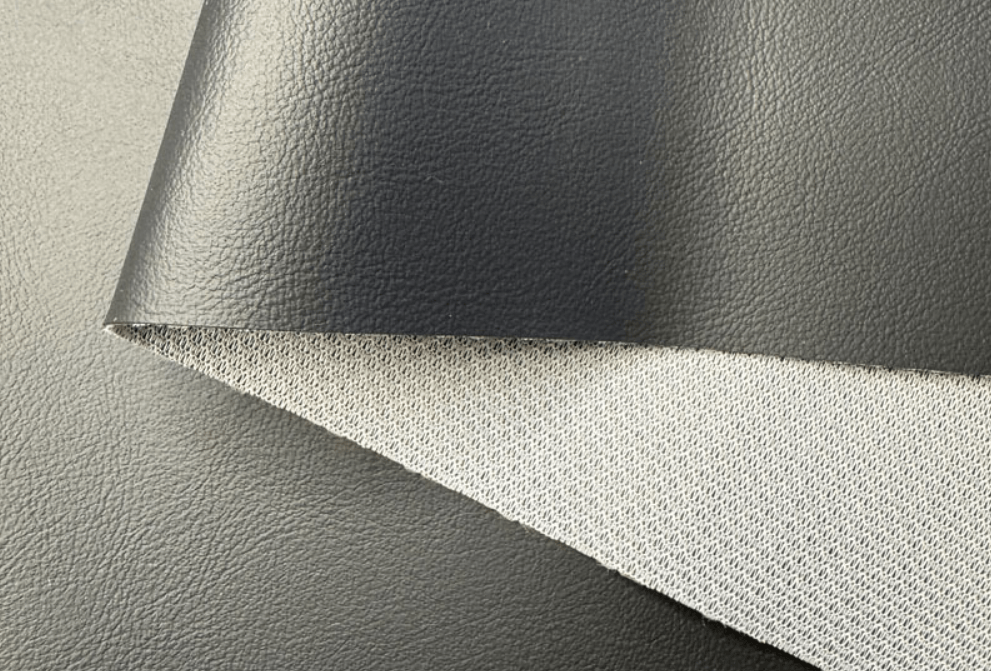
Specifying complete construction means defining every controlled layer and appearance feature delivered to the converter or part manufacturer. The brief should cover the PVC surface and topcoat, dense or foamed layers where applicable, bonding layer, textile or other backing, total and layer thicknesses, width, color, grain, gloss, hand feel, and intended process.
Surface appearance is only the first screen. A grain can look correct while the backing is too stiff for sewing, the foam collapses during wrapping, the adhesive is incompatible, or the layer interface fails after aging. Separate a visual development swatch, a laboratory specimen, a pilot roll, and a production-intent laminate because each answers a different approval question.
Published research shows why numerical data must remain limited to the construction and method reported. One automotive PVC/CF-PVC foam-leather study reported surface densities of 765 g/m² for its PVC sample and 773 g/m² for its carbon-fiber-modified sample. It reported tensile strengths of 32.6 MPa and 48.9 MPa, elongations of 214% and 185%, and tear strengths of 11.4 kN/m and 14.7 kN/m for the compared constructions. Those results belong to the formulations, specimens, and methods in the paper—not to every automotive PVC leather. See the published PVC/CF-PVC research paper.
Thickness must also be stated by meaningful layers. A study-specific foam thickness of 3.63 mm is evidence about that experimental system only; it is not a universal purchasing target. State what the material must do in the intended part, then use a production-intent sample to verify that construction.
| Construction element | What to specify | What to verify |
|---|---|---|
| Surface system | Color, grain, gloss, topcoat, texture | Master sample, viewing condition, and defect criteria. |
| Layer structure | Dense PVC, foam, print, adhesive, backing, perforation | Construction sheet tied to the sample and test specimen. |
| Dimensions | Thickness, width, mass per area, tolerances | Measurement basis, sampling plan, and roll identification. |
| Process compatibility | Sewing, wrapping, bonding, forming, or cutting needs | Actual-process trial at seams, corners, holes, and adhesive contact. |
A color, embossing, backing, thickness, topcoat, foam, adhesive, or manufacturing-site change should be treated as a new approval question. Similar appearance does not prove equivalent composition, process performance, emissions, or mechanical behavior.
Actionable recommendation
Require a controlled construction sheet and production-intent sample identifying the layer stack, backing, usable width, surface reference, color standard, intended process, measurement basis, and revision number before approving a quotation.
Translate Testing, Safety, Emissions, and Chemical Rules Into a Matrix
Building a test matrix means assigning a method, specimen construction, conditioning, acceptance criterion, laboratory, report, and requalification trigger to each material risk. It is not the same as collecting certificates that use the word “automotive.” A result is useful only when it can be connected to the material, lot, formulation, and finished-part route under approval.
For U.S. projects within the scope of FMVSS No. 302, the cited limit is 102 mm/min under prescribed conditions. It does not establish abrasion resistance, flex durability, weathering, VOC, odor, fogging, chemical compliance, or OEM approval. ISO 3795 supplies a horizontal-burning method for road-vehicle materials and combinations within its scope; it does not supply one universal pass/fail limit for every program.
Separate surface risks instead of placing them under a generic durability heading. SAE J365 is a relevant surface-scuffing method reference. ISO 105-X12 addresses dry and wet rubbing procedures for color transfer, while ISO 105-B06 addresses artificial-light and heat aging of colored substrates. The buyer must still define the load, media, conditioning, visual endpoint, and required limit.
For coated fabrics, ISO 1419 is relevant to accelerated heat-aging evaluation, and ISO 2411 provides a coating-adhesion-strength method. Do not compare abrasion or flex cycle counts unless the abrasive, load, specimen, conditioning, endpoint, and construction are equivalent. A result before aging may not reveal hardening, whitening, cracking, delamination, or topcoat failure.
Cabin emissions and fogging need separate matrix entries. ISO 12219-4 describes a small-chamber approach for evaluating emissions from vehicle-interior materials or components. It can support comparison and quantification, but the acceptance limit must come from the applicable OEM, customer, or regulatory program. Do not use a generic “low-emission” statement as proof of VOC, odor, or fogging performance.
Chemical compliance is another gate. In the legal context cited in the research, EU vehicle-material rules give maximum concentrations of 0.1% by weight for lead, mercury, and hexavalent chromium and 0.01% by weight for cadmium in homogeneous materials, subject to applicable exemptions. Review the current text in the EUR-Lex vehicle-material document. The research also cites a REACH Candidate List communication threshold of more than 0.1% w/w for articles in the stated context; use current duties and list information through ECHA’s SVHC information.
| Risk area | Buyer defines | Evidence needed |
|---|---|---|
| Flammability | Applicable law, component scope, specimen stack-up, method, and limit | Traceable report with construction, conditioning, result, date, and lot. |
| Wear and flex | Load, abrasive, cycles, flex mode, aging condition, and endpoint | Before-and-after data for the proposed laminate. |
| Emissions and fogging | Analytes, odor or fogging method, preparation, and limit | Report tied to the color, formulation, backing, adhesive, and assembly where required. |
| Chemicals | Restricted-substance list and Candidate List date | Declaration, analytical evidence where needed, exemptions, and change control. |
A report is evidence for its reported specimen and conditions, not a field-life guarantee. Likewise, ISO/IEC 17025 competence supports confidence in testing but does not itself make a material compliant with an OEM requirement.
Actionable recommendation
For every required test or declaration, record the exact construction, color or formulation, backing, specimen condition, method, laboratory, lot, result, governing limit, report date, and requalification trigger in one approval matrix.
Validate the Sample in the Finished-Part and Supply Process
Validating the sample means checking the proposed PVC leather through the actual cutting, sewing, wrapping, lamination, bonding, perforation, or assembly route before serial release. It connects laboratory evidence with the part geometry, process stress, appearance standard, and installation conditions that the buyer will actually use.
Color and grain are useful for initial screening, but they cannot prove that a full-width roll will run consistently through production. They also cannot show behavior at a seam, corner, perforation, adhesive joint, or foam transition. Use the intended backing, thickness, grain, topcoat, adhesive, and process settings in the pilot where possible. Record a substitute rather than treating it as equivalent.
I once reviewed a PVC artificial-leather sample intended for an automotive seat. Its surface grain and color met the visual requirement, but repeated bending produced slight whitening along the fold. After discussing the result with the factory, I learned that the issue was related to the PVC surface formulation and the bonding process between the surface and the backing fabric. That experience showed me that automotive PVC leather should not be approved on color, grain, and price alone; flex resistance, abrasion resistance, and surface-to-backing adhesion should be tested before acceptance.
For OEM programs, the route normally moves from development sample to process trial, pilot or validation build, and controlled bulk approval. The file should identify the approved sample revision, results, production site or source route, inspection method, retained reference, and changes that trigger requalification. For aftermarket products, include fitment, installation, edge wrapping, sewing, customer cleaning, replacement conditions, and claims printed on product or packaging.
Third-party testing may help where customer requirements or risk justify it. ISO/IEC 17025 is the international reference for testing and calibration laboratory competence. Yet the report must still identify the exact specimen, method, and acceptance rule. A report for another color, backing, thickness, or manufacturing route may inform development but should not automatically approve the quoted material.
| Validation stage | Inspect | Release question |
|---|---|---|
| Visual sample | Color, grain, gloss, hand feel, visible defects | Does it match the approved master under the defined viewing condition? |
| Process trial | Cutting, sewing, stretch, wrapping, bonding, seams, and corners | Does it run through the intended process without unacceptable damage or distortion? |
| Component validation | Finished appearance, touch points, flex zones, cleaning, and fitment | Does the finished component meet its own acceptance criteria? |
| Bulk control | Lot variation, width, thickness, color, defects, and retained sample | Can the approved construction be identified and reproduced in serial supply? |
Actionable recommendation
Do not move from swatch approval directly to bulk release. Require a documented process trial and retained production-intent reference covering the approved construction, revision, finished-part result, test evidence, and permitted changes.
Freeze the Specification and Release the Material
Freezing the specification means creating one controlled release document linking the application, construction, appearance reference, test matrix, compliance evidence, inspection plan, traceability record, and change-control rules. It prevents development approval of one material followed by delivery of a materially different construction in bulk.
The release file should identify the part and market scope, layer stack-up, surface reference, color and grain standard, thickness and width tolerances, backing and adhesive information, process notes, approved sample, test reports, chemical declarations, inspection criteria, lot identification, retained sample requirements, and requalification triggers. If a supply route involves specialized production partners, require clear source identification and change notification. The useful control is repeatability and traceability of the approved construction, not a marketing description of the supply chain.
Quotations are comparable only when their assumptions are comparable. A lower price may reflect a thinner backing, different topcoat, narrower usable width, looser color tolerance, stock construction, lower testing scope, different packaging, or another delivery condition. Ask each supplier to identify what is fixed and what is proposed. Treat a formulation, backing, adhesive, embossing-roll, colorant, manufacturing-site, or recycled-input change as a potential revalidation event until the responsible quality team decides otherwise.
OEM supply may require a customer-specific development and production-approval package. Aftermarket supply may emphasize fitment, declared market compliance, replacement consistency, installation instructions, and claim substantiation. Both routes need an acceptance sample and a procedure for containing nonconforming rolls or finished covers. A generic automotive-PVC-leather label is not sufficient control.
| Release gate | Required record | Reason for control |
|---|---|---|
| Specification freeze | Application, construction, surface standard, tolerances, process, revision | Prevents ambiguous quotations and uncontrolled substitutions. |
| Evidence review | Reports, declarations, methods, limits, specimen and lot identity | Shows whether the evidence supports the material being purchased. |
| Process approval | Pilot result, finished-part images, defects, fitment, corrective actions | Connects material behavior to the real part and production route. |
| Serial control | Incoming inspection, retained master, lot traceability, change notice | Protects consistency after development approval. |
When sustainability information is included, define it with the same precision. Distinguish a legal restricted-substance declaration from a voluntary environmental claim. For recycled content or carbon data, identify the material scope, functional unit, data boundary, method, and required evidence. Do not turn a whole-vehicle policy or a general environmental statement into a PVC-leather-specific fact without direct, bounded support.
Actionable recommendation
Release the material only after the signed specification, representative evidence, finished-part validation, first-lot inspection, retained sample, and written change-control process are complete.
Frequently Asked Questions
Include the vehicle and component, destination market, production route, surface and color reference, grain and gloss, layer construction, backing, thickness, width, tolerances, required tests, acceptance criteria, sample route, inspection plan, lot traceability, and change-control rules. The specification should identify the finished application rather than only naming PVC leather.
No. A swatch can screen color, grain, gloss, and initial hand feel, but it cannot prove process compatibility, full-roll consistency, finished-part appearance, aging behavior, flex resistance, abrasion resistance, or layer adhesion. Use a production-intent sample and a process or component trial before bulk approval.
When the applicable scope and prescribed procedure are met, it provides evidence about the specified burning behavior of the tested material or construction. It does not by itself prove abrasion resistance, flex durability, weathering, emissions, odor, fogging, chemical compliance, or OEM approval. The report must identify the specimen and conditions.
No. They may share material risks, but OEM projects usually follow a vehicle-program or customer approval route, while aftermarket projects may place more emphasis on fitment, installation, replacement consistency, market documentation, and declared claims. Define the actual part, market, process, and responsible approval authority for either route.
Yes. VOC, SVOC, aldehydes, odor, and fogging are related but distinct evaluation topics and may use different methods and limits. Confirm the customer’s sample preparation, method, analytical targets, conditioning, and acceptance criteria. Do not treat a general low-emission statement as proof of fogging or odor performance.
It should identify the material construction, color or formulation, backing, thickness, specimen preparation, conditioning, test method, laboratory, result, acceptance criterion, report date, lot or production reference, and any limitations. If the report does not represent the quoted production-intent material, request a project-specific evaluation or document the difference.