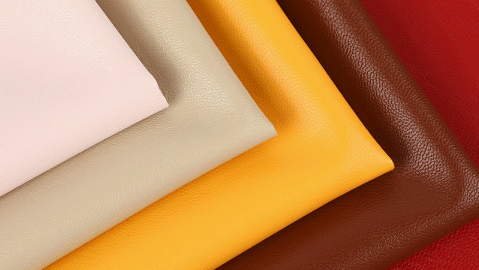

What Does a PVC Leather Furniture Specification Actually Include?
A PVC leather furniture specification refers to the written description of the complete coated upholstery construction and the evidence required to verify it for a defined furniture application.
“PVC leather,” “vinyl,” and “PVC-coated fabric” describe a PVC surface applied to a textile substrate. The substrate may be woven, knitted, or nonwoven, and the backing affects stretch, drape, sewing, and load behavior.

The first control is the measurement basis. Total thickness should be distinguished from the thickness of the PVC face layer. Coated fabrics can be compressible, so a thickness number is not fully comparable unless the test method and applied pressure are known. [ISO 2286-3] defines a method for determining the thickness of rubber- or plastics-coated fabrics under specified pressure.
Mass must use a clear basis: ounces per linear yard, ounces per square yard, or grams per square metre. These figures are not interchangeable. At 54 inches wide, one linear yard contains 1.5 square yards, so buyers should compare products on the same area basis. [ISO 2286-2] addresses total, coating, and substrate mass per unit area.
Width should be specified as usable cutting width, not only as a nominal catalogue width. The purchase order should also state roll length, measurement method, roll direction, and the permitted lot tolerance. [ASTM D751] provides a coated-fabric test framework for properties such as breaking strength, tear, and coating adhesion; it does not create one universal furniture-vinyl construction.
For indoor contract upholstery, start with the applicable coated-fabric performance specification and its individual property tests. For outdoor furniture, be careful: [ASTM D3690] excludes porch, deck, and lawn furniture. An indoor result cannot automatically qualify covered outdoor seating for UV, humidity, condensation, or repeated wetting.
Action recommendation: Build the RFQ around a construction schedule: total thickness, usable width, roll length, mass basis, backing, topcoat, grain, colour, lot, tolerance, test method, and cleaning limitations.
How Should Buyers Specify Thickness, Width, Backing, and Texture?
Thickness, width, backing, and texture refer to four connected specification controls that determine how a PVC upholstery material looks, handles, processes, and performs in a particular furniture construction.
Thickness. Thickness is a design input, not a stand-alone durability rating. A thicker face can change hand feel, pattern definition, foam read-through, folding behavior, and cutting yield. It does not by itself prove coating adhesion, tear resistance, seam strength, flex resistance, chemical resistance, or fire performance. The specification should therefore state nominal total thickness in millimetres, the measurement method, the pressure or gauge condition, and the permitted lot tolerance. If the project needs a particular feel, the production team should assess thickness together with the backing and the actual foam shape.
Width. Width affects nesting efficiency and material yield. State finished usable width rather than relying on a catalogue width. Also state whether the quoted width is measured edge to edge or between usable boundaries. Roll length should be stated separately because a roll put-up is a logistics attribute, not proof of quality. A buyer should record the roll direction and inspect whether the grain, print, or colour has a visible directional effect before planning cutting layouts.
Backing. Backing is the textile structure behind the PVC coating. A polyester knit, woven backing, nonwoven backing, napped jersey, or blended construction can produce different stretch, drape, needle behaviour, tear propagation, and edge anchoring. The substrate category is important enough that the [ACT physical-properties guideline] uses different tear and seam-strength paths for woven, knit, and nonwoven constructions. The buyer should request fibre composition and, where relevant, backing mass or construction details.
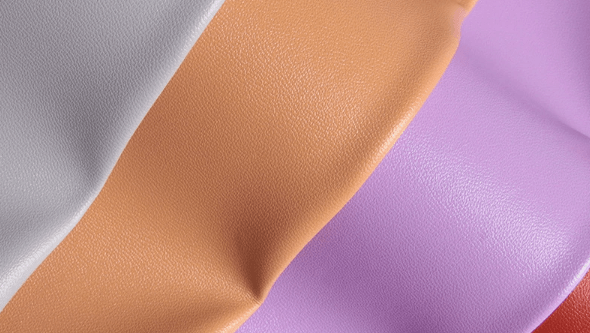
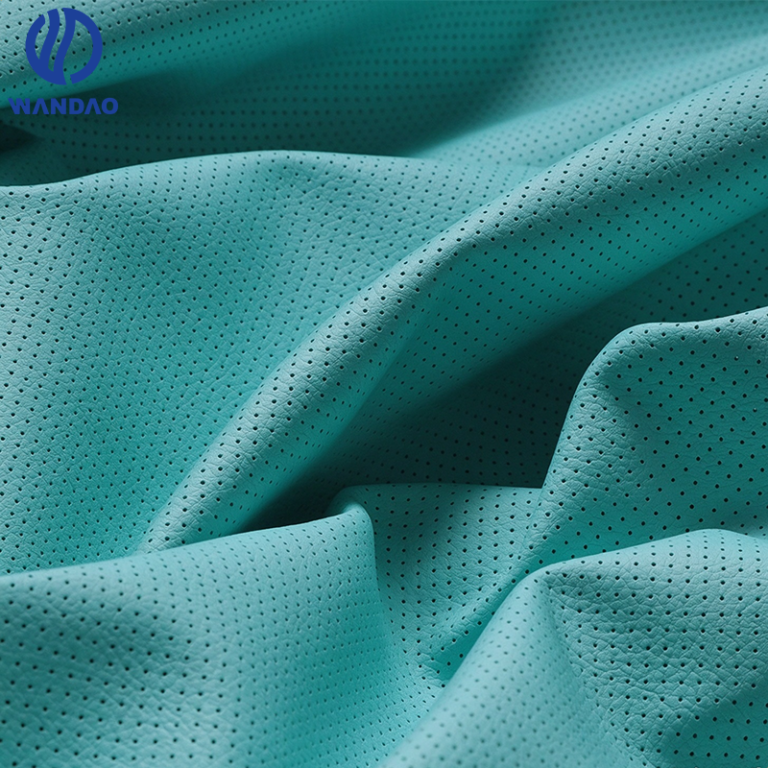
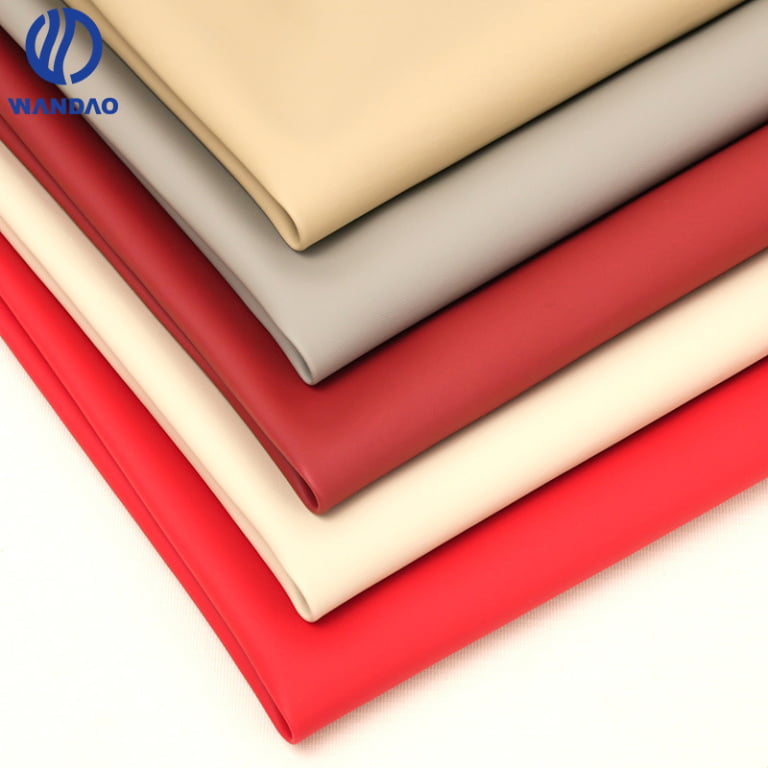
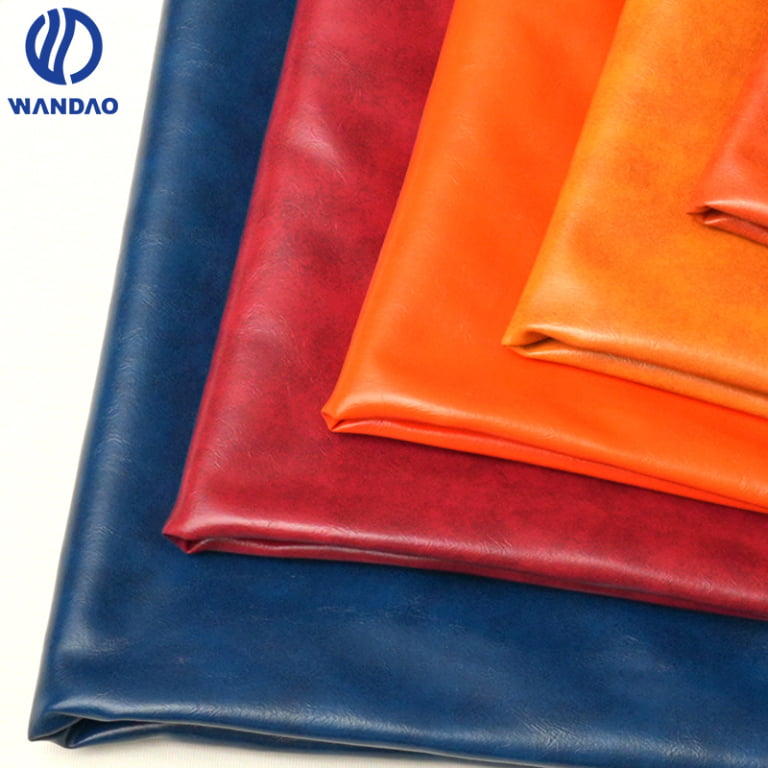
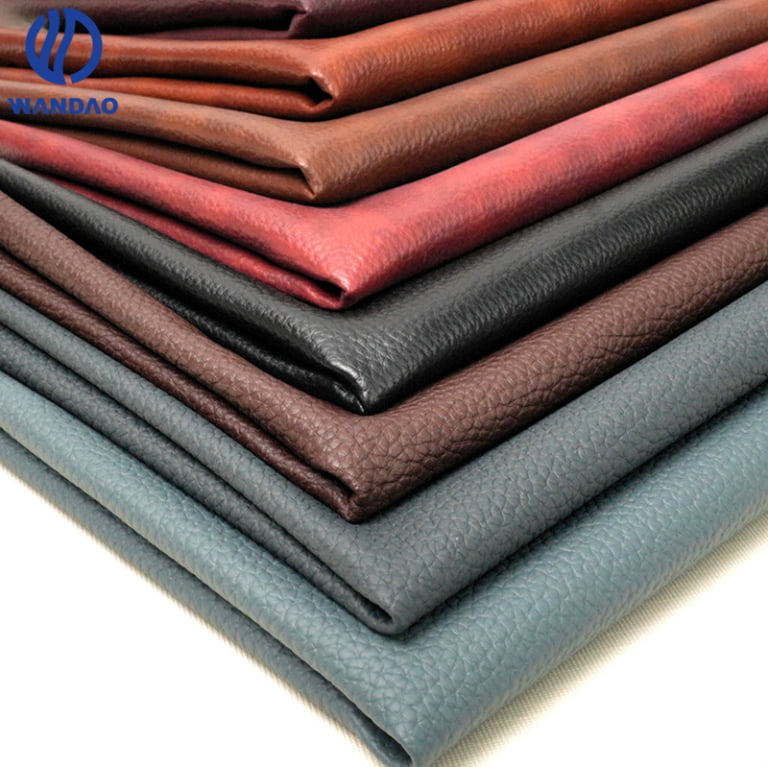
Texture. Texture refers to the visual and tactile surface created by embossing, printing, coating, or a combination of processes. Grain is normally product-specific rather than a universal construction class. A deep emboss may give a stronger leather-like visual effect, but its depressions can increase the cleaning work in a high-soil environment. A smooth or shallow grain may be easier to wipe, but it can make scuffs, fingerprints, or surface variation more visible. The correct choice depends on the furniture design, colour, lighting, soil type, and maintenance method.
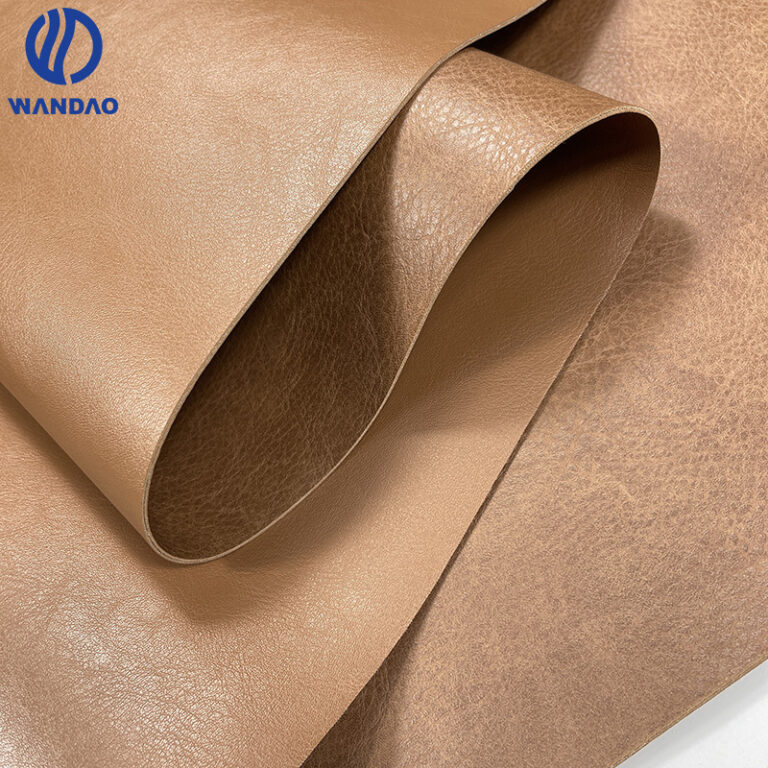
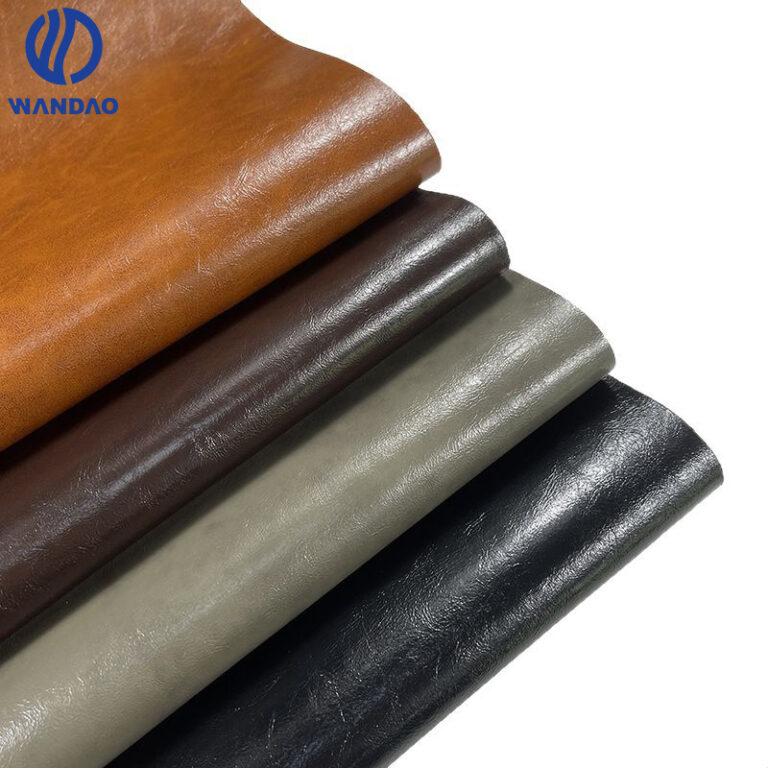
When I reviewed the supplied commercial product comparison, I observed that the same type of upholstery material was reported through different units and different levels of construction detail. Some entries identified the backing clearly, while others left topcoat or tolerance information unpublished. That observation is why I would turn a sample over before judging the face: the reverse side often reveals whether a catalogue comparison is actually comparing like with like. This is a material-review observation, not a measured service-life result.
| Specification field | What to record | Why it matters |
|---|---|---|
| Total thickness | Nominal value, measurement method, pressure, and tolerance | Prevents a face-film gauge from being mistaken for total construction thickness. |
| Usable width | Finished cutting width, edge exclusions, measurement method, and roll direction | Supports realistic yield and nesting calculations. |
| Mass | g/m² plus the stated linear-yard or square-yard basis | Allows fair comparison between coating load and backing mass. |
| Backing | Fibre, knit/woven/nonwoven structure, backing mass where relevant | Influences sewing, stretch, tear, drape, and seam behavior. |
| Texture and finish | Emboss or print reference, gloss target, colour standard, topcoat, and revision | Controls appearance, cleanability, and substitution risk. |
Action recommendation: Approve a physical control sample and production mock-up showing both face and backing. Record the exact construction and reject unapproved changes to backing, topcoat, emboss, or measurement basis.
How Should PVC Leather Be Matched to Different Furniture Applications?
Application matching refers to selecting the complete PVC upholstery system according to the dominant loads, cleaning chemicals, geometry, climate, and regulatory requirements of the finished furniture.
Office seating, hotel seating, healthcare seating, restaurant booths, and public waiting areas all use upholstery, but they do not create the same failure pattern. A task chair may experience repeated body contact and edge flexing. A restaurant booth may receive food oils and frequent wiping. Healthcare seating may be exposed to a named disinfectant programme. Covered outdoor furniture may face UV, heat, humidity, and condensation even when rain is limited. The specification should begin with that use profile instead of copying one thickness or abrasion number into every project.
| Application | Construction priorities | Verification focus | Texture and cleaning direction |
|---|---|---|---|
| Office and conference seating | Stable backing, predictable stretch, coating adhesion, seam and edge behavior | ASTM D751 physical properties, ASTM D4157 abrasion, applicable indoor upholstery requirements | Fine or shallow grain; obtain written compatibility for office cleaners and sanitizer residue. |
| Restaurant booths and banquettes | Backing and seam strength, resistance to localized edge wear, cleaner compatibility | ASTM D751 adhesion, tear, breaking strength, tack-tear; ASTM D4157 with abrasive identified | Smooth or low-relief grain is easier to wipe; test the actual degreaser and disinfectant. |
| Hotel lobby and shared hospitality seating | Appearance retention, luggage scuff resistance, stain response, repeated maintenance | Indoor coated-upholstery specification plus colour, stain, flex, and cleaner trials | Use a realistic mock-up; do not treat darker colour as a substitute for performance evidence. |
| Healthcare and clinical seating | Continuous coating, strong adhesion, sewn-system integrity, disinfectant compatibility | ASTM D751 and D4157 plus the facility’s exact chemical, concentration, dwell, and rinse protocol | Prefer a surface that can be cleaned consistently; do not use an antimicrobial claim as a substitute for disinfection. |
| Covered outdoor furniture | Outdoor-rated backing, UV/weathering evidence, moisture management, mildew and low-temperature checks | ASTM D751 weathering-related methods where applicable plus product-specific UV and mildew reports | Indoor ASTM D3690 evidence is not outdoor qualification; define water, UV, heat, and cleaning exposure. |
| High-traffic public seating | Tear propagation, seam strength, flex, adhesion, repair and cleaning strategy | ASTM D3690 and D751; ACT high-traffic abrasion guidance with the approved abradant | Low-relief, non-glossy surfaces can reduce soil retention; validate the facility’s cleaning matrix. |
For public-space coated fabrics, the [ACT high-traffic guideline] identifies 50,000 Wyzenbeek double rubs using ASTM D4157 with an approved #10 cotton duck or wire screen as a screening reference. That number is not a universal warranty and does not replace tear, seam, flex, adhesion, cleaning, or fire evidence.
Fire requirements must also be assigned to the correct level. For upholstered furniture within the applicable United States scope, [CPSC guidance] explains that 16 CFR Part 1640 uses the TB 117-2013 test method for relevant upholstered-furniture components. A material data sheet marked “TB 117” does not automatically prove that every finished chair, sofa, or booth configuration complies. [NFPA 260] is likewise a defined cigarette-ignition component/classification framework, not a blanket statement that a polymer is fire compliant.
Action recommendation: Write a separate performance schedule for each application family. Name the use intensity, furniture geometry, cleaning chemicals, environmental exposure, abrasion method and abradant, fire requirement, and assembly level before a supplier submits samples.
Which Procurement Mistakes Create the Most Risk?
Procurement mistakes refer to decisions that treat one material attribute or one laboratory number as a substitute for the complete construction and the actual failure modes of commercial furniture.
The most common mistake is assuming that more abrasion cycles or greater thickness automatically means a longer service life. The [ACT abrasion guidance] states that results above 100,000 double rubs have not been shown to be a reliable indicator of increased fabric lifespan. It also reports no correlation between Wyzenbeek and Martindale results and notes that results from multiple abrasion tests on some structures can vary by 60% or more. Those findings make test method, abradant, pressure, tension, endpoint, and specimen direction essential parts of the comparison.
| Common mistake | What the evidence says | Better purchasing control |
|---|---|---|
| “Thicker is automatically better.” | Thickness does not replace adhesion, tear, tensile, seam, flex, or chemical testing. | Set thickness for hand and construction, then qualify the separate failure modes. |
| “A high double-rub number proves long life.” | ACT says results above 100,000 double rubs are not a reliable indicator of increased lifespan. | Use the relevant abrasion screen plus seam, tear, flex, adhesion, and cleaner tests. |
| “Wyzenbeek and Martindale can be converted.” | ACT reports no correlation between the two methods; test results can vary by 60% or more on some structures. | Compare only like-for-like method, abrasive, load, endpoint, direction, and conditioning. |
| “The backing is secondary.” | ACT sets substrate-specific tear and seam paths because woven, knit, and nonwoven constructions behave differently. | Declare the backing before selecting the test method and approve a sewn mock-up. |
| “A flat sheet test proves the seams.” | ASTM D751 tack-tear testing addresses resistance to tearing at needle punctures, a separate risk from unpunctured tensile strength. | Test the actual stitch, thread, welt, foam, pull, and seam configuration. |
| “Any vinyl-safe cleaner is acceptable.” | Repeated chemical exposure can change colour, gloss, tack, stiffness, or cracking behavior, depending on the finish. | Require SKU-specific chemical compatibility, concentration, dwell time, wipe cycles, rinse rules, and exclusions. |
| “Deep texture is only a design decision.” | Embossed depressions can require brushing to release soil; indiscriminate solvents can damage or discolour PVC. | Run a soil-and-cleaning trial on the selected grain and colour before approval. |
The ACT physical-property guidance gives useful examples of why a full test schedule matters: a minimum coating adhesion value of 3 lbf/in, breaking strength of 50 × 50 lbf, flex testing for 25,000 cycles without appreciable crazing, cracking, whitening, or delamination, and different tear and tack-tear paths for different substrates. These are guideline values and test conditions, not a guarantee for every project. They should be cited with the applicable revision and used only when the project requires that guideline.
For example, the same guidance lists tear minima of 4 × 4 lbf for woven or knit paths and 15 × 15 lbf for nonwoven or nonwoven-composite paths. It also identifies substrate-specific seam-strength minima of 25 × 25 lbf for woven, 30 × 25 lbf for knit, and 35 × 35 lbf for nonwoven or nonwoven-composite substrates. [ACT physical-properties guideline] These figures demonstrate the principle: a result is meaningful only when its method and substrate are identified.
Action recommendation: Put the test method, version, laboratory, conditioning, direction, abradant, load, endpoint, and exact SKU on the purchase specification. Reject unqualified claims such as “commercial grade,” “heavy duty,” or “over 100,000 rubs” when the underlying report is missing.
How Will Regulation and Sustainability Change PVC Leather Specifications Through 2030?
Future-oriented PVC leather specification refers to a procurement brief that controls formulation, emissions, chemical claims, traceability, circularity, and performance instead of treating sustainability as a marketing label.
The first change is stronger chemical disclosure. [U.S. EPA phthalate work] scheduled final TSCA risk evaluations for several phthalates, including DCHP, DIBP, DBP, BBP, and DEHP, by December 2025. EPA also identifies phthalates as high-production-volume chemicals used primarily as plasticizers in PVC products. This does not mean every PVC upholstery product is prohibited. It means a buyer should request a current restricted-substance declaration, identify intentionally added plasticizers where the project requires it, and distinguish manufacturing-worker exposure questions from finished-product compliance.
Recycled content brings a similar distinction between a material claim and a safe specification. A 2024 peer-reviewed study of PVC flooring found regulated chemicals above 0.1 wt% in 16% of the sampled products, with recycled PVC identified as a likely pathway. [Environmental Science & Technology study] The study is about flooring, not furniture upholstery, so its percentage should not be transferred to seating. Its procurement lesson is still relevant: recycled content needs chemical screening and a known formulation route. A declaration of recycled polyester backing does not prove recycled PVC in the face coating, and bio-attributed PVC does not mean biodegradable PVC.
Low-emission requirements are also moving toward assembled-product evidence. [UL GREENGUARD] states that GREENGUARD Gold limits emissions of more than 360 VOCs and total chemical emissions and incorporates the CDPH chamber method. Published GREENGUARD Gold criteria include 220 micrograms per cubic metre for TVOC and 7.3 parts per billion for formaldehyde. [UL GREENGUARD criteria] These are emissions benchmarks, not a guarantee of odour perception, durability, or a health outcome in every building. The purchase order should name the chamber method, product configuration, reporting date, and pass criterion rather than ask for “zero VOC.”
For office furniture, a separate [UL summary of ANSI/BIFMA emissions testing] identifies criteria of 50 parts per billion for formaldehyde and 500 micrograms per cubic metre for TVOC, with stricter optional criteria also discussed. The figures should not be mixed with GREENGUARD Gold limits because the programmes, criteria, and testing context are not identical.
Antimicrobial claims will require more precise wording. [U.S. EPA treated-article guidance] distinguishes a claim that protects the treated article from a public-health claim such as “kills germs.” The latter needs an appropriate registration or regulatory basis. An antimicrobial treatment does not replace cleaning, disinfection, seam design, or a compatibility test with the facility’s chemical programme.
In Europe, [EU Ecodesign for Sustainable Products Regulation] creates a framework for ecodesign requirements, Digital Product Passports, and green public procurement. It is a framework regulation; product-group delegated acts determine concrete requirements. Buyers should prepare material identification, substance declarations, recycled-content evidence, repair and disassembly information, and end-of-life data, but should not claim that a universal 2030 upholstery deadline already exists.
Recycling is technically possible for some PVC-coated textiles through separation, delamination, or related processing, but technical feasibility is not the same as a post-consumer take-back route for foam-attached, contaminated commercial seating. [EU LIFE coated-textile recycling project] and [peer-reviewed PVC recycling review] support the distinction between a possible process and an accessible recovery system. A circular specification should therefore name the collection geography, minimum quantity, accepted condition, freight responsibility, and actual disposition route.
Action recommendation: Add a 2030-ready data package to every major project: exact formulation category, plasticizer and restricted-substance declaration, recycled-content evidence by layer, chamber-emissions report where required, claim wording, traceability, disassembly instructions, and a defined take-back route. Keep these sustainability controls separate from abrasion, seam, fire, and cleanability qualification.
Frequently Asked Questions
A: No. Commercial PVC upholstery is specified product by product. Thickness should be stated as total construction thickness with the measurement method, pressure condition, and tolerance. It should be qualified together with backing, adhesion, tear, seam, flex, cleaning, and application requirements.
A: Use usable width for cutting and yield calculations, and record nominal width separately if it appears on the technical sheet. The purchase specification should define edge exclusions, measurement method, roll direction, roll length, and the accepted tolerance.
A: No. Thickness can influence hand feel and construction behavior, but it does not prove coating adhesion, tear resistance, seam strength, flex resistance, disinfectant resistance, or field life. Those properties require their own tests and a production mock-up.
A: There is no universal best backing. Woven, knit, and nonwoven substrates have different stretch, tear, sewing, and seam behavior. Select the backing according to the furniture geometry and load, then use the test path appropriate to that substrate category.
A: Not by themselves. ACT identifies 50,000 Wyzenbeek double rubs with an approved abradant as a high-traffic coated-fabric screening reference, while also stating that results above 100,000 double rubs are not a reliable indicator of increased fabric lifespan. Review adhesion, tear, seam, flex, cleaning, fire, and assembly requirements as well.
A: Not automatically. Indoor coated-upholstery standards can exclude porch, deck, and lawn furniture. Covered outdoor seating still needs evidence for UV, heat, humidity, condensation, wetting, mildew, low-temperature behavior, and the intended cleaning routine.