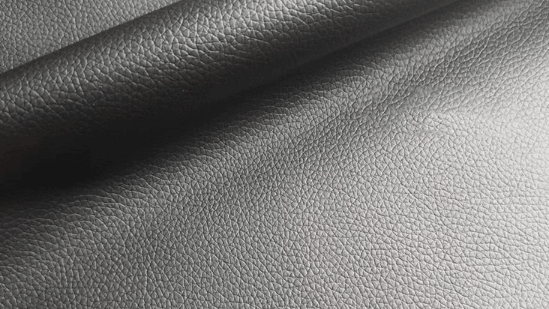
This guide separates verified standards information from commercial procurement practice and engineering judgment. It does not treat a supplier’s website, an abrasion number, or a colour photograph as proof of long-term furniture performance.
What Should You Prepare Before Contacting a PVC Leather Supplier?
Preparing a supplier brief refers to collecting the application, visual, construction, quantity, and compliance information needed for a supplier to recommend a relevant PVC upholstery material.
The quality of the first supplier recommendation depends heavily on the quality of the buyer’s brief. “Please quote PVC leather for furniture” is too broad. The supplier needs to know what furniture will be manufactured, how the material will be cut and installed, how often it will be cleaned, and whether a project or destination market has specific fire, chemical, or emissions requirements.
Send a product photograph when you have one
If you already have a product photograph, send it with the inquiry. A clear image of the sofa, chair, headboard, booth, or finished panel helps the supplier understand the geometry, cushion shape, seam locations, piping, quilting, and overall design direction. Add the target thickness, estimated quantity, colour, texture, backing preference, and intended use. A product image does not replace a physical sample, but it can reduce the number of unsuitable materials sent during the first round.
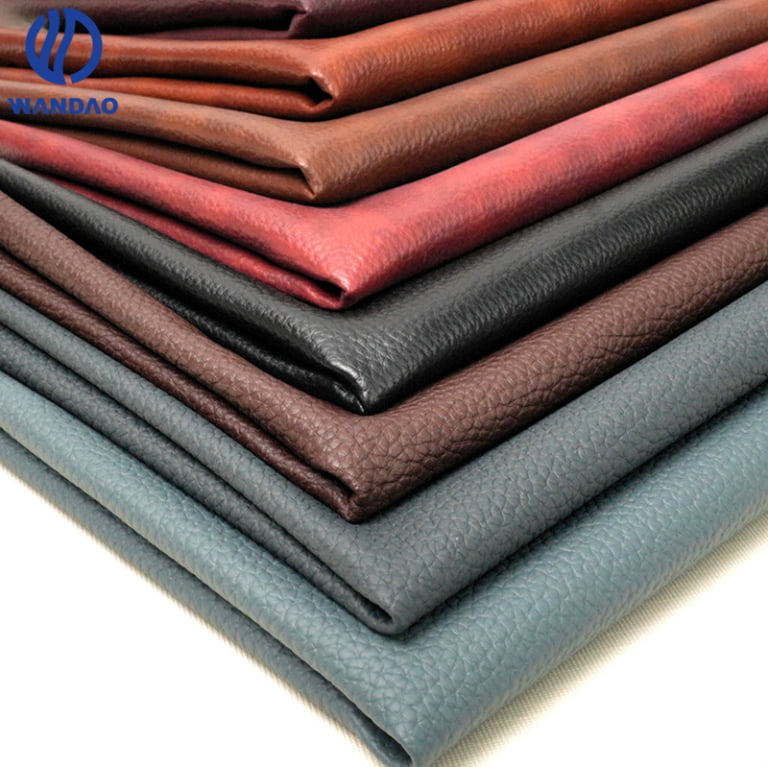
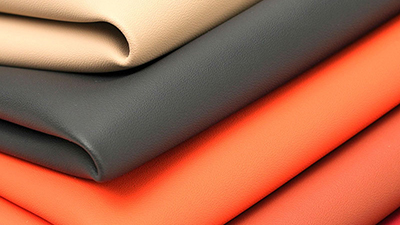
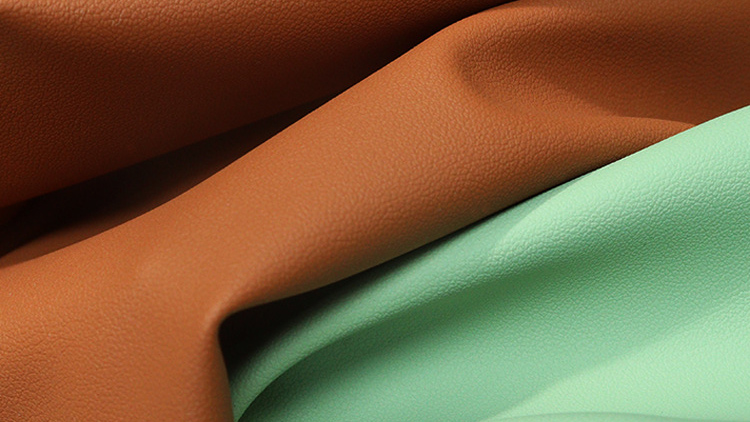
If you do not have a product photograph, search for a similar style online and send reference images. These images can communicate whether you want a fine leather grain, litchi or pebble grain, Nappa-style surface, fine wrinkle, fabric-look effect, matte finish, satin finish, or a brighter surface. The reference image is a design starting point, not a guarantee that the supplier can reproduce every visual feature exactly.
Describe the material requirement in a structured way
| Information to provide | Examples or questions | Why it helps |
|---|---|---|
| Furniture application | Sofa, dining chair, office chair, hotel seating, restaurant booth, healthcare seating | Different uses create different loading, cleaning, and appearance requirements. |
| Product geometry | Flat panel, rounded arm, deep cushion, tight radius, piping, channel, quilting | Helps determine whether conformability or dimensional stability is more important. |
| Visual target | Colour, grain, gloss, print, two-tone effect, reference image or physical swatch | Reduces misunderstanding about appearance and surface finish. |
| Construction | Target thickness, backing type, usable width, roll direction, sewing or stapling method | Allows the supplier to match the material to the manufacturing process. |
| Quantity and schedule | Trial quantity, expected annual demand, required delivery window | Helps compare stock, ready-stock, and custom development options. |
| Testing and market | Fire, abrasion, cleaning, chemical, emissions, or destination-market requirements | Prevents late testing surprises after the material has been approved. |
If you have an existing material sample and need the new PVC leather to look or feel similar, send the physical sample to the supplier. A supplier can compare the face, backing, thickness, grain, gloss, and hand feel more reliably from the physical reference than from a photograph. The sample may still require technical analysis and development; “similar” should not be treated as “identical” until the buyer approves a new control sample.
In my own supplier-screening workflow, I do not approve a material from the face photograph alone. I turn the sample over, record the backing and construction information, then compare the material on the actual furniture shape or a representative mock-up. This simple habit often reveals that two samples with similar colour and grain are not equivalent in handling or production behavior.

Action recommendation: Send one concise inquiry package containing the product image or reference image, application, target colour and texture, thickness, backing, quantity, furniture geometry, sample requirement, and testing needs. The more specific the brief, the more useful the first quotation and sample set will be.
How Can You Evaluate a PVC Leather Supplier’s Technical Capability?
Evaluating technical capability refers to checking whether the supplier can identify, document, sample, test, and reproduce the exact PVC upholstery construction required by the furniture project.
A supplier’s ability is broader than the number of colours shown in a catalogue. You should evaluate whether the supplier can explain the PVC face, solid or expanded construction, backing, topcoat, embossing or printing route, total thickness, mass, usable width, and tolerances. [ISO 7617-1] is a relevant international reference for PVC-coated knitted fabrics for interior upholstered furniture and requires important visual and construction characteristics to be agreed between the purchaser and supplier. For woven PVC upholstery, the applicable woven-fabric specification should also be confirmed.
Ask for a product-specific technical data sheet
The data sheet should identify the exact style or SKU, colour scope, backing construction, nominal thickness, mass, usable width, surface finish, grain or emboss reference, and any stated tolerances. It should also identify the test methods used for strength, tear, coating adhesion, flex, abrasion, low-temperature cracking, blocking, or cleaning resistance where those properties are relevant.
[ASTM D751] provides a family of coated-fabric test methods covering properties such as dimensions and mass, breaking and tear strength, coating adhesion, low-temperature crack resistance, seam strength, heat aging, and blocking. It is a menu of methods, not a single certificate that automatically qualifies every furniture application. Ask which method, specimen direction, conditioning, endpoint, and acceptance criterion apply to the offered material.
Review the supplier’s public business information
You can ask the supplier for their Alibaba platform account, independent website, product catalogue, technical library, and company information. These sources help you assess whether the supplier can communicate product categories, applications, technical terms, and development options consistently. Look for clear descriptions of PVC, PU, backing, thickness, texture, surface treatment, applications, sampling, and quality control.
However, an Alibaba storefront or independent website is evidence of communication and market presentation, not proof of manufacturing capability. Use it as one screening layer, then request product-specific documents, a physical sample, production information, and—when the project justifies it—a factory or process audit. A polished website cannot replace traceability or a test report.
Check whether the supplier understands application matching
A useful supplier should ask what the furniture will do, not only what colour you want. For a rounded sofa, the supplier may need to discuss stretch, recovery, foam conformity, and seam behavior. For a dining chair or office chair, dimensional stability, edge loading, tack tear, and cutting control may matter more. For healthcare or food-service seating, the actual cleaning and disinfectant programme must be discussed before material approval.
[ACT coated-fabric physical-properties guidance] separates coating adhesion, breaking strength, tear, seam or tack-tear performance, flex, and other properties. That separation is a useful test of supplier competence: a supplier that answers every application question with one abrasion number has not provided a complete technical evaluation.
Action recommendation: Ask each candidate supplier for the same technical submittal. Compare exact construction, method-matched test evidence, application questions, sample quality, and change-control discipline—not just the appearance of the catalogue or website.
How Should You Compare Samples, Stock, Ready-Stock, and Custom PVC Leather?
Comparing PVC leather supply options refers to choosing between an available inventory material, a ready-stock roll, and a custom-developed construction according to approval risk, quantity, price basis, and replenishment needs.
When a customer has no reference image or sample, the supplier can send several existing products for selection. Tell the supplier what the material will be used for so the sample set is not limited to visually attractive but technically unsuitable options. Compare the face and reverse side, then review the material on a cushion, panel, corner, or sewn detail that represents the final product.
Understand the commercial route
Inventory, ready-stock, and custom goods are not the same commercial option. Inventory material may be suitable when the buyer needs a lower commitment or wants to use an existing colour and texture. Ready-stock material may be available in rolls and can shorten the approval path, but the buyer should still confirm the actual quantity, lot, colour continuity, roll length, and technical documents. Custom material can provide a specific colour, grain, gloss, backing, thickness, or finish, but it normally requires more development coordination and a minimum quantity.
For the procurement model used in this project, warehouse inventory may be quoted by metric ton, while ready-stock and custom materials may be quoted by roll. This is a commercial practice to confirm with the supplier, not a universal industry rule. Before comparing prices, ask whether the quote is per tonne, per roll, per metre, or per usable square metre; confirm the width, roll length, weight basis, packaging, Incoterm, currency, and whether cutting loss is included.

For ordinary PVC leather, a practical project MOQ may be around 1,000 metres. Some special styles may be available from around 500 metres. These figures should be treated as the applicable supplier or project condition, not as a global PVC standard. MOQ can change with colour, embossing, backing, topcoat, production schedule, and whether the material is already in stock.
Use a sample approval sequence
- Reference selection: Send a product image, online style reference, physical sample, or a written specification.
- First sample review: Check colour, grain, gloss, hand feel, backing, thickness, and apparent defects.
- Application trial: Cut and sew or upholster a representative part using the intended foam, seam, piping, thread, needle, and attachment method.
- Technical verification: Request the tests required by the application and destination market.
- Pre-production confirmation: Approve a production-representative trial roll or lot before bulk release.
- Golden sample: Retain the signed material reference, colour, texture, construction, test matrix, and packaging requirements.
A sample is not only for visual approval. It is an opportunity to discover edge curling, grain distortion, needle-hole enlargement, puckering, seam splitting, surface tack, poor feed, or incompatibility with the planned cleaning method. Keep notes and photographs with the approval record so a later replacement or replenishment can be compared against the same standard.
Action recommendation: Compare stock, ready-stock, and custom options on the same total-cost basis. Separate material price from tooling, sampling, testing, packaging, freight, MOQ, and replenishment risk before selecting the lowest apparent quotation.
What Quality and Compliance Evidence Should a Supplier Provide?
Supplier quality and compliance evidence refers to documented proof that the specified material is controlled, tested, traceable, and suitable for the intended furniture system and market.
Start with the exact construction. The report or technical submittal should identify the product code, colour, backing, thickness, topcoat, production lot, test date, laboratory, method edition, specimen direction, conditioning, result, and acceptance criterion. A family brochure can help with initial screening, but it should not replace evidence for the exact colour, finish, backing, and lot when the project is critical.
Request the right performance package
| Property | Evidence to request | Why it matters |
|---|---|---|
| Construction and dimensions | Thickness, mass, usable width, roll length, backing and topcoat declaration | Prevents comparison of different measurement bases or hidden layer structures. |
| Mechanical performance | Breaking strength, tear, coating adhesion, tack tear or seam performance, and flex | Addresses rupture, needle-hole, delamination, and repeated bending risks. |
| Abrasion | ASTM D4157, ASTM D3389, or another agreed method with abradant and endpoint stated | Shows surface-wear performance under a defined laboratory method. |
| Cleaning and chemicals | Exact cleaner/disinfectant, concentration, dwell time, wipe cycles, rinse rule, and appearance criterion | Connects the test to the real maintenance programme. |
| Fire | Applicable material or finished-assembly report for the destination market | A cover-only statement may not prove finished-furniture compliance. |
| Emissions and chemistry | Restricted-substance declaration, emissions report, and certificate scope where required | Supports project, regulatory, and indoor-air requirements. |
| Traceability | Roll label, backing lot, formulation batch, production line or shift, inspection record, retained sample | Allows a defect to be contained and a later lot to be compared. |
For high-traffic coated upholstery, the Association for Contract Textiles identifies 50,000 Wyzenbeek double rubs with the specified abradant as a voluntary high-traffic screening guideline. [ACT coated-fabric abrasion guideline] ACT also warns that abrasion results are not a direct prediction of product lifespan. Do not accept “100,000 rubs” without the method, abradant, load, endpoint, and exact material construction.
Where an external laboratory is used, ask whether it is accredited for the relevant method and material matrix. [ISO/IEC 17025] addresses the competence, impartiality, and consistent operation of testing and calibration laboratories. Accreditation does not make an unsuitable test method relevant, but it improves confidence in the laboratory’s management and technical competence.
For U.S. upholstered furniture within the applicable scope, [16 CFR Part 1640] incorporates the TB 117-2013 approach. The buyer should confirm whether the evidence applies to the cover, filling, barrier, decking, or completed furniture construction. Similarly, a low-VOC or environmental label should be checked for the exact product scope. [UL GREENGUARD] explains that GREENGUARD Gold uses chamber-emission criteria and CDPH-related requirements; a supplier’s general “low VOC” phrase is not equivalent to a product-specific certificate.
Action recommendation: Make test reports and declarations part of the approval gate. Do not release a bulk order until the exact construction, chemical requirements, fire path, laboratory evidence, and lot-traceability process are documented.
What Supplier Red Flags Should Furniture Buyers Avoid?
Supplier red flags refer to missing, inconsistent, or unverifiable information that increases the chance of receiving a material different from the approved PVC upholstery construction.
| Red flag | Why it creates risk | Buyer response |
|---|---|---|
| Only price is discussed | The quote may hide different width, weight basis, backing, finish, packaging, or test scope. | Issue a standard RFQ and request a like-for-like quotation. |
| Digital photos replace physical samples | Photos cannot confirm hand feel, thickness, backing, gloss, grain depth, or sewing behavior. | Request an A4 swatch, cutting sample, or production-representative roll. |
| “Commercial grade” is the only performance statement | The phrase has no defined method, endpoint, or acceptance criterion by itself. | Request product-specific reports and identify the required tests. |
| Test report does not match the offered material | A different colour, backing, topcoat, thickness, or factory can produce different results. | Require exact SKU, construction, lot, and report scope. |
| No change-control commitment | Resin, plasticizer, pigment, backing, emboss, topcoat, or subcontractor changes can alter performance. | Put no-substitution and change-notification requirements in writing. |
| MOQ or lead time is vague | The buyer may discover extra tooling, colour, or production constraints after approval. | Obtain MOQ and lead time by colour, backing, finish, and custom option. |
| No traceability or retained sample | A later complaint cannot be connected to a batch or approval standard. | Require roll labels, batch records, inspection results, and a golden sample. |
| Certificates cannot be verified | A management certificate, expired report, or unrelated product certificate may be presented as product compliance. | Check the issuing body and product scope; UL’s [SPOT product database] is one example of product-level certificate verification. |
A supplier should also be able to explain what happens when a complaint occurs. Ask how they quarantine affected rolls, investigate the root cause, compare retained samples, issue corrective action, and prevent recurrence. Replacing a roll without identifying the failure mechanism may solve one shipment but leave the same risk in the next order.
Be cautious with unsupported sustainability or performance language. “Phthalate-free,” “antibacterial,” “eco-friendly,” “waterproof,” “hospital grade,” and “scratch resistant” each require a defined scope and evidence. For antimicrobial claims in the United States, [U.S. EPA treated-article guidance] distinguishes product-protection claims from public-health claims. A treated surface is not automatically a substitute for cleaning or infection-control procedures.
The final decision should be based on repeatability. Can the supplier manufacture the same approved PVC construction, in the same colour and texture, with the same backing, test scope, packaging, and traceability on the next order? If the answer is unclear, the supplier may be suitable for exploratory sampling but not yet suitable for a critical furniture production programme.
Action recommendation: Use a gated decision: reject critical compliance or traceability failures first, then score price, MOQ, lead time, customization, communication, testing, and service. A supplier that cannot control the approved construction is not low-cost if the furniture must be reworked or reupholstered.
Frequently Asked Questions
A: Send the furniture application, product photograph or reference image, target colour and texture, approximate thickness, backing preference, quantity, geometry, sample requirement, destination market, and any cleaning, fire, chemical, or emissions requirements.
A: Yes. Explain what the material will be used for and provide the desired colour, texture, thickness, backing, quantity, and performance requirements. The supplier can send relevant existing options for selection, but you should still approve a physical sample and application trial.
A: Yes, when the new material needs to match an existing product. A physical sample allows comparison of face, backing, thickness, grain, gloss, and hand feel. The supplier should provide a new sample for your approval rather than promise an exact match from a photograph.
A: For the procurement model described in this project, ordinary PVC leather is commonly planned at about 1,000 metres, while some special styles may start around 500 metres. MOQ is supplier- and construction-specific, so confirm it by colour, backing, finish, emboss, and stock status.
A: Pricing depends on the supplier’s commercial model. In this project, inventory may be quoted by metric ton, while ready-stock and custom goods may be quoted by roll. Confirm the unit, width, roll length, weight basis, packaging, freight terms, MOQ, and whether tooling or testing is included.
A: No. Those channels help evaluate communication, product presentation, and application knowledge, but they do not prove production capability or product compliance. Request exact technical documents, physical samples, traceability, test reports, and an audit or production trial when the project risk justifies it.