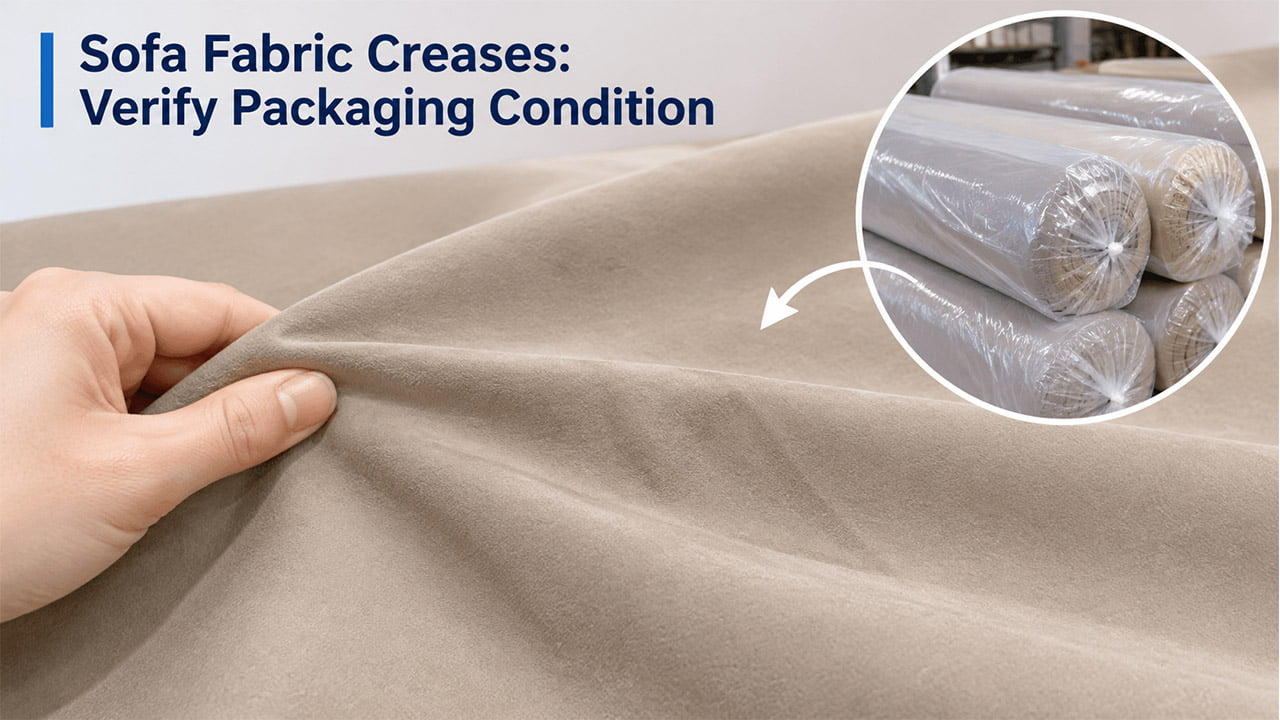
Sofa upholstery pressure marks after shipping should be investigated using the packed furniture configuration, not only a loose material swatch. Map the mark against protectors, straps, nested parts and other contact points, then record its condition immediately after unpacking and after an agreed recovery period. Distinguish a surface imprint from sticking, a sharp crease or a depressed insert. The purchasing decision is whether the material and packaging combination meets the agreed arrival appearance requirement.
Match the mark to the package before changing the material
Keep photographs of the unopened package, internal protection and furniture as unpacked. Identify the location of each visible mark on a drawing or overall image. Compare its outline with nearby packaging features. A repeating grid or straight band can guide the investigation, but correspondence alone does not prove the mechanism.
Record the packaging revision, packing arrangement and known storage or transit history. If that history is incomplete, preserve the uncertainty. A factory simulation and a returned shipment should not be treated as identical exposures simply because both produced an indentation.
For a proposed PU sofa upholstery construction, retain the exact material identity and a reference sample. The word “PU” does not explain every mark. The face, padding, cover fit and package contact can all be relevant questions for a controlled comparison.
Classify sofa upholstery pressure marks before testing
| Observed condition | What to distinguish | Useful record |
|---|---|---|
| Imprint matching a protector | Surface appearance versus underlying depression | Contact map and timed recovery images |
| Surfaces stick during unpacking | Blocking or transfer rather than pressure alone | Contact materials and separation observation |
| Sharp fold line | Creasing associated with a folded geometry | Packing orientation and fold location |
| Broad cushion depression | Insert or support contribution | Whole-cushion comparison |
| Colour or sheen change | Staining, rubbing or finish change | Untouched reference under consistent light |
This classification is an investigation aid, not a diagnosis from appearance. More than one condition can occur at the same contact. For example, a protector may leave both an imprint and a visible transfer. Record those separately so a successful change in one outcome does not conceal an unresolved second problem.
A complaint described only as “wrinkles” is too broad for a useful supplier response. Name the region, geometry and observation time. Include whether any smoothing, cleaning or warming occurred before photography; those actions can alter the evidence being compared.
Define the arrival condition the buyer will accept
Agree whether inspection occurs immediately after unpacking or after a specified recovery period under defined conditions. If both matter, record both. Do not decide the recovery interval after observing which sample looks best. A statement that marks “eventually disappear” is not a usable delivery requirement without an agreed endpoint.
Use an approved appearance reference and consistent viewing arrangement. Include overall and close views of the named zones. A minor indentation visible only in a particular light may still matter to the customer, but the contract should state how that judgement is made rather than leaving inspectors to invent different conditions.
Keep the furniture manufacturer involved when the mark appears to involve padding or support. Material acceptance and finished-furniture arrival acceptance are related but different. A roll sample that remains flat does not establish that the completed packed sofa will arrive in the required condition.
Image placeholder: Sofa packaging contact map showing protectors, strap paths and nested components, with corresponding upholstery locations photographed before packing and after unpacking.
Design a controlled packed-product comparison
Start with production-representative furniture and packaging. Retain an unpacked reference under the agreed comparison conditions where practical. Use the actual protection materials, contact arrangement and closure process, and identify every sample. A hand-pressed swatch can screen an idea but should not be described as a validated shipping simulation.
The packaging team should select an appropriate distribution-test plan. ASTM D4169 provides a laboratory framework for evaluating shipping units against anticipated distribution hazards. It is not a sofa-specific pressure-mark limit and does not replace the product’s appearance specification.
For diagnostic development, compare a clearly identified packaging change against the baseline while keeping the furniture construction constant. Alternatively, compare a material change with the packaging held constant. If both change together, the result can select a package-product combination but cannot cleanly isolate which change produced the difference.
Keep investigative opening separate from formal certification testing
ISTA’s testing guidance calls for representative samples and cautions against opening packages during a procedure intended for certification. It recommends separating intermediate investigative inspections from the uninterrupted formal test when needed.
Agree this distinction with the laboratory before starting. If the development team wants to inspect marks between stages, label that run as investigative and follow the applicable procedure for any later formal pass claim. Do not quietly open, rearrange and reseal a package while still presenting the result as an unchanged standard sequence.
Record the chosen procedure and all deviations. A useful report explains what was tested and what conclusion the run can support. Avoid choosing a familiar parcel method solely by name when the furniture’s package type and distribution route require a different assessment.
Observe recovery without introducing an unapproved repair
At unpacking, document the as-received condition before touching the marked surface. Then follow the agreed observation schedule. Maintain the defined environment and record any authorised action. An untouched recovery result and a result after manual adjustment are different data points and should remain distinguishable.
Do not use a heat gun, steam or an unapproved chemical to make the trial sample look acceptable. This article is not a repair guide. If a manufacturer has an authorised corrective procedure, evaluate and label that outcome separately from whether the original packaging met its delivery requirement.
If the mark remains, ask the furniture team to examine whether it is in the face appearance, the cushioning or another part of the assembly. Preserve the comparison sample and packaging contacts. A persistent mark warrants investigation, but persistence alone does not identify the responsible layer.
Choose corrective trials that address the observed contact
Potential packaging revisions include a different protection geometry, contact arrangement or approved packing sequence. These are options for the packaging engineer to develop and test, not universal remedies. The revised package must still satisfy its other handling and transport requirements.
A softer-looking protector is not automatically better, and more wrapping is not automatically safer for appearance. Judge the revised combination through the agreed plan. Check for new problems such as different imprints, rubbing or contact transfer rather than inspecting only the original mark location.
When comparing alternatives in the furniture upholstery range, keep the packaging and arrival criteria explicit. A material comparison should not disguise a package redesign, and a package improvement should not be advertised as a universal property of a polymer family.
Image placeholder: Baseline and revised sofa protection arrangements with matched post-unpacking observation sheets, separating immediate appearance from the agreed recovery inspection.
Release the package and product together
Retain the furniture construction, upholstery code, packing instructions, protector identities and approved test record. Include the arrival inspection method and the specific appearance reference. Production should know which combination passed rather than receiving a general instruction to “pack more carefully.”
Review relevant changes to the furniture geometry, upholstery, padding, protection materials or packing process. A previously accepted package may no longer represent the changed product. Decide the necessary retesting through the programme rather than transferring the old report automatically.
For shipment feedback, link the complaint to the packing revision and material or furniture batch. Gather the as-unpacked photographs before repairs are attempted. This gives the next investigation a traceable starting point and helps distinguish an isolated handling event from a repeatable design concern.
To discuss material sampling, send Wandaoleather the sofa construction, packaging contact map and pressure-mark observations. Include the agreed arrival and recovery criteria so the comparison addresses the delivered furniture, not only a flat swatch.
Frequently Asked Questions
Does a shipping imprint prove that the upholstery material is defective?
No. Investigate the packed product, contact materials, furniture construction and exposure history. The mark is evidence of an outcome, not a complete cause diagnosis.
Are pressure marks and blocking the same problem?
No. Pressure-related appearance and surfaces sticking during separation are different observations, although they may occur together. Record and evaluate each relevant condition separately.
How long should a sofa be allowed to recover after unpacking?
Agree the inspection interval and conditions before testing. This article sets no universal recovery time; report immediate and later observations according to the buyer’s acceptance plan.
Can a loose swatch replace a packed-sofa test?
No. A swatch may screen a material interaction, but it does not represent every contact, load and support condition of the packaged furniture.
Can the package be opened halfway through a formal transit test?
Follow the selected procedure and laboratory instructions. Keep investigative intermediate inspections separate when opening would invalidate the intended formal test or certification claim.
Should heat be used to remove marks before acceptance inspection?
No unapproved treatment should be used. Preserve and inspect the original condition first; any authorised repair outcome must be identified separately from the original package-product acceptance.