Market Context and Application Suitability of PVC Leather for Door Panels
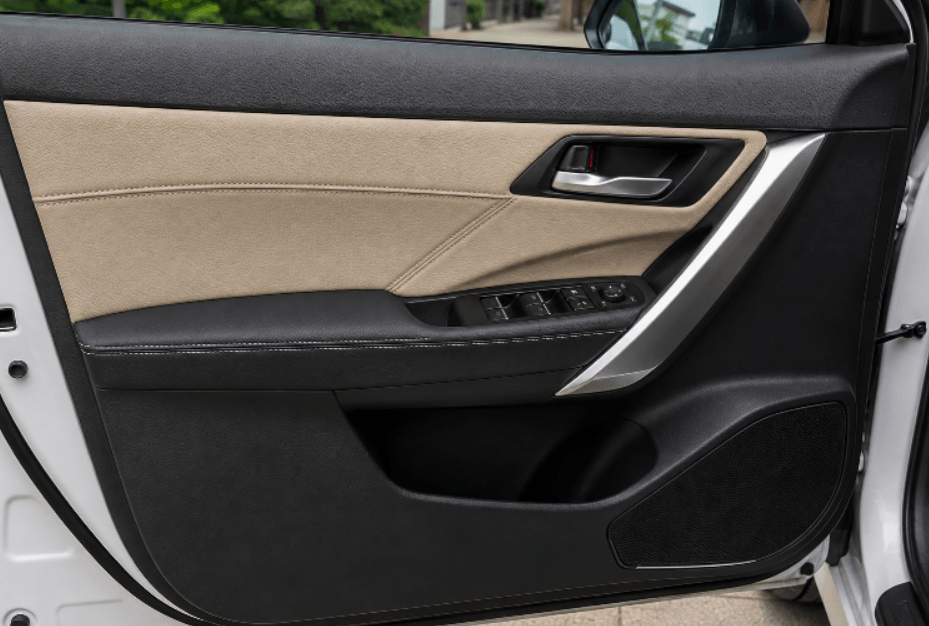
Market application of PVC leather for automotive door panels refers to the use of vinyl-based synthetic leather as the visible skin or insert material on door trim, armrests, map pockets, and lower panels, primarily in cost-sensitive passenger cars, commercial vehicles, and certain aftermarket or fleet applications.
Public market reports typically measure the broader automotive PVC artificial leather category (seats, door panels, instrument panels, armrests, and aftermarket covers) rather than door-panel skins alone. Industry estimates place the global automotive PVC artificial leather market in the range of roughly USD 12.5 billion in 2021 to USD 12.74–15.3 billion in 2025, with projected CAGRs between about 1.6 % and 3.43 % depending on the research firm and definition of aftermarket versus OEM content. These figures should be treated as industry estimates, not audited door-panel volume data. Spherical Insights QYResearch via Sohu DIResearch via Gelonghui Straits Research
Verified production data provide a clearer demand driver. Global passenger-car production reached 75.5 million units in 2024, with China accounting for 35.4 % of that volume. North America produced 11.4 million passenger cars the same year. These numbers establish the scale of OEM door-panel skin demand but do not translate directly into PVC share. ACEA
In practice, PVC remains competitive in entry-level passenger cars, economy SUVs, commercial vehicles, and applications that prioritize stain resistance and cleanability. Higher-trim passenger cars and many EV programs increasingly specify PU/TPU soft skins, TPO/TPE skins, textiles, or microfiber for improved haptic feel, lower VOC perception, and recyclability narratives. Manufacturer documentation confirms that PVC slush powders are still engineered for instrument panels, door panels, and glove-box skins, while PU systems appear in premium door-panel applications on certain high-end models. Mitsubishi Chemical BASF
Drivers favoring PVC include mature calendering, coating, embossing, and vacuum-forming processes; design flexibility in grain and color; and relatively low material cost at volume. Constraints include plasticizer and stabilizer management under REACH, cabin VOC and fogging requirements, and competitive pressure on soft-touch feel in high-contact zones. REACH restricts four phthalates (DEHP, DBP, BBP, DIBP) to 0.1 % by weight in plasticized materials, a threshold that affects formulation work even when automotive exemptions or transitional arrangements apply. China’s GB/T 27630 sets cabin air-quality limits for benzene, toluene, xylene, ethylbenzene, styrene, formaldehyde, acetaldehyde, and acrolein; these are vehicle-level requirements, not a ban on PVC, but they force system-level control of skin, foam, adhesive, and ink. EUR-Lex China MEE
Action recommendation
Treat global PVC leather market numbers as directional only. Build your own bottom-up estimate using regional vehicle volume × door-panel PVC coverage area × areal density × process yield, then segment by OEM, trim level, and door-panel zone before locking a material strategy.
Flame Retardancy Standards and Compliance Considerations
Flame retardancy requirements for automotive door panel PVC leather refer to the horizontal or vertical burn performance that interior materials must meet when tested as single layers or tightly bonded composites under specified specimen size, conditioning, and flame exposure conditions.
The dominant horizontal-burn rules are FMVSS 302 (United States), GB 8410-2006 (China), and CMVSS/TSD 302 (Canada). ISO 3795 is a test method only; it does not itself set a pass/fail limit. UN ECE R118 applies primarily to certain M3 Category II and III buses and coaches and adds vertical-burn and melt-drip requirements that ordinary passenger-car door panels usually do not face under EU type-approval.
| Jurisdiction / Standard | Specimen size (typical) | Conditioning | Burn rate limit | Key pass criteria |
|---|---|---|---|---|
| FMVSS 302 (US) | 102 × 356 mm; max 13 mm thickness from occupant side | 21 °C, 50 % RH, 24 h | ≤ 102 mm/min | Also passes if self-extinguishes within 60 s and burn distance ≤ 51 mm |
| GB 8410-2006 (China) | 356 × 100 mm; max 13 mm | 23 ± 2 °C, 45–55 % RH, 24–168 h | ≤ 100 mm/min | Maximum of ≥ 5 specimens; A/B classifications for self-extinguishing cases |
| CMVSS / TSD 302 (Canada) | ≈ 102 × 356 mm | ≈ 21 °C, 50 % RH, ≥ 24 h | ≤ 101.6 mm/min | Aligned with FMVSS 302 approach for interior materials within 13 mm of occupant compartment |
| ISO 3795 | 356 × 100 mm; max 13 mm | 23 ± 2 °C, 50 ± 5 % RH, 24 h–7 d | No inherent limit | Reports burn rate only; limit must come from regulation or OEM specification |
| UN ECE R118 (selected buses) | Horizontal: 356 × 100 mm; Vertical: 560 × 170 mm | 23 ± 2 °C, 50 ± 5 % RH | ≤ 100 mm/min (H or V) | Installation orientation matters; melt-drip test required for certain roof/seat areas |
Data above are verified source values drawn from the regulatory texts. Cornell / FMVSS 302 GB 8410-2006 Justice Canada RI / ISO 3795 UNECE R118
A critical distinction is that a PVC skin that passes FMVSS 302 or GB 8410 as a free film does not automatically qualify the finished door panel. Both FMVSS 302 and GB 8410 require tightly bonded composites to be tested as composites. Adhesives, foam layers, scrims, and substrate can change burn behavior. Thickness, free-edge exposure, holes, and welding lines also matter. OEM specifications such as Volkswagen TL 1010 typically reference the same horizontal methods but add requirements for the actual part construction and change-control rules. Eurolab / VW TL 1010
The opportunity side is that well-formulated PVC systems routinely meet the 100–102 mm/min horizontal limits when the full composite is engineered together. The risk is treating a skin-level certificate as vehicle-level compliance.
Action recommendation
Require burn reports on the exact composite structure (skin + foam or backing + adhesive if present) that will be used on the door panel, and record specimen orientation, thickness, and maximum observed rate. Never accept a report that only says “passed FMVSS 302” without the supporting numbers and construction description.
Heat, Light Aging, and Long-Term Appearance Stability
Heat, light aging, and long-term appearance stability of PVC leather for door panels refer to the material’s ability to retain color, grain definition, surface integrity, and mechanical properties after exposure to elevated temperature, humidity, and filtered sunlight typical of the vehicle cabin.
Door-panel upper areas near the beltline and window experience higher thermal and UV loads than lower map-pocket zones. A Chinese automotive engineering society draft technical requirement classifies interior surfaces into temperature zones; upper door-panel trim is placed in a higher zone with a reported maximum temperature of 95 °C and corresponding xenon-arc exposure targets of at least 360 h (Class I) or 550 h (Class II) under method A-1 of GB/T 32088-2015, with gray-scale rating ≥ 4 and no cracking, chalking, or whitening. Lower zones carry shorter exposures. These figures are verified from the draft document. SAE-China draft
Supporting method standards include GB/T 16422.2 / ISO 4892-2 (xenon-arc) and GB/T 16422.3 / ISO 4892-3 (fluorescent UV). OEM methods such as VW PV 3930 (humid-climate xenon) and PV 1303 (cabin light exposure) are frequently referenced in laboratory practice; published summaries of PV 3930 list conditions around black-standard temperature 65 °C, chamber 35–45 °C, RH 60–80 %, and cumulative doses on the order of 350 MJ/m². Exact parameters must be taken from the controlled OEM document. GB/T 16422.2 Micom / PV 3930 summary CTI
Common failure modes observed on PVC door-panel skins are plasticizer migration leading to surface stickiness, color shift from dehydrochlorination and oxidation, grain flattening or cracking under thermal cycling, and loss of adhesion between skin, foam, and substrate. Low-molecular-weight plasticizers increase the risk of fogging and migration; higher-molecular-weight or polymeric plasticizers, appropriate thermal stabilizers (commonly Ca/Zn systems for interior use), HALS, and UV absorbers, plus a compatible topcoat, reduce but do not eliminate the need for full-system testing.
In one set of side-by-side aging trials I ran on production-intent door-panel composites, identical grain PVC skins were laminated to the same foam and PP substrate and exposed for 500 h of filtered xenon versus a parallel fluorescent-UV screening cycle. The xenon-exposed upper-zone samples showed measurable gray-scale drop and slight surface tack on the higher-plasticizer formulation, while the lower-plasticizer, polymeric-plasticizer variant retained gray-scale 4–5 and no tack. The fluorescent-UV samples exaggerated surface chalking that did not appear under the xenon conditions more representative of glass-filtered cabin light. That single observation reinforced why xenon methods aligned with cabin spectra should be the gate for upper-door-panel approval and why UV-only screening is useful only for early formulation ranking.
The opportunity is that properly stabilized PVC systems can meet the durability windows required for most volume door-panel applications at lower cost than many soft-touch alternatives. The risk is under-specifying the upper-zone exposure or testing the skin in isolation from the actual foam and adhesive package.
Action recommendation
Define separate aging packages for upper beltline zones and lower non-contact zones. Lock the xenon method, filter, irradiance, black-standard temperature, humidity cycle, and evaluation criteria (gray scale, ΔE, grain retention, tack, adhesion after exposure) into the material specification before any tooling release.
Zone-Specific Mechanical and Aesthetic Requirements
Zone-specific mechanical and aesthetic requirements for PVC leather on automotive door panels refer to the differentiated thickness, strength, elongation, tear, adhesion, softness, gloss, and grain targets that apply to armrests, inserts, upper trim, map pockets, and lower panels because each zone experiences different loads and visibility demands.
No single ISO, ASTM, or SAE standard publishes universal numerical limits for every door-panel zone. The ranges below are engineering starting windows derived from published sample data and typical OEM practice; they must be confirmed against the specific vehicle program’s material specification.
| Door-panel zone | Typical thickness (mm) | Areal density (g/m²) | Key mechanical emphasis | Gloss / grain notes |
|---|---|---|---|---|
| Armrest / elbow rest | 0.95–1.35 | 700–950 | Higher compression recovery, abrasion, tear; good inter-layer adhesion | Low–medium matte grain; avoid sharp peaks |
| Decorative insert | 0.70–1.05 | 520–780 | Formability, edge stability, scratch resistance | Controlled gloss 2–8 GU; finer or geometric grains |
| Upper trim / beltline | 0.65–1.00 | 500–750 | Dimensional stability under heat/UV; low fogging | Very low gloss (often < 3 GU) to limit windshield reflection |
| Map pocket / lower kick area | 0.80–1.20 | 600–900 | High tear and scuff resistance; robust edge strength | Medium-coarse durable grain |
| Lower non-contact panel | 0.60–0.90 | 450–700 | Cost and basic formability | Matched grain and gloss to adjacent parts |
Published research samples illustrate realistic magnitudes. One peer-reviewed PVC artificial-leather sample used for bonding studies measured 1.05 mm total thickness, 117 N/30 mm tensile load, 120 % elongation, and 14.7 N tear force. Another study of automotive PVC foam leather reported project requirements around 800 ± 80 g/m², tensile strength > 35 MPa, elongation 180–215 %, and tear > 10 kN/m (trouser tear, ISO 13937-2). Unreinforced and carbon-fiber-modified variants in the same work showed tensile values of 32.6 MPa rising to 48.9 MPa with a corresponding drop in elongation. These are verified sample or project values, not universal limits. PMC 10934881 PMC 10650038
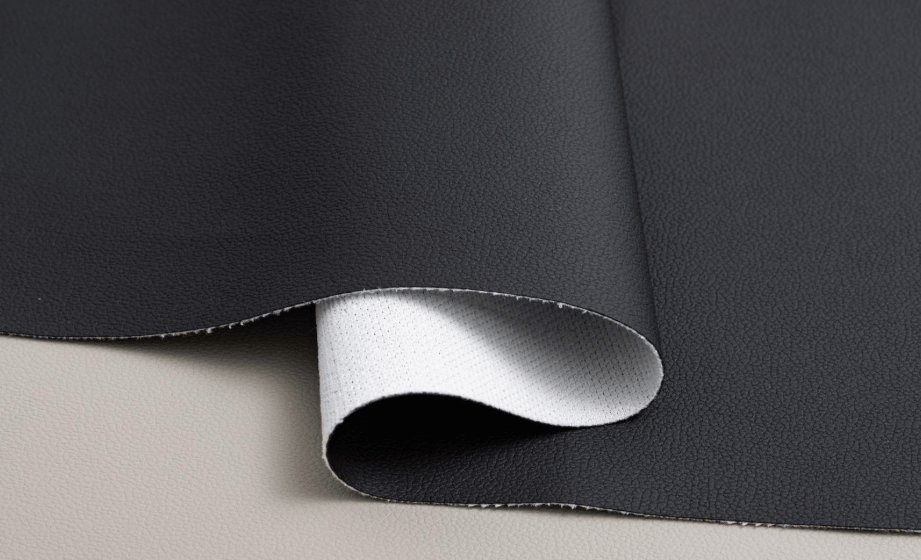
Backing choice matters. Knitted polyester backings improve drape and soft hand for complex armrest contours; woven backings improve dimensional stability and tear at map-pocket openings. Foam-layer thickness and cell structure control compressibility and substrate-print-through; excessively coarse or thick foam can reduce recovery and high-temperature stability. Surface topcoats (aqueous PU or acrylic) lower gloss and improve soil resistance but must be checked for flex cracking and adhesion after aging. Substrate surface energy (PP or TPO) often requires flame or plasma treatment; one study recorded 38–39 % higher peel strength on etched and treated PP versus untreated material under the specific adhesive and 90° peel conditions used. PMC 10650038
Test methods that align well with coated fabrics include ISO 2286-3 for thickness of foam-containing structures, ASTM D751 for mass, tensile, tear, and coating adhesion, ISO 4675 or ASTM D2136 for low-temperature flex, and ISO 813 or OEM peel methods for skin-to-substrate adhesion. Gloss is measured per ISO 2813 or ASTM D523 at the angle specified by the program (commonly 60° for interior skins). ISO 2286-3 ASTM D751
Action recommendation
Write three separate requirement blocks into the RFQ: (1) free-film or composite mechanical properties, (2) adhesion to the actual substrate with the production adhesive and surface treatment after heat/humidity aging, and (3) zone-specific appearance and durability targets. Never apply a single set of numbers to every door-panel location.
Practical Selection Process and Qualification Checklist
A practical selection process for PVC leather on automotive door panels refers to the structured sequence of defining zone requirements, screening candidate constructions, verifying regulatory and aging performance on the final composite, and confirming supply-chain capability before tooling commitment.
Begin with the vehicle’s market destinations. A program selling into North America, China, and Europe will need FMVSS 302 / CMVSS 302, GB 8410, and the relevant OEM cabin-emission and substance lists (REACH, GB/T 27630 system approach). Next map each door-panel zone to its dominant stresses and write quantitative targets for thickness, areal density, tensile/tear (with method and specimen width), inter-layer adhesion, gloss, grain depth, and aging exposure. Require suppliers to declare the full construction: PVC skin formulation family (plasticizer type and approximate level), foam or non-foam, backing type and weight, topcoat chemistry, and any flame-retardant or low-VOC packages.
Laboratory screening should progress from free-film properties to full composite burn, VOC/fogging/odor, xenon aging of upper-zone constructions, and adhesion after heat and humidity. Keep formulation-screening UV exposures separate from formal xenon qualification; the spectra and failure modes differ. Once a construction is frozen, lock change-control language that forces re-validation for any alteration of plasticizer, stabilizer, pigment, foam density, adhesive, or topcoat.
On the supply side, evaluate whether the producer can support the required customization depth (color, grain, thickness, backing, flame package, low-VOC) at the program’s MOQ and lead-time expectations, and whether third-party test reports from accredited laboratories are available for the exact construction. IATF 16949 remains the baseline quality-system expectation for automotive interior materials. Avoid treating any single laboratory certificate as permanent approval; production consistency and change management determine long-term success.
The opportunity in PVC is its mature process window, design flexibility, and cost position for the many door-panel zones that do not require the softest haptic feel. The constraint is that every performance claim must be demonstrated on the actual multi-layer construction under the exact test conditions the OEM will use.
Action recommendation
Issue a single technical package that contains zone-by-zone targets, the full list of required test methods with acceptance criteria, the composite construction definition, and a change-control matrix. Use that package for both internal design freeze and supplier quotation so that every subsequent discussion refers to the same measurable baseline.
Frequently Asked Questions
Q: Does a PVC skin that passes FMVSS 302 automatically meet GB 8410?
A: Not necessarily. The burn-rate limits are close (102 mm/min versus 100 mm/min), but specimen conditioning, number of specimens, and the rule that the maximum rate among specimens is reported differ. Always run the exact method required by the target market on the final composite.
Q: Can laboratory aging hours be converted into years of real-world service?
A: No reliable general conversion exists in the public standards. Xenon or heat-aging results demonstrate relative ranking and compliance with a stated exposure; they do not by themselves prove a service-life percentage unless the program has established correlation data for that specific material system and climate.
Q: What thickness range is typical for door-panel PVC leather?
A: Engineering practice commonly falls between approximately 0.65 mm and 1.35 mm depending on zone, with armrests at the higher end and non-contact lower panels at the lower end. Exact values are set by the OEM material specification and forming process.
Q: Is ISO 3795 a pass/fail standard for door-panel materials?
A: No. ISO 3795 is a horizontal burn-rate measurement method. A pass/fail decision requires an additional regulatory or OEM limit (for example 100 mm/min or 102 mm/min).
Q: Why do upper door-panel zones often demand lower gloss than map-pocket areas?
A: Upper zones can reflect into the windshield. Programs therefore specify very low gloss (frequently below 3 GU at 60°) and fine, non-specular grains to reduce driver distraction, while lower zones can tolerate higher gloss if durability is maintained.
Q: Should flame, aging, and adhesion tests be performed on the free PVC skin or on the finished composite?
A: Critical tests—especially flammability, adhesion after aging, and system-level VOC/fogging—must be performed on the production-intent composite (skin + foam/backing + adhesive + substrate surface treatment). Free-film data are useful for screening but are not sufficient for part approval.