1. Define the Comparison Unit Before Asking Whether PVC or PU Is Better
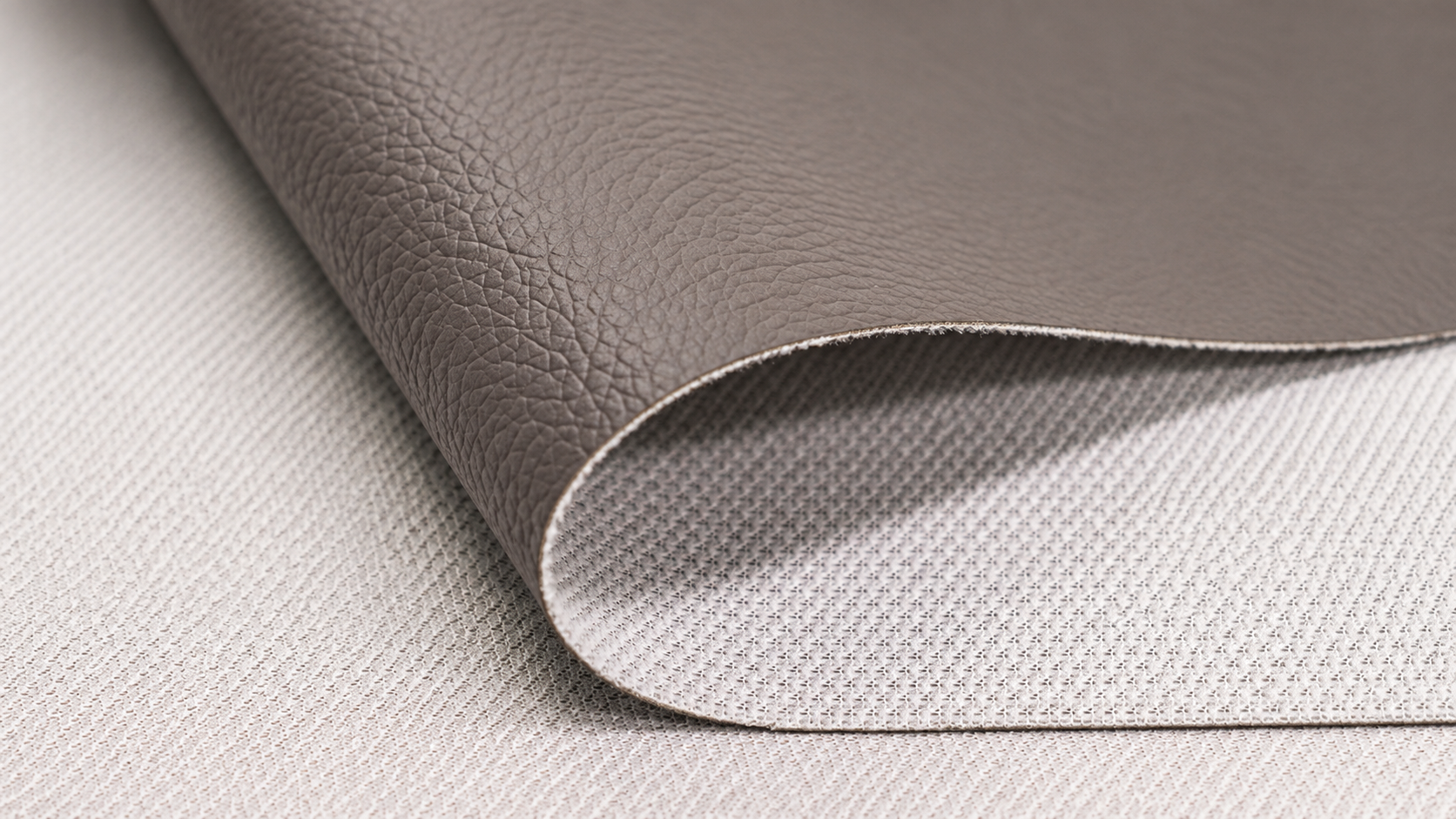
A comparison unit refers to the complete, traceable material construction and finished application being evaluated, not only the polymer name on a quotation. Record the vehicle category, component, contact zone, climate, cleaning exposure, production route, destination market, and acceptance authority. Then identify the surface, topcoat, foam, adhesive, backing, thickness, width, color, grain, gloss, perforation, and revision.
A seat center, side bolster, headrest, door panel, armrest, headliner, pillar trim, and aftermarket cover do not experience the same loads or environments. Contact, flexing, compression, sunlight, cleaning, staining, seam stress, and installation deformation change by part. A correct-looking swatch is only an appearance screen.
PVC may be calendered, plastisol-coated, foamed, embossed, or transferred from release paper. PU may use solvent-based dry transfer, wet coagulation, water-based dispersion coating, or solvent-free reactive coating. These routes bring different drying, curing, bonding, thickness-control, equipment, and scrap requirements.
Public resin figures show why raw-material pricing is not finished-roll evidence. A market source reports PVC resin at USD 644 per tonne in the United States for Q2 2026 and PU resin at USD 1,698 per tonne in the United States for Q4 2025. These are resin-only references from different reporting periods, not automotive leather-roll prices. See the PVC resin price report and PU resin pricing report. Finished-roll price also reflects additives, backing, foam, coating, adhesive, embossing, drying, inspection, scrap, logistics, compliance, and margin.
| Comparison field | What to freeze | Evidence to request |
|---|---|---|
| Application | Vehicle, part, contact zone, climate, cleaning, installation | Part drawing, process sheet, use profile, market requirements. |
| Construction | Surface, topcoat, foam, adhesive, backing, thickness, width, color | Layer diagram, production-intent sample, data sheet, batch identity. |
| Performance | Wear, flex, peel, heat, low temperature, chemicals, odor, VOC, fogging | Matched methods, conditioning, specimen details, and endpoints. |
| Commercial basis | Delivered price, usable yield, process loss, claims, replacement | Quote, nesting trial, plant records, quality and field data. |
Actionable recommendation
Issue one controlled comparison sheet before requesting bids. Require each supplier to identify the exact part, layer stack, backing, thickness, process, market, tests, acceptance limit, and evidence classification. Reject quotations that say only “automotive PVC” or “automotive PU.”
2. Compare the Production and Post-Processing Route, Not Just the Polymer
A production-route comparison refers to how each material is formed, bonded, finished, inspected, and converted into the vehicle part. The route influences thickness stability, texture replication, color consistency, line constraints, scrap mechanisms, sewing behavior, thermoforming, lamination, and environmental controls.
In PVC calendering, resin, plasticizer, stabilizer, filler, pigment, and optional foaming ingredients are mixed and plasticized before being formed through rolls. The sheet may then be laminated to backing or foam, embossed, finished, cooled, and wound. Roll gap, temperature, speed, melt condition, and web tension are important controls. This route can suit stable, high-volume specifications, but formulation, color changeover, texture change, and thermal balance still need production control.
Soft PVC requires a plasticizer system. A published study reports plasticizer use of 40–120 wt% relative to PVC resin in artificial-leather formulations designed to obtain softness and flexing behavior, and discusses migration and coating adhesion. This is a study-backed formulation reference, not a universal automotive recipe. Identify the plasticizer chemistry and test migration, tack, bonding, odor, fogging, and aging. See the peer-reviewed PVC and water-based PU study.
Release-paper transfer can reproduce fine grain and controlled gloss in both PVC and PU. A published PU experiment used wet film thickness of 0.20–0.35 mm, drying at 80–100°C for 5–10 minutes, curing at 130–150°C for 3–5 minutes, and lamination at 0.3–0.5 MPa. Those parameters belong to that experiment, not general automotive settings. See the PU release-paper experiment.
Solvent-based PU can create adjustable multilayers, but the line must manage solvent evaporation, residual solvent, exhaust, recovery, and safety. Wet-process PU can form a porous structure through coagulation and washing, adding solvent removal, washing, drying, recovery, and wastewater requirements. The research dossier cites a 0.1 mg/kg DMF limit in a relevant regulatory context; verify the exact article definition and market in the EU regulation and REACH annex reference.
Water-based PU is not simply solvent-based PU diluted with water. Water evaporates, dispersed particles fuse, and the coating may need post-crosslinking. In the PVC/WPU study, adding 2 wt% leveling agent reduced contact angle from 73.9° to 27.7°, produced a spreading coefficient of 24.1 mJ/m², and achieved ISO 2409 adhesion grade 0 in that experimental system. These results show that wetting can be engineered; they do not guarantee every WPU will bond to every PVC surface.
| Route | Potential strength | Risk to validate |
|---|---|---|
| PVC calendering | Direct sheet formation and stable high-volume geometry | Migration, changeover loss, texture relaxation, backing compatibility. |
| Release-paper transfer | Fine texture, controlled gloss, functional multilayers | Flow, release, curing, lamination, peel consistency. |
| Water-based PU | Reduced conventional organic-solvent burden | Drying energy, residual water, foam, leveling, adhesion, humidity. |
| Solvent-free PU | Reactive high-solids route with reduced solvent evaporation | Metering, pot life, moisture, reaction, cleaning, shutdown scrap. |
Actionable recommendation
Run a production-relevant trial with the intended line, backing, adhesive, color, grain, and part geometry. Measure coating weight, thickness, line speed, first-pass yield, rework, changeover loss, sewing, forming, lamination, and energy from plant records.
3. Evaluate Comfort and Sensory Quality on the Complete Seat Construction
Comfort and sensory quality refer to the occupant’s combined thermal, tactile, friction, odor, visual, and compression experience at the finished seat or interior part. These outcomes depend on the face layer, foam, backing, perforation, ventilation, temperature, clothing, and seat design as much as on polymer chemistry.
“Breathability” can mean air permeability, water-vapor transmission, moisture absorption, thermal effusivity, or perceived heat and dampness. These measurements are not interchangeable. A dense PU film may transmit little moisture, while a porous PU structure may provide more water-vapor pathways. Dense PVC can also be perforated and combined with open-cell foam and active ventilation.
A 2025 review reports that PU synthetic leather has a water-vapor transmission rate generally 30–50% lower than genuine leather. This is a comparison between PU synthetic leather and genuine leather, not a measured PVC-versus-PU automotive-seat difference. The review connects transport to polymer hydrophilicity and connected pore structure. See the synthetic-leather water-vapor review. For procurement, specify ASTM E96/E96M, cup type, temperature, humidity, specimen direction, thickness, area, and conditioning through the ASTM method page.
Thermal touch requires controlled temperature and compression. A SAE study measured thermophysical properties of automotive interior materials, including foam, leather/foam laminates, and plastic laminates, over −20°C to +60°C and at compression levels up to 60%. The study treated temperature and compression as linked variables, showing why a face-polymer label cannot describe the entire contact experience. See the SAE thermophysical-property study.
Tactile quality includes cold touch, bending stiffness, surface drag, softness, pressure response, and compression recovery. PVC can be softened through plasticizer, foam, thin surface layers, and topcoat design. PU can range from hard and smooth to soft and porous. Odor must be evaluated separately from VOC because adhesive, backing, foam, additives, and post-curing all contribute. SAE J1351 provides a hot-odor evaluation framework, not a universal PVC or PU grade.
I once reviewed a PVC artificial-leather sample intended for an automotive seat. Its surface grain and color met the visual requirement, but repeated bending produced slight whitening along the fold. After discussing the result with the factory, I learned that the issue was related to the PVC surface formulation and the bonding process between the surface and the backing fabric. That experience showed me that approval cannot rest on color, grain, and price; flex resistance, abrasion resistance, and surface-to-backing adhesion should be tested before acceptance.
| Sensory topic | Why labels are insufficient | Recommended comparison |
|---|---|---|
| Moisture comfort | Pores, perforations, foam, backing, and ventilation control the result. | Matched WVTR plus finished-seat thermal and moisture testing. |
| Thermal touch | Color, emissivity, foam, compression, and surface temperature interact. | Conditioned contact tests at defined compression. |
| Softness and drag | Topcoat, grain, plasticizer, soft segment, and backing change hand feel. | Blind tactile review plus bending, compression, and friction tests. |
| Odor | Volatiles come from the whole laminate and curing history. | OEM odor method or SAE J1351 on production-intent material. |
Actionable recommendation
Test PVC and PU blind on matched laminates with the same thickness, foam, backing, perforation, color family, and conditioning. Record WVTR, thermal response, compression recovery, friction, odor, surface temperature, and trained-user scores.
4. Compare Durability and Compliance Under Identical Conditions
Matched-condition performance refers to comparing PVC and PU specimens with the same thickness, backing, direction, conditioning, method, load, cycles, endpoint, and failure definition. Without those controls, tensile, tear, abrasion, flex, scratch, hydrolysis, sweat, and temperature data may describe construction differences rather than polymer differences.
For mechanical testing, lock the backing fiber, yarn, weave or knit, mass per area, foam, adhesive, surface coating, thickness, and specimen direction. A published automotive PVC/CF-PVC study reported surface density of 765 g/m² for its PVC sample and 773 g/m² for its carbon-fiber-modified sample. It reported tensile strength of 32.6 MPa and 48.9 MPa, elongation of 214% and 185%, tear strength of 11.4 kN/m and 14.7 kN/m, and total VOC of 5.505 mg/m³ and 3.975 mg/m³ for those PVC constructions. These are useful research results, but they are not a PVC-versus-PU paired dataset or universal limits. See the published automotive PVC study.
Use standards to define how a test is performed, then use the customer or OEM specification to define what passes. ISO 2411 provides a coating-adhesion method and ISO 1419 provides accelerated-aging approaches for coated fabrics. Neither creates a universal peel strength, aging duration, or material ranking. After aging, repeat peel, flex, appearance, color, gloss, hardness or modulus, and odor checks on the same construction.
Abrasion cycles are not interchangeable. Taber, Martindale, Wyzenbeek, and OEM methods use different abrasives, loads, motions, conditioning, and endpoints. For scratch resistance, specify the tool, force, speed, number of passes, contact geometry, and failure definition. “50,000 cycles” has no reliable meaning without those details.
Hydrolysis and heat are chemistry-sensitive. Polyester PU, polyether PU, aliphatic PU, aromatic PU, and modified PVC can respond differently to heat, moisture, oxidation, and light. PVC evaluation should include plasticizer migration, tack, hardening, low-temperature flex, adhesion, and heat/light color change. PU evaluation should include hydrolysis, oxidation, yellowing where relevant, topcoat retention, peel, low-temperature flex, and moisture-conditioned performance. Do not infer field years from accelerated hours or laboratory cycles.
For U.S. interior materials within the relevant scope, FMVSS No. 302 sets a horizontal-burning requirement of no more than 102 mm/min under prescribed conditions. The NHTSA test procedure identifies the reporting framework. Passing it does not establish abrasion, flex life, weathering, VOC, odor, fogging, chemical compliance, or OEM approval.
Chemical compliance is an independent gate. Regulation (EU) 2018/2005 restricts DEHP, DBP, BBP, and DIBP in plasticised materials at 0.1 wt% individually or in combination in the relevant EU context. The definition can include PVC, PU, coatings, adhesives, inks, and other polymers. Thus, “PU is automatically free of phthalate risk” and “all PVC contains harmful phthalates” are both inaccurate shortcuts. Review the EU restriction regulation and the REACH restrictions overview.
| Performance gate | Matched requirement | Interpretation rule |
|---|---|---|
| Strength and tear | Same backing, thickness, direction, conditioning, method, and failure description. | Do not attribute a backing-dominated result to the face polymer alone. |
| Wear and scratch | Same abrasive or tool, load, cycles, endpoint, and visual grading. | Do not convert cycles from different instruments into one ranking. |
| Heat, moisture, and flex | Same exposure, recovery time, geometry, and post-aging tests. | Do not convert accelerated hours into calendar years without correlation. |
| Legal and chemical | Applicable market, homogeneous-material scope, regulation version, exemptions. | Do not infer compliance from polymer identity or one certificate. |
Actionable recommendation
Create a blind A/B matrix with one construction variable changed at a time. Require initial and aged tensile, tear, peel, abrasion, flex, scratch, chemical, sweat, VOC, odor, fogging, and flammability evidence, with the visual and mechanical failure endpoint defined before testing begins.
5. Select PVC or PU by Application, Risk, and Total Qualified Cost
A material-selection decision refers to choosing the construction that meets finished-part performance, compliance, production, supply, and lifecycle requirements at an acceptable verified cost. It is not choosing the lowest quotation, the most expensive material, or the strongest marketing narrative.
For high-contact seat centers, side bolsters, and premium touch points, evaluate a specific PU route when tactile refinement, low gloss, porous structure, or moisture transport is important. Polyether PU or another high-hydrolysis-resistance system may deserve screening in hot and humid conditions, but the chemistry must be confirmed and tested. A validated low-migration PVC construction may be better where stain resistance, cleaning, surface closure, cost control, and replacement architecture dominate.
For commercial vehicles, buses, taxis, work vehicles, and high-cleaning interiors, qualified PVC can be attractive when it passes wear, flex, chemical, heat, low-temperature, adhesion, flammability, odor, and fogging gates. Consider PU when it provides a documented benefit in comfort, process yield, replacement avoidance, or a customer requirement. For door panels, armrests, map pockets, loading zones, headliners, and pillars, rank the actual failure mode first instead of selecting by polymer label.
Use verified plant and field inputs for lifecycle modeling. Total qualified cost = landed material cost + cutting and process loss + testing and compliance + rework and claims + maintenance + replacement + end-of-life cost. Do not enter assumed roll prices, yields, annual energy, warranty rates, or replacement years as facts. Replace them with comparable quotations, nesting trials, measured yield, metered energy, QMS data, warranty history, service records, recycler acceptance, and local disposal charges.
The only public energy benchmark identified in this research is 57.8 GJ per tonne for PVC resin cradle-to-gate. It covers resin production, not coating, backing, foaming, embossing, trimming, or seat conversion, so it cannot be compared fairly with PU without matched boundaries. See the PVC resin life-cycle assessment. End-of-life is also a system issue. A UK benchmark gives landfill tax of £130.75 per tonne from April 2026, while a WRAP survey reports a median non-hazardous landfill gate fee of £26 per tonne. These are public disposal benchmarks, not global automotive contract prices. See the UK landfill-tax rates and WRAP gate-fee report.
| Priority | First route to screen | Release evidence |
|---|---|---|
| Cleaning, stain, heavy contact, cost | Low-migration automotive PVC and heavy-duty PU | Matched cleaner, sweat, abrasion, flex, heat, adhesion, odor, and flammability results. |
| Touch, low gloss, moisture comfort | Polyether or microfibre PU and perforated or ventilated PVC | Matched WVTR, thermal, tactile, compression, odor, and finished-seat validation. |
| High heat, sunlight, fogging | Specialized PVC or weather-designed PU | Heat/light aging, migration, fogging, VOC, odor, gloss, color, and peel retention. |
| Aftermarket replacement | Either qualified route selected by fitment and field evidence | SKU consistency, installation trial, claim substantiation, cleaning, and replacement data. |
Freeze the approved sample and change-control rules. A new topcoat, plasticizer, polyol, backing, adhesive, embossing roll, pigment, recycled input, or manufacturing site can change performance while the product name remains unchanged. Keep the batch, revision, construction drawing, test reports, retained master, inspection plan, and requalification triggers in the release file.
Actionable recommendation
Choose PVC or PU only after the candidate passes the project’s finished-part matrix and its verified total qualified cost is supported by plant and field data. Freeze the exact construction and require written review before changes.
Frequently Asked Questions
A: Neither is universally better. The appropriate choice depends on the complete construction, part location, climate, cleaning, comfort, appearance, production route, compliance market, and verified performance. Compare matched PVC and PU laminates rather than polymer names alone.
A: No. PU can be designed for refined touch, low gloss, porous structure, or a lower-solvent route, but those are properties of a defined formulation and process. PVC can also be engineered for durable, low-migration, low-gloss, and cleanable applications. Environmental conclusions require defined lifecycle boundaries, chemistry, energy, durability, and end-of-life evidence.
A: No. PVC can perform strongly against water, stains, cleaning, and surface wear in suitable constructions. PU durability varies with polyether or polyester chemistry, topcoat, backing, hydrolysis resistance, heat, light, and chemical exposure. Use the actual project tests and failure endpoints to decide.
A: No. Water-vapor transmission depends on pores, hydrophilicity, thickness, topcoat, backing, foam, perforation, and seat ventilation. Dense PU can transmit little moisture, while porous PU may transmit more. Dense PVC can be perforated and ventilated. Report matched WVTR and finished-seat results.
A: No. Within the applicable scope, FMVSS 302 provides evidence about the prescribed burning behavior of the tested material or assembly. It does not prove abrasion, flex, weathering, VOC, odor, fogging, chemical compliance, or OEM approval. The report must identify the specimen and conditions.
A: Request the complete layer construction, batch identity, thickness and backing data, matched test plan, initial and aged results, chemical declarations, VOC, odor, and fogging evidence where relevant, process-trial results, quotation assumptions, change-control commitment, and field or warranty data when available. Approve the exact construction, not a generic material category.