1. How Long PVC Furniture Leather Actually Lasts — By Application
Service life here refers to the period during which PVC furniture leather keeps acceptable flexibility, surface integrity, and color before cracking, peeling, or stiffening becomes visually unacceptable to the end user — not a number printed on any certificate.
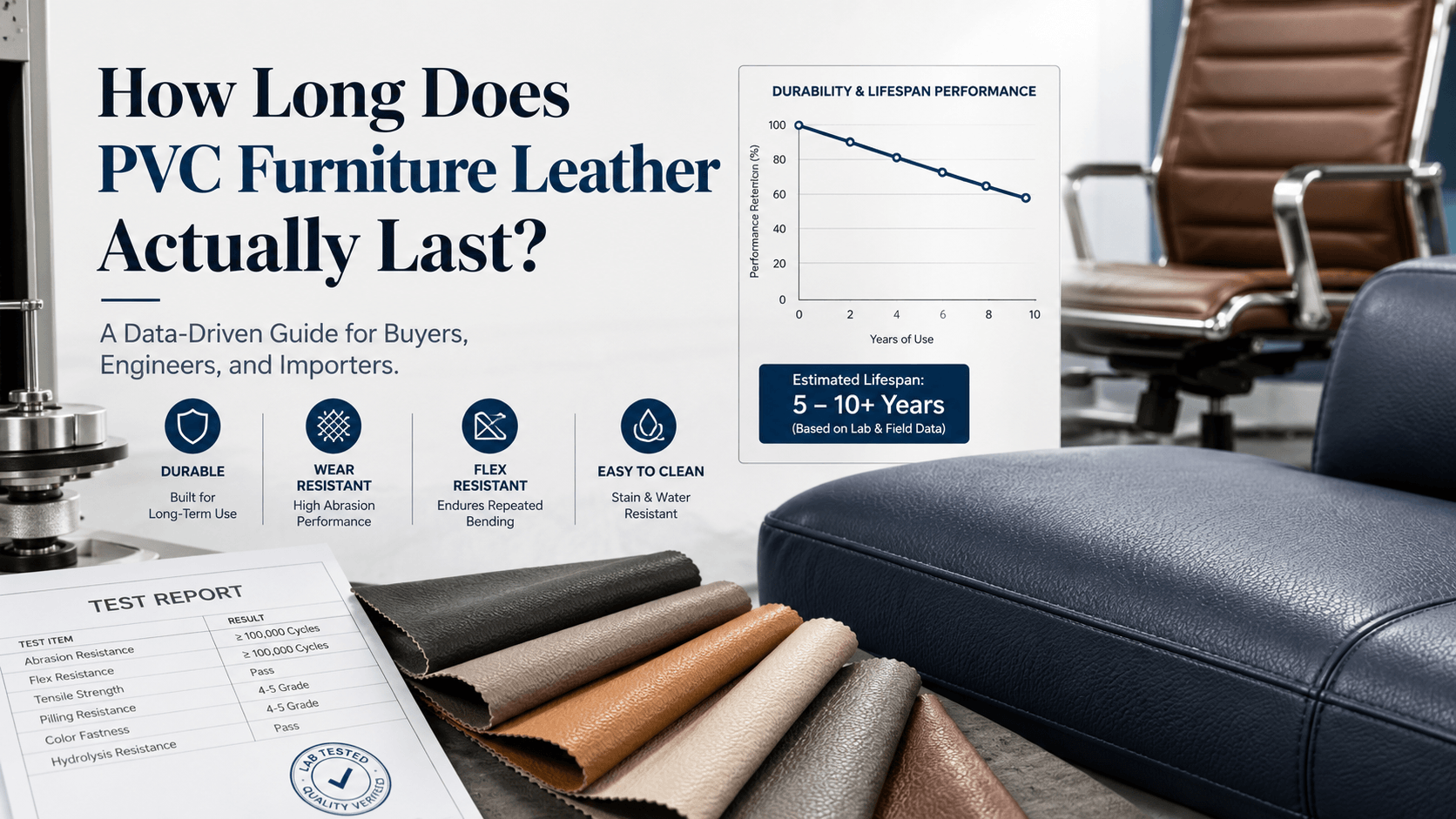
Under normal household conditions, the commonly cited range is 3–8 years, with well-formulated, well-maintained products reaching 8–10 years or more; heavy use, strong sunlight, and frequent sweat/oil contact shorten that window significantly 3rdtest. The gap by application is meaningful:
| Application | Typical real-world lifespan | Primary failure driver |
|---|---|---|
| Sofas | 5–10 years (budget lines often 3–5) | High seating frequency, large load-bearing surface, frequent flex points — cracking, peeling, tackiness show up first 3rdtest |
| Office chairs | 3–7 years | Prolonged compression, friction, and sweat concentrate on armrests and seat pan, which age fastest std.samr.gov.cn |
| Dining chairs | 5–8 years, longer under light use | Shorter contact time, but higher exposure to spills, cleaning chemicals, and wiping 3rdtest |
Two things are worth flagging for procurement teams. First, published standards — including QB/T 5067-2017 (China’s PVC furniture leather standard) and GB/T 38464-2020 (flex-fastness test method) — measure performance properties (abrasion, flex, light aging, heat aging), not years of service openstd.samr.gov.cn. Second, the industry has no universal hour-to-year conversion, which means any lifespan number a supplier quotes is an estimate built on their own test conditions, not a certified fact.
It also helps to know the failure sequence, not just the endpoint. Visible aging in ordinary PVC or synthetic leather furniture commonly begins around 2–4 years in — earlier if the material sits in direct sunlight, later in shaded, low-touch environments behome.com.tw. The first signs are usually subtle: a loss of surface flexibility, fine hairline cracks at fold points, and slight color unevenness. These typically show up well before the dramatic failure modes — visible cracking, sheet-like peeling — that buyers usually associate with “the leather is done” blog.sina.com. For quality control and warranty purposes, that earlier stage is the more useful signal to monitor, since by the time large-area peeling appears, the product is already past the point of any practical fix.
Accelerated aging tests (QUV, xenon-arc) are sometimes cited as a shortcut to predicting real-world years, but there’s no fixed, reliable hour-to-year conversion factor for PVC furniture leather specifically — results depend heavily on the exact formulation, test parameters, and the climate the product will actually sit in roachelab.com. The only dependable approach is running the supplier’s specific material through both accelerated aging and a real outdoor/window exposure baseline, then correlating the two — a generic “2,000 hours of QUV equals X years” figure borrowed from another material (automotive coatings, for instance) does not transfer reliably to furniture-grade PVC leather b2bwiki.baidu.
Action:
Don’t accept a verbal “5 years” from a supplier. Ask for the QB/T 5067-2017 (or applicable) compliance statement plus the underlying abrasion, flex, and light-aging test data, and match it against your actual end-use case — sofa, office chair, or dining chair — before finalizing spec.
2. What “Durable” Actually Means: Wear-Resistance Standards and Martindale Cycles
Wear-resistance rating refers to the number of Martindale rub cycles a material withstands before reaching a defined level of surface damage, tested under standards like ASTM D4966, ISO 5470, or China’s GB/T 24117 Wikipedia – Martindale.
None of these standards set a single mandatory “pass” threshold for furniture leather — the number that matters is written into the buyer’s spec sheet or the product standard, not the test method itself Wikipedia – Martindale yiqi-oss.oss-cn-hangzhou.aliyuncs.com. That said, the market has converged on informal benchmarks:
- ~20,000 cycles — entry-level, minimum usable threshold
- 30,000–50,000 cycles — solid residential/general commercial grade
- 50,000+ cycles — commonly marketed as “high abrasion resistance” or premium
- 100,000+ cycles — heavy commercial/public space use Wikipedia – Martindale
The dialectic here is worth stating plainly: a supplier telling you their material “passed Martindale testing” tells you almost nothing — passing at 15,000 cycles and passing at 80,000 cycles are both “passes.” The opportunity for procurement teams is that this ambiguity is easy to close: cycle count is a number, and numbers can be written into contracts.
Action:
Put a minimum Martindale cycle count directly into your PO or technical spec (e.g., “≥30,000 cycles per ISO 5470, raw lab report required”) rather than accepting a pass/fail claim.
3. PVC vs PU vs Microfiber vs Genuine Leather: Where PVC Really Stands
Material benchmarking refers to comparing abrasion resistance, aging resistance, and lifespan tendency across the four materials furniture buyers most commonly weigh against each other.
Based on available industry data, the rough ordering is microfiber leather ≥ high-quality genuine leather > PU leather > PVC leather, though this shifts with formulation and test method b2bwiki.baidu. PVC typically holds up fine on initial surface hardness and water/stain resistance, but tends to stiffen and crack faster under long-term heat and light exposure than PU or microfiber b2bwiki.baidu. It’s worth being direct about one gap in the record: no BIFMA, EN, or China Light Industry Council report was found that runs all four materials through the same standardized head-to-head test and publishes a ranking hangyan.co. Most “comparison data” you’ll find online comes from individual batch tests, not authoritative cross-material benchmarks — treat any specific ranking with that caveat.
I ran a simple, unscientific version of this comparison myself: I kept two swatches — one standard PVC and one PU-coated microfiber, both marketed for sofa use — on a south-facing windowsill for about ten weeks, alongside identical swatches kept in a drawer as a control. By week six, the PVC sample showed a faint but noticeable stiffening at the fold point and a slight color shift compared to its drawer-kept twin; the microfiber sample was still visually indistinguishable from its control at that point. This isn’t lab-grade data — no controlled temperature, no UV meter — but it lined up with what the published sources describe: PVC’s failure mode shows up early as stiffening and micro-cracking at flex points, well before anything looks dramatically “worn out” blog.sina.com.
The opportunity side matters just as much as the risk side: PVC’s weaker average performance doesn’t rule it out for demanding applications — it rules out unspecified, low-formulation PVC. In waterproof, easy-clean, budget-sensitive contexts (hospitality, family-with-kids, pet-owning households), a well-formulated PVC leather with good abrasion and UV data can outperform a mediocre PU or microfiber product synthetic-leather.com.
Action:
Stop comparing materials by name. Request the same test battery — Martindale cycles, flex fastness, QUV/UV aging, colorfastness — from the same production batch across your PVC, PU, and microfiber candidates, so the comparison is apples-to-apples instead of marketing-to-marketing.
4. Why PVC Leather Fails Early: The Real Root Causes
Premature failure refers to cracking, peeling, tackiness, or hardening that appears well before the material’s expected service window, and it is almost never caused by one factor — it’s the combined effect of plasticizer instability, backing fabric quality, coating structure, and process control.
Ranked by contribution to early failure:
- Plasticizer migration — the single biggest driver. Because plasticizers bond to PVC through weak physical interaction rather than chemical bonds, heat, light, pressure, and skin oils gradually push them out of the material, causing surface tackiness, hardening, shrinkage, and eventually cracking. Depending on severity, this alone can cut expected lifespan by roughly 20–30% in mild cases and over 50% in severe cases — worse with low-quality, high-migration plasticizer systems patents.google – CN103834128A.
- Backing fabric quality — a weak, high-shrinkage, poorly bonded backing fails first under repeated flexing, dragging the surface coating down with it. The gap between good and poor backing fabric can account for a 30–50% difference in final service life zh.wikipedia.
- Coating thickness and structure — too thin, and the material cracks along flex points early; too thick, and uneven curing creates internal stress that causes delamination. Properly optimized thickness typically adds 20–40% lifespan versus under-specified thickness, but gains taper off past the optimal range — thickness alone is not a fix nbthq.com b2bwiki.baidu.
- Calendering vs. coating process — well-controlled calendering tends to produce more consistent results; coating (knife-over) processes can achieve more complex multilayer structures but are more sensitive to drying and curing variance. Process control differences alone can shift lifespan by 10–30% even with identical formulation sohu.com.
Environmental stress compounds all four. UV exposure plus heat is consistently described as the harshest combination — it drives light-oxidation, chain breakdown, and accelerated plasticizer migration simultaneously blog.sina.com. Coastal, high-salt-fog environments add surface contamination and accelerate hardware corrosion, but the salt itself is a secondary factor compared to sun and heat for the leather substrate itself b2bwiki.baidu. Humid southern climates without strong sun exposure tend to produce a different failure mode — tackiness, mold, and adhesive-layer degradation — rather than fast cracking businessresearchinsights.com.
Action:
Ask suppliers, in writing, what plasticizer system and backing fabric spec they use — not just the finished-product test results — and match that information against your end-use environment (window-facing, coastal, high-humidity) before signing off.
5. How to Extend Lifespan and Vet a Reliable Chinese Supplier
Lifespan-extension technology refers to formulation and process upgrades — UV stabilizers, low-migration plasticizers, wear-resistant coatings, low-VOC systems — that directly counter the failure mechanisms above, and the engineering data on each is more concrete than most marketing claims suggest.
- UV stabilizer + upgraded heat stabilizer systems: typically extend lifespan 30–50%, approaching 80% in high-UV-exposure conditions laohuashiyanxiang.com.
- Internal/eco-friendly plasticizer systems (e.g., covalently anchored plasticizers): one cited patent reports migration rate dropping from 5.3–5.6% to 0.43–0.71% over 10 days — roughly a 90% reduction in migration rate — translating to an estimated 50–100% lifespan improvement in flexibility retention and crack resistance patents.google – CN103834128A.
- Wear-resistant matte coatings and abrasion additives: reduce mass loss or gloss loss under abrasion testing by 30–70%, translating to roughly 30–100% longer time-to-visible-wear at high-friction points like seat pans and armrests byk.com.
- Low-VOC, low-odor formulations: limited effect on mechanical lifespan, but extend the “user-acceptable” lifespan by 50–100%, since odor and stickiness — not just cracking — are common reasons buyers replace furniture early WO2022243084A1.
Combined, these upgrades typically produce at least a 50–120% lifespan improvement over baseline PVC formulations, with automotive-interior-grade formulations pushed into furniture applications reaching close to 2x in premium cases patents.google – CN103834128A.
It’s worth directly addressing a few common misconceptions here, because they cost buyers money when left unchecked.
“Low price always means short lifespan.” The relationship is moderate, not deterministic — price mostly reflects the probability distribution of failure rate across a batch, not a guarantee for any single product b2bwiki.baidu. Properly formulated, well-processed low-cost PVC leather can meet normal household durability needs; conversely, expensive material misapplied to the wrong use case, or produced with poor process control, can fail early despite the price tag jingyan.baidu.com.
“Thicker always means more durable.” Thickness affects hand feel and coverage, but coating formulation and backing quality are the real determinants of crack resistance. A poorly formulated thick coating can actually trap uneven internal stress and delaminate faster than a well-engineered thinner one cn.nubuck-leather.com.
“PVC is inherently short-lived compared to genuine leather.” This doesn’t hold up as a blanket rule. In high-cleaning-frequency, waterproof-priority, budget-sensitive use cases, PVC can outperform poorly maintained genuine leather; genuine leather’s advantage is more about breathability, feel, and repairability than a guaranteed longer service life 360doc.com.
“PVC is only suitable for low-end furniture.” This reflects PVC’s cost position more than its actual ceiling. High-specification PVC leather with strong wear layers, stable coloring, and compliant chemistry performs well in hospitality, family, and pet-owning settings where stain resistance and cleanability matter more than the material name on the spec sheet cn.nubuck-leather.com.
For supplier vetting specifically, prioritize documentation over showroom impressions:
- QB/T 5067-2017 compliance statement (or applicable regional equivalent), plus underlying abrasion/flex/light-aging test data baijianwang.com
- CNAS/CMA-accredited third-party lab reports from the same production batch you’re sourcing — historical samples aren’t representative yjsyi.com
- REACH documentation for EU-bound goods and CPSIA documentation for US-bound goods, particularly for anything touching children or sensitive-use furniture bjhgyjs.cn
- Raw Martindale, flex-fastness, and colorfastness reports — not just a pass/fail certificate yjsyi.com baijianwang.cn
- Suppliers that participate in industry standard drafting or publicly document R&D in PVC furniture leather tend to have tighter batch consistency and stronger customization capability zhongdingpcsheet.com
Action:
Build your supplier scorecard around three non-negotiables — a valid compliance statement against a named standard, a same-batch CNAS/CMA lab report, and documented UV/plasticizer-migration data — and treat “feels premium in hand” as a tiebreaker, not a qualifying criterion.
FAQ
A: Most household applications see 3–8 years, with well-formulated, well-maintained products reaching 8–10 years. Sofas typically last 5–10 years (budget lines 3–5), office chairs 3–7 years, and dining chairs 5–8 years, depending on friction, sun exposure, and maintenance 3rdtest.
A: There’s no universal legal minimum, but industry practice treats ~20,000 cycles as entry-level, 30,000–50,000 as solid residential/commercial grade, and 50,000+ as premium. Specify the exact number and require the raw lab report, not just a pass/fail claim Wikipedia – Martindale.
A: On average, no — the rough industry ordering is microfiber ≥ high-quality genuine leather > PU > PVC, but this is not absolute. A well-formulated PVC product can outperform a poorly made PU or microfiber one, especially in waterproof, easy-clean use cases b2bwiki.baidu.
A: No. Price and lifespan are moderately, not strongly, correlated. Price reflects probability of good formulation and process control across a batch, not a guarantee for any individual product — properly made low-cost PVC leather can meet normal durability needs b2bwiki.baidu.
A: At minimum: a QB/T 5067-2017 (or applicable) compliance statement, a same-batch CNAS/CMA-accredited third-party test report, raw Martindale/flex/colorfastness data, and REACH or CPSIA documentation depending on your export market yjsyi.com bjhgyjs.cn.
A: Strong UV exposure combined with high heat is generally the harshest combination, driving light-oxidation and accelerated plasticizer migration. Humid environments without strong sun tend to cause tackiness and mold rather than fast cracking, and coastal salt fog mainly adds surface contamination and hardware corrosion risk blog.sina.com businessresearchinsights.com.