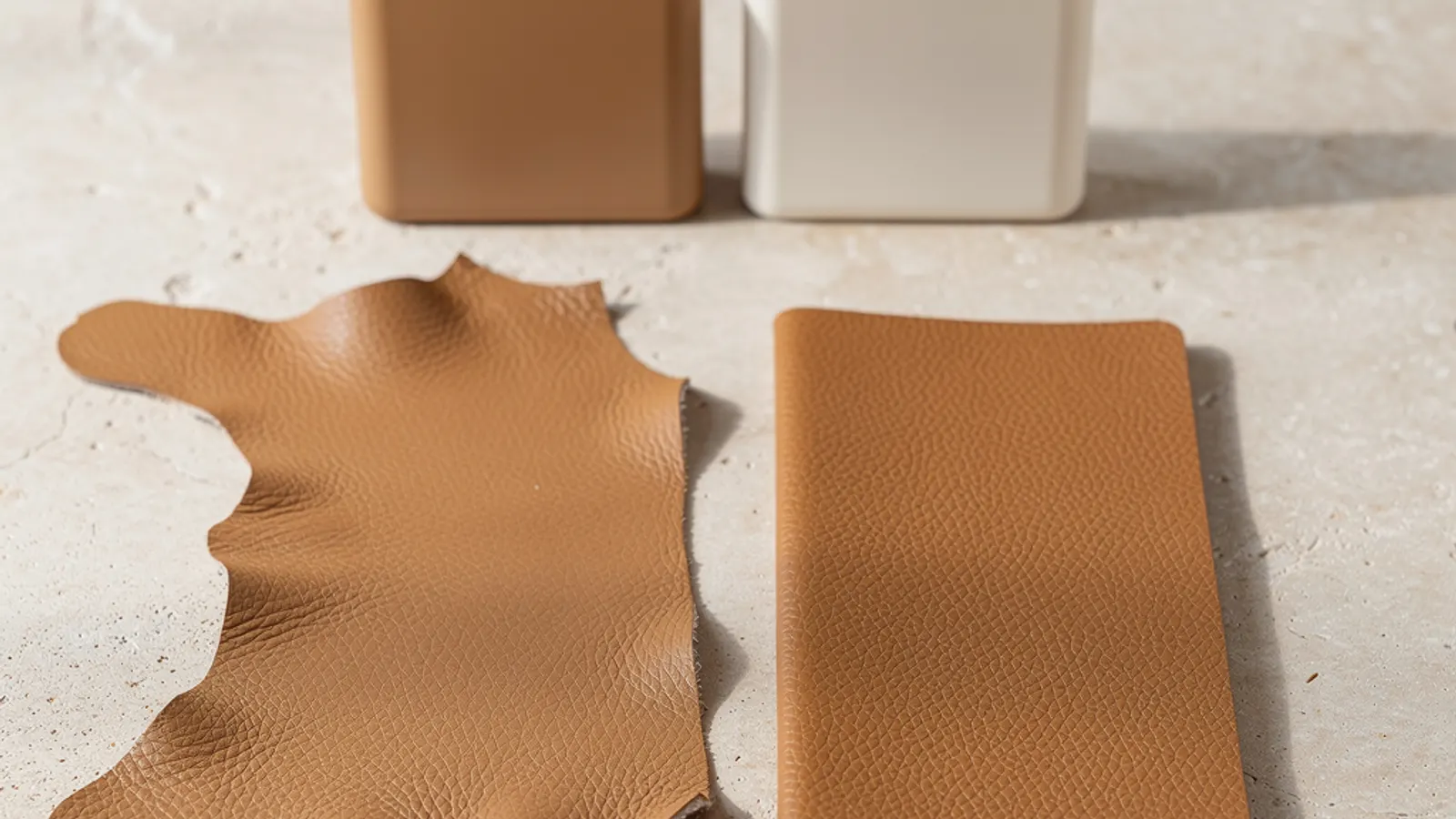
What is veg tan leather? It is animal-hide leather tanned with plant-derived tanning agents, not leather made from vegetables and not a vegan material. For a bag or accessory buyer, that distinction changes the brief: decide whether you need the original hide construction, a particular tan appearance, or a verified non-animal alternative. Those are different requirements. A replacement should be approved for its composition, finished appearance and manufacturing behavior rather than selected because its name sounds similar.
What Is Veg Tan Leather Describing?
The abbreviation describes a tanning route. The Leather Working Group explains that vegetable tanning uses extracts from plant sources, including wood and nuts. Its definition of vegetable-tanned leather still begins with hide or skin. The plant contribution is the tanning agent; it does not replace the animal substrate. See the LWG explanation of tanning terminology.
Keep three questions separate when reading a specification. What is the base material? How was it processed? What finish has been applied? “Vegetable-tanned bovine leather” addresses the first two more clearly than “natural leather,” but it still does not fully describe the color, surface coating, thickness or finished hand.
If your design needs a non-animal alternative, start a separate material-selection route. Our synthetic leather options for bags and accessories provide an application-based starting point. They are not vegetable-tanned hides, and an appearance match should not be presented as material equivalence.
Veg Tan, Vegan and Plant-Based Are Different Claims
A useful purchasing rule is to assign each label a specific job. A tanning description identifies processing. A non-animal requirement identifies an origin restriction. A plant-content claim describes an ingredient or proportion that still needs explanation. Mixing those jobs produces unclear quotations and misleading product descriptions.
| Term in the brief | What it tells you | What still needs confirmation |
|---|---|---|
| Vegetable-tanned leather | An animal-hide material with a specified tanning route | Species, finish, thickness and relevant performance |
| Vegan leather alternative | A non-animal material claim | Actual construction and the scope of supporting declarations |
| Plant-based alternative | A claim about plant-derived content | Which layer, how much content and what other ingredients remain |
| Tan or natural-look finish | An appearance target | Base material, process and whether appearance changes are acceptable |
For example, a buyer may request a tan cardholder that contains no animal-derived materials. Sending an attractive vegetable-tanned hide sample does not answer that request. Conversely, sending a tan coated textile does not answer a brief that specifically requires animal hide suitable for an established leather-working process. Resolve the requirement before comparing prices.
The Surface Does Not Tell the Whole Material Story
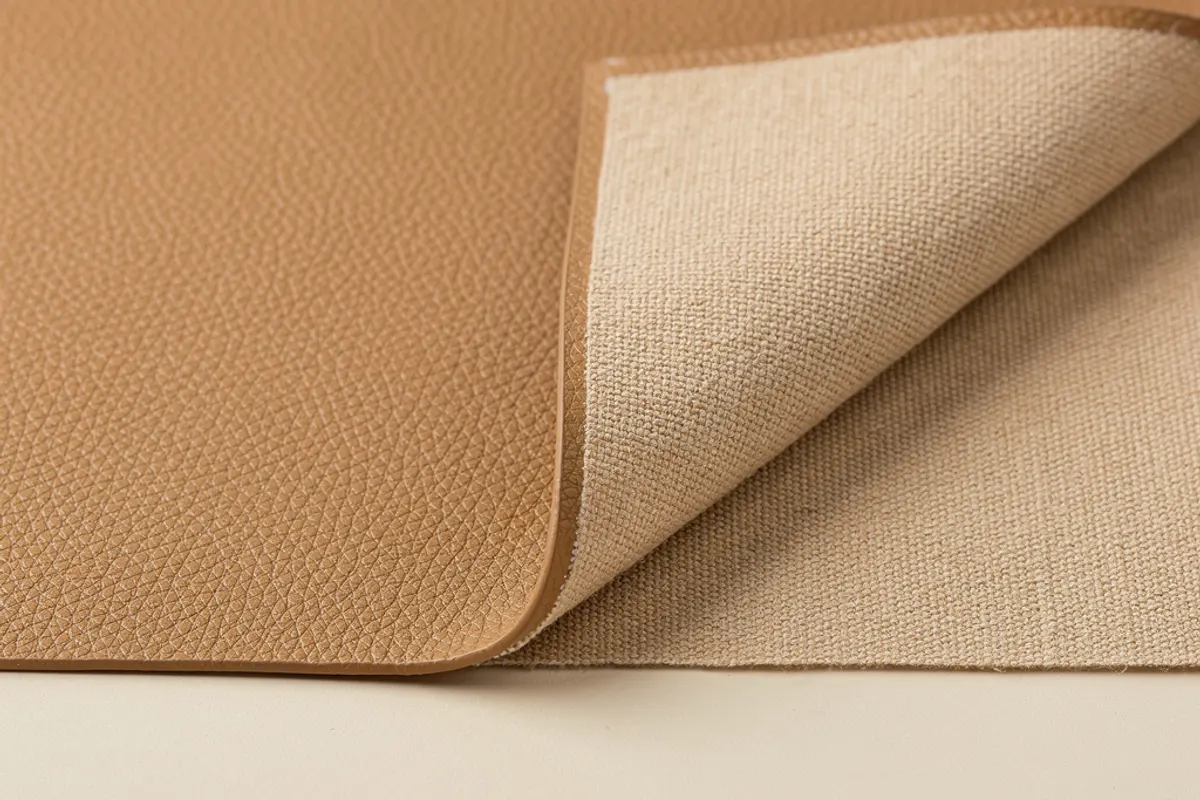
Color and grain are useful approval features, but they are not composition evidence. A tan surface can be a design choice. Ask for a written construction description linked to the sample code, and inspect both faces and a cut edge. Treat that inspection as a screening step, not proof of tanning chemistry.
Where the base material is disputed, ISO 17131:2020 covers identification of leather by microscopy. It is not a blanket certificate for every other claim attached to the sample. Ask a qualified laboratory what additional work is appropriate if the unresolved question concerns the tanning route or a particular ingredient.
Finishing is another separate variable. LWG’s overview of leather finishing describes polymer binders used to create protective films and surface treatments that alter appearance and handle. Therefore, the presence of a coating does not by itself establish that the base is synthetic, and a vegetable-tanned description does not mean that the surface is untreated.
Request the face finish and backing information together. For a coated textile candidate, identify the coating family, textile backing and any additional laminated layers. For a hide candidate, identify the hide and finishing system as far as the supplier can substantiate. Do not replace missing information with a smell test or a photograph.
Turn the Reference Sample Into Separate Requirements
The following is a practical development workflow, not a universal test standard. Its purpose is to separate the features a designer wants to retain from those that may change during a material substitution.
Decide what the reference is actually demonstrating
Mark whether the reference is approved for color, grain, firmness, edge appearance or finished shape. A single “match this” instruction leaves the supplier guessing. It can also cause the purchasing team to reject a useful alternative for the wrong reason, such as an intentional difference in backing appearance that will never be visible in the finished item.
Use a protected master sample and record its condition when approved. If the design is intended to change visibly with handling, agree what acceptable change looks like rather than promising a particular patina. Include unacceptable examples such as patchy staining, unwanted color transfer or a visibly different replacement panel. A desired aged look and an uncontrolled defect are not the same approval category.
Separate flat-swatch approval from accessory approval
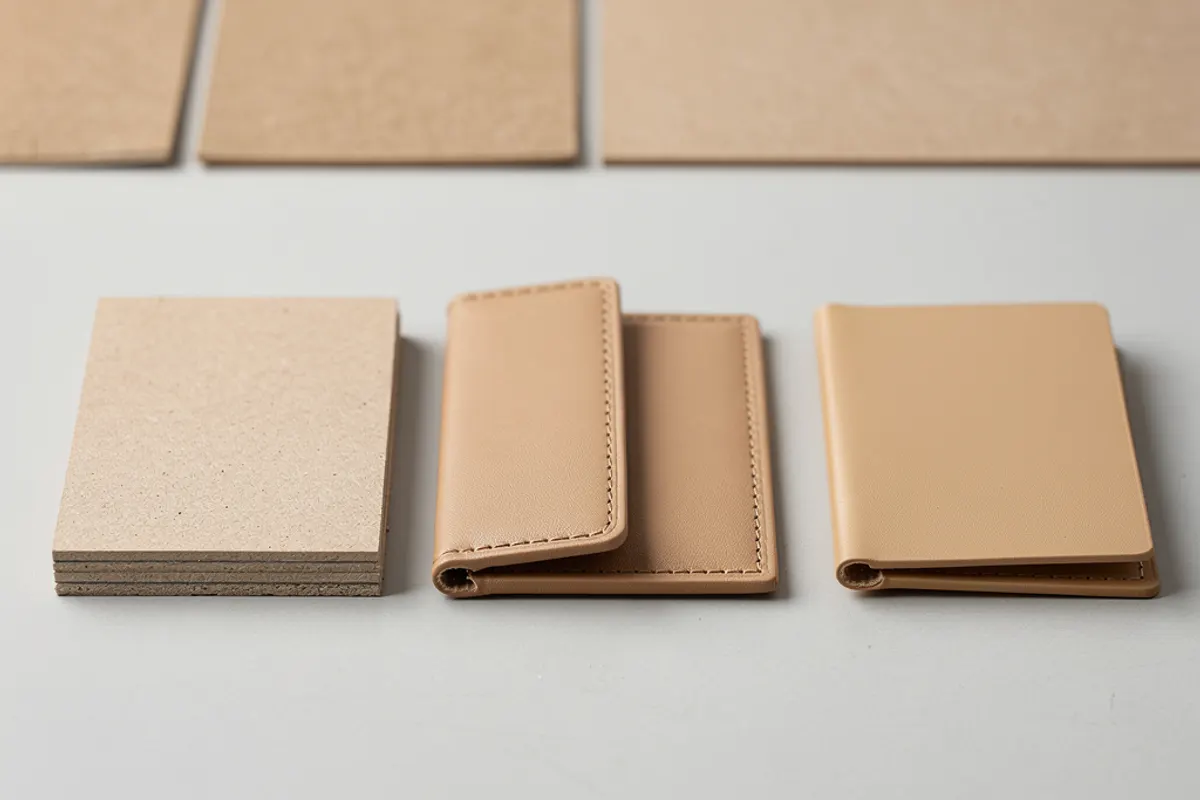
A swatch shows only one stage of the design. Request a representative corner, folded opening and stitched junction before approving the full construction. Evaluate the actual stack of outer material, lining, reinforcement and adhesive. Record where the sample was reduced in thickness or supported, so the approved feel can be reproduced.
For a cardholder, insert the intended cards before judging pocket access and overall bulk. For a small flap, assess closure alignment after repeated handling. These are proposed prototype checks; establish the number of repetitions and acceptance criteria for your project rather than treating informal handling as a certified durability test.
Do Not Carry the Old Edge Process Into a New Material Unchecked
If the original design uses an exposed edge, make that a deliberate substitution gate. Ask the development team to demonstrate the proposed edge construction on the replacement material. Compare the visible cut section, corner finish and behavior after folding. Do not assume that an edge treatment approved for hide will produce the same result on a coated textile.
Consider a turned, bound or painted edge when those constructions fit the design. The appropriate option depends on the actual material and assembly, not simply on whether the face is called PU or vegan. The purpose of the trial is to find a repeatable result, not to hide an unapproved material change.
Likewise, approve any debossed detail on the intended production material. Specify the visual result and let the manufacturer establish suitable settings through trials. Check clarity, surrounding gloss and any surface damage after handling. Do not transfer a heat or pressure setting from the old material without validation.
Choose Evidence That Answers the Actual Question
Material identity, surface appearance and finished-product behavior require different evidence. A composition declaration cannot demonstrate resistance to color transfer. A rubbing report cannot confirm that a product contains no animal-derived ingredients. Ask what each document establishes before adding it to the approval file.
| Approval question | Useful evidence | Boundary |
|---|---|---|
| Is this hide or a non-hide construction? | Traceable material declaration; suitable identification work if disputed | Appearance alone is insufficient |
| Will the leather surface transfer color during rubbing? | A relevant color-fastness report for the selected finish | Not proof of waterproofing or non-animal origin |
| Will water leave a visible spot on the leather? | A water-spotting evaluation | Not a complete bag water-ingress test |
| Will the substitute assemble as intended? | Approved component and finished-item trials | A flat sample cannot settle all construction questions |
ISO 11640:2018 addresses leather surface behavior under rubbing with wool felt. ISO 15700:1998 addresses color fastness to water spotting. These are examples for leather, not automatic methods or pass limits for every synthetic replacement. Confirm the appropriate method, specimen condition and acceptance level with the testing laboratory.
For every report, match the sample identity to the proposed material, including finish and color where relevant. If the material or finishing changes, decide whether the evidence still applies. Keep the report’s result separate from any broader sales claim.
Write a Brief That Both Purchasing and Design Can Use
A clear brief might read: “Develop a non-animal alternative for this tan accessory panel. Match the approved appearance target, disclose the complete supplied construction, and demonstrate the proposed edge and decoration processes on an assembled sample. Confirm the required surface-performance tests separately.” This is suggested procurement wording, not a certification statement.
Add the component drawing, target thickness range, lining and reinforcement details, intended market, expected order quantity and any required documentation. State whether the supplied material alone or the complete finished accessory must satisfy the non-animal requirement. If the latter applies, the finished-goods team must also review components outside the material supplier’s scope.
For candidate selection, review PU leather for bag constructions or the microfiber synthetic leather material guide. These are alternative material routes to evaluate, not guarantees that either reproduces vegetable-tanned leather or meets every non-animal claim without verification.
Frequently Asked Questions
Is veg tan leather vegan?
No. Veg tan means vegetable-tanned animal-hide leather. The vegetable part describes the tanning agents, not a replacement for the hide.
Is vegetable-tanned leather the same as plant-based leather?
No. Vegetable-tanned leather remains an animal-hide material. A plant-based alternative is a separate construction whose plant-derived content and other components need to be specified.
Does vegetable-tanned leather mean an untreated surface?
No. The tanning description does not fully describe the finish. Ask separately about coloring, coatings and other surface treatments on the selected material.
Is veg tan leather waterproof?
The name alone does not establish waterproof performance. Define whether you need resistance to visible water spotting, material penetration or water entering the finished accessory, then request evidence for that requirement.
Can synthetic leather replace veg tan in a cardholder?
It may be a candidate, but it is not an automatic drop-in replacement. Validate the assembled thickness, pocket access, folds, edges, decoration and required surface performance on the proposed construction.
Does vegetable tanning prove a product is environmentally preferable?
No. A tanning label alone is not a complete environmental comparison. Any comparative claim needs evidence with a defined product, lifecycle scope and basis of comparison.
Choose the Requirement Before Choosing the Label
Vegetable tanning, non-animal origin and a tan aesthetic are three different starting points. Decide which one is essential, then approve the actual construction against a written brief. If you are developing a synthetic alternative, send your accessory reference and material requirements to discuss candidate samples and the checks needed before approval.