What Are PVC Leather Textures and Surface Finishes for Furniture?
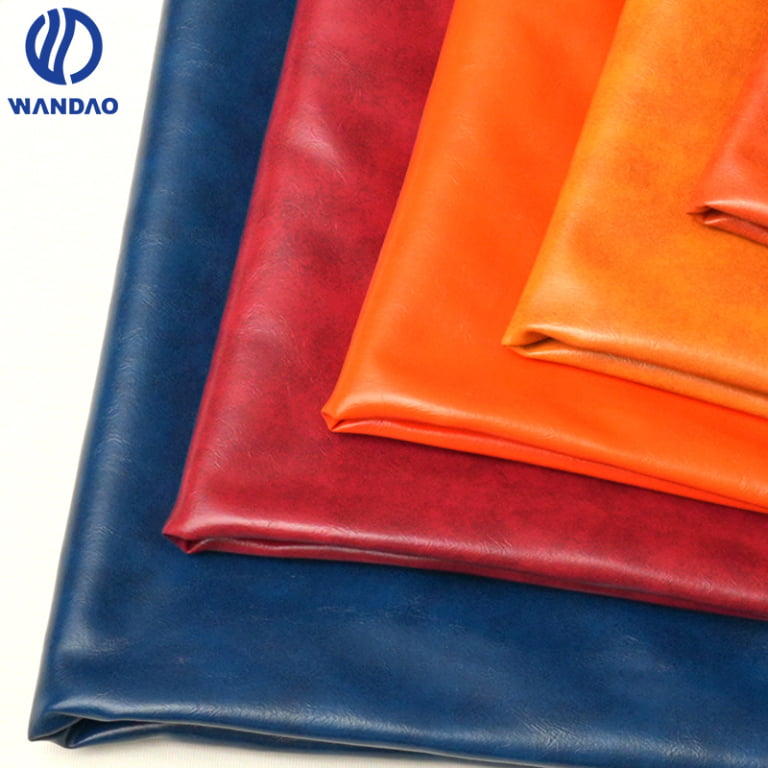
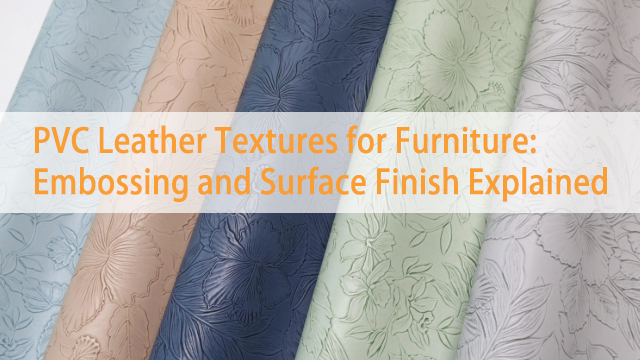
PVC leather texture refers to the physical or visual relief on the PVC face, while surface finish refers to the coating or surface treatment that changes its optical and tactile response.
A typical coated upholstery construction combines a PVC face, optional foam, a backing, and a protective finish. Texture may come from embossing, release-paper transfer, vacuum forming, printing, or a combination; the topcoat changes how the relief looks and feels.
These texture names are commercial design descriptions, not ASTM or ISO construction classes. Approve a physical grain reference rather than writing only “leather texture” on the purchase order.
| Texture or finish | Visual and tactile direction | Furniture fit | Procurement caution |
|---|---|---|---|
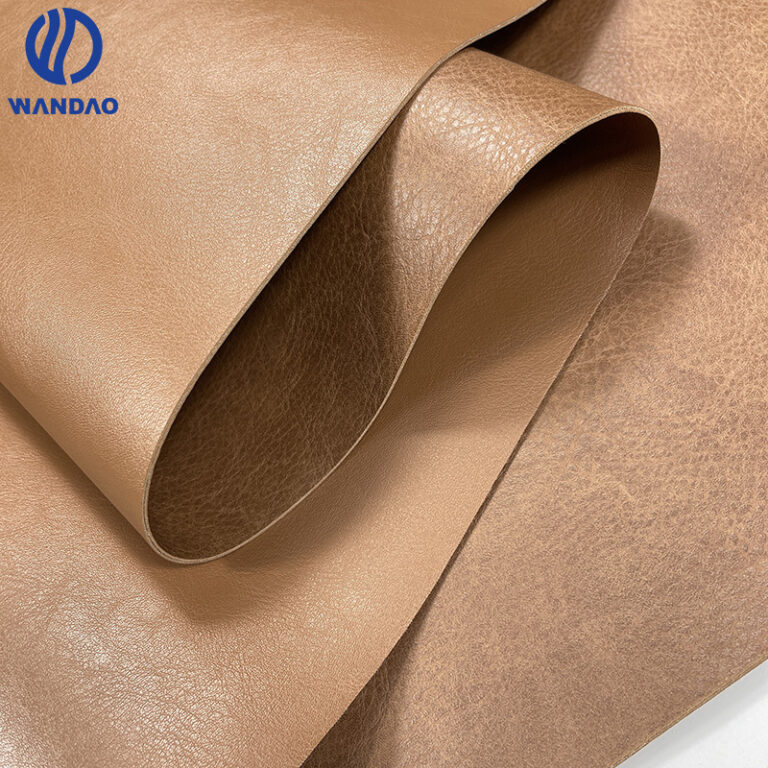
| Fine leather or cowhide grain | Quiet, natural-looking relief with broad collection flexibility | Sofas, dining chairs, office chairs, hotel seating, and headboards | Specify the actual emboss, repeat, gloss, and colour reference; the name alone is not controlled. |
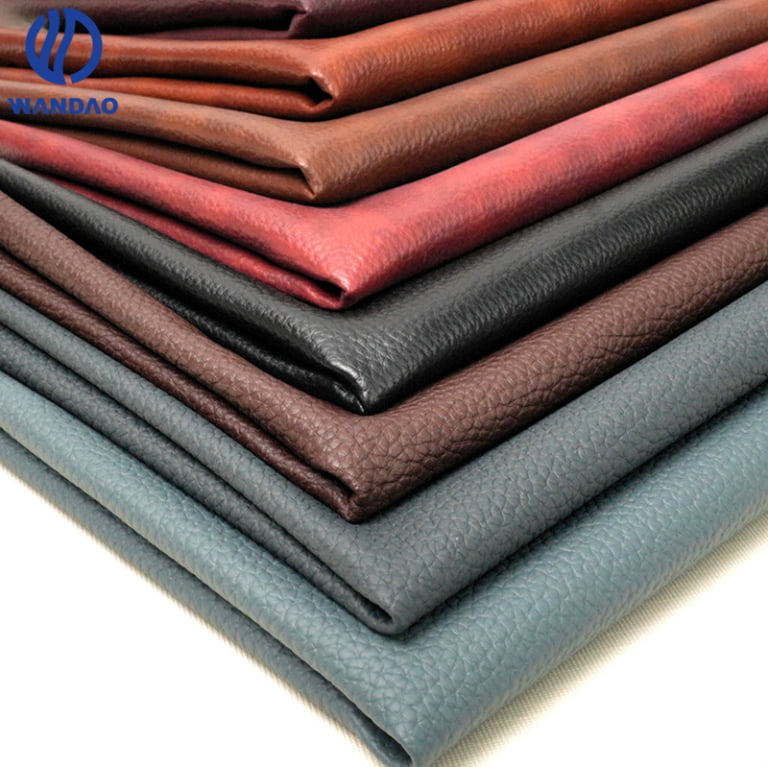
| Litchi or pebble grain | Visible rounded cells and a stronger leather-like surface character | Dining, casual sofas, office seating, restaurant furniture, and hotel public areas | Deep valleys can hold soil or residue; confirm cleaning access and chemical compatibility. |
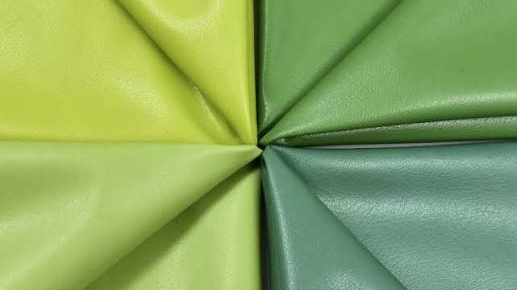
| Nappa-style or fine grain | Shallow, fine relief with a soft and visually calm appearance | Contemporary sofas, lounge seating, upholstered beds, and premium-style headboards | Fine relief may show scratches or colour variation more clearly; qualify the topcoat. |
| Fine wrinkle or micro-wrinkle | Subtle creasing that gives depth without a busy pebble pattern | Modern sofas, hotel furniture, and upholstered wall or bed panels | Pair the depth with the intended gloss; excessive relief and gloss can look uneven. |
| Fabric-look or linen-look | Printed or embossed textile appearance while retaining a coated surface | Hospitality, workplace lounge, dining, and selected healthcare furniture | Clarify whether the effect is printed, embossed, or both; test print retention separately. |
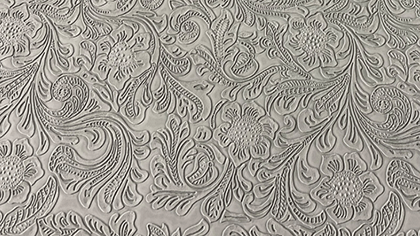
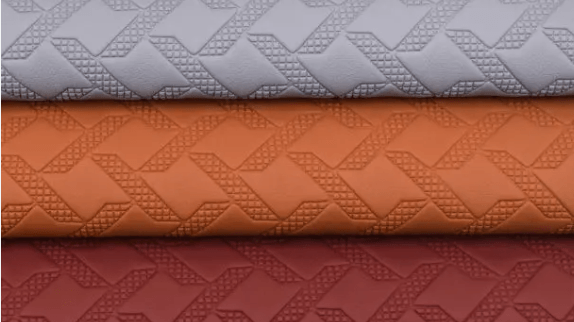
| Geometric or custom texture | Ribs, grids, diamonds, channels, logos, or project-specific patterns | Headboards, feature chairs, banquettes, reception furniture, and branded environments | Confirm repeat size, alignment, tool or artwork cost, colour control, and repair expectations. |
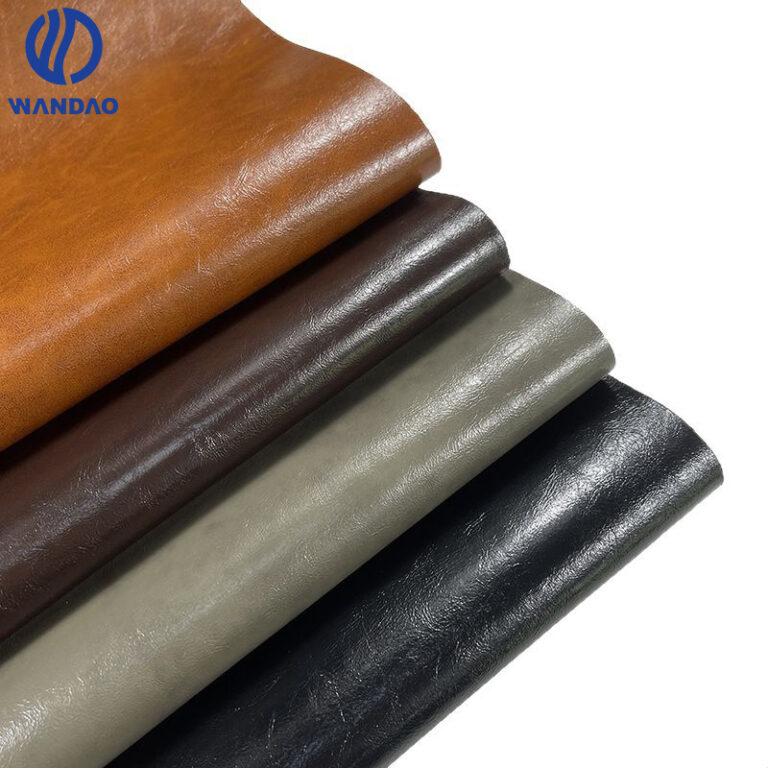
Gloss is a separate decision from grain. Matte and semi-matte reduce glare; high-gloss reflects more but can reveal fingerprints, scuffs, and gloss loss. ISO 2813 defines 20°, 60°, and 85° geometries; record angle and location. [ISO 2813]
Action recommendation: Approve texture geometry, gloss, hand feel, and cleaning performance on the finished PVC laminate, not from a name or digital image.
How Are PVC Leather Textures Created?
PVC leather texture creation refers to forming, printing, embossing, cooling, and finishing the PVC structure so that the intended surface relief and appearance remain consistent after production.
| Route | How the pattern is formed | Useful when | Important control points |
|---|---|---|---|
| Steel-roll embossing | Softened PVC passes through an engraved steel roll and counter-roll nip | Repeat production, standard leather grain, fabric-look emboss, and medium-to-large programs | Web temperature, roll temperature, line load, speed, backing stability, cooling, and roll engraving. |
| Release-paper transfer | PVC skin is formed against a textured release paper or film and peeled from the carrier | Fine, controlled grain and carefully managed matte, satin, or gloss effects | Carrier surface, release behavior, gelation, peel, reuse, colour/effect transfer, and face uniformity. |
| Vacuum embossing | Suction pulls softened foam PVC into a porous engraved wheel or mould | Deep or three-dimensional patterns on high-foam constructions where mechanical crushing is a concern | Heating, vacuum, wheel speed, foam state, cooling, and retained relief after winding. |
| Printed texture or effect | Ink or coating creates visual pattern; embossing can add physical relief | Custom graphics, two-tone effects, limited collections, and rapid visual development | Ink adhesion, registration, flex, abrasion, cleaner resistance, topcoat coverage, and colour consistency. |
Texture creation is a process-system result. A WIPO patent describes PVC-sol gelation at 200–250 °C before foam formation. [WIPO PVC transfer-coating patent] A peer-reviewed study tested a 0.3 mm PVC layer at 190–215 °C for 40–90 seconds; its selected condition was 210 °C for 60 seconds, with 3.63 mm optimized foam thickness. [Peer-reviewed PVC foaming study] These are experiments, not universal furniture settings.
For steel-roll embossing, a patent gives 150–230 °C roll temperature, 170–210 °C preferred, 100–500 N/cm pressure, and 5–200 m/min speed, with 10–50 m/min preferred. [PVC steel-roll embossing patent] The data support co-controlling heat, pressure, speed, and cooling.
Texture depth needs careful wording. No universal furniture-PVC grain-depth specification was identified. A patent for another PVC floor-covering construction describes about 0.15 mm conventional relief and up to 0.4 mm deeper relief. [PVC flooring embossing patent] These figures show possible scales, not furniture requirements.
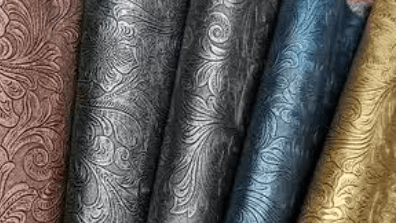
Printing can precede embossing, but the print must remain bonded and flexible while the surface deforms. A PVC-leather patent describes water-based paint printing followed by embossing. [PVC leather printing and embossing patent] Request print-retention and cleaner-resistance evidence alongside abrasion and flex data.
Action recommendation: Ask the supplier for texture route, direction, repeat, conditioned relief, and topcoat sequence. Approve after cooling and conditioning, not from a hot-line sample.
How Do Thin Films and Topcoats Change Gloss, Hand Feel, and Cleanability?
A PVC surface film or topcoat refers to a thin protective or functional layer applied over the PVC face to modify touch, gloss, stain response, scratch visibility, and resistance to selected cleaning chemicals.
A thin film can be designed for flexibility and surface protection, but its result depends on polymer, crosslinking, adhesion to plasticized PVC, coat weight, curing, and the underlying grain. A softer film may preserve supple hand but be more vulnerable to blocking or mar; a harder film may improve scratch or cleaner resistance while feeling less soft. Approve the balance on the exact construction.
Matte, satin, and high-gloss effects come from leveling, matting agents, pigments, waxes, silicone modification, or a transfer carrier. Gloss is optical; waterproofness and cleanability are performance properties. A continuous low-surface-energy film may reduce wetting or soil anchoring, but seams, edges, wicking, defects, and chemical exposure can still control the furniture result.
| Finish direction | Potential benefit | Potential trade-off | Test or control to request |
|---|---|---|---|
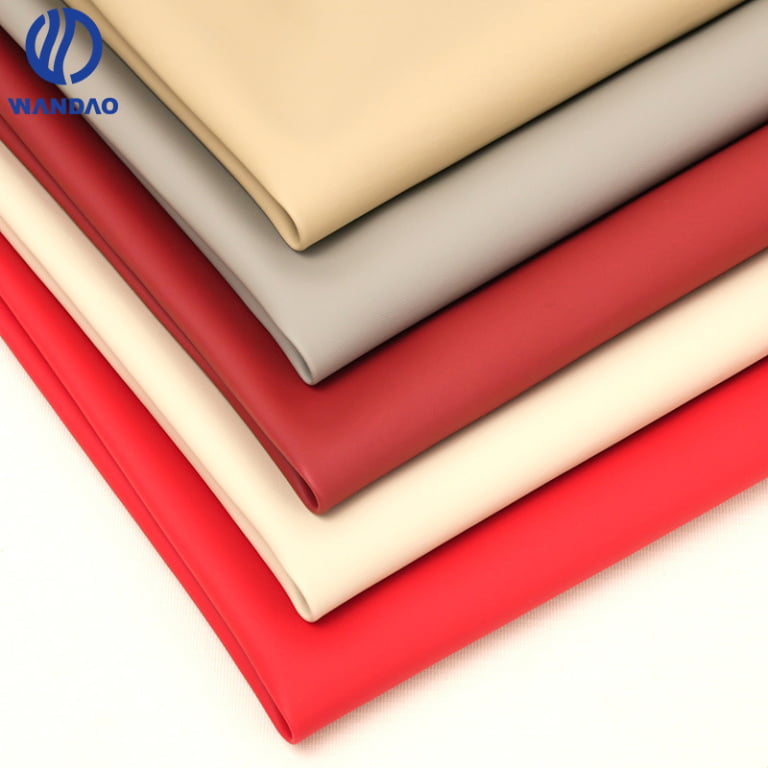
| Matte | Lower glare and a quieter, less plastic-looking appearance | Roughness or poorly bound matting can increase drag, soil retention, whitening, or gloss variation | Gloss geometry, stain/cleaner response, abrasion, crocking, flex, and colour change. |
| Semi-matte or satin | Balances colour depth, subdued reflection, and broad furniture compatibility | “Satin” is not a standardized performance class; results depend on the finish chemistry | Defined gloss target, visual master, cleaner panel, and lot-to-lot appearance check. |
| High-gloss | Strong reflection, crisp colour, and sharper visual effects | Fingerprints, scratches, surface deformation, and gloss loss may be more conspicuous | Gloss at a fixed angle, scratch/mar, stain recovery, alcohol/cleaner, and colour-change testing. |
| Soft-touch or waxy | Lower plastic feel and a dry, silky, or lubricious hand | Excessively soft or low-surface-energy layers can block, pick up soil, or impair recoat/adhesion | Hand master, coefficient-of-friction method if relevant, blocking, abrasion, cleaner, and aged adhesion. |
| Printed or two-tone effect | More visual depth, custom colour, and differentiated furniture appearance | Print registration, ink adhesion, metamerism, and topcoat coverage add variation risks | Print-retention, flex, abrasion, cleaner, lightfastness, and colour measurement. |
A peer-reviewed study reported 60° gloss of 0.8 for one self-matting WPU formulation, roughness rising from 0.109 to 0.567 μm with crosslinker change, ISO 2409 adhesion grade 0, and survival of 300 abrasion cycles under 1 kg in ASTM D4060. [PVC surface-treatment study] These results are formulation-specific and show why matte or soft-touch claims need measured gloss, adhesion, abrasion, and chemical evidence.
For a specialized soft-touch coating, a patent gives 0.01–0.80 coefficient of friction and 0.1–20 gloss units at 60°. [Soft-touch coating patent] This disclosed range is not a PVC furniture standard; state the method, counterface, load, and gloss geometry.
For gloss control, [ISO 2813] defines 20°, 60°, and 85° measurement geometries. For chemical and stain evaluation, [ASTM D1308] can be used to assess effects such as discoloration, gloss change, softening, swelling, and adhesion loss after household-chemical exposure. The actual cleaner, concentration, dwell time, number of cycles, and visual acceptance criterion must be stated.
Do not describe a glossy PVC surface as automatically waterproof. If the project requires surface liquid resistance, hydrostatic resistance, seam leakage resistance, or disinfectant cleanability, name that property and its method separately. “Water-resistant,” “easy-clean,” “alcohol-cleanable,” and “waterproof” are not interchangeable claims.
Action recommendation: Require a finished-surface test panel containing the selected grain and topcoat. Measure gloss, colour, stain recovery, cleaner response, scratch or mar, flex, blocking, and adhesion before approving a production finish.
How Should Buyers Choose PVC Leather Texture for Each Furniture Application?
Application-based texture selection refers to matching grain relief and surface finish to furniture geometry, soil exposure, lighting, cleaning frequency, and the required compliance package.
A buyer should not use one texture for every furniture category simply because it is easy to source. Fine or shallow grains are often easier to wipe and visually integrate across a collection. More pronounced litchi or pebble textures can add visual character and may make small everyday marks less obvious, but deeper valleys can increase soil-retention and cleaning requirements. High-gloss, pearlescent, metallic, and strong geometric effects are usually better treated as controlled design accents unless the project specifically requires them.
| Furniture use | Texture and finish starting point | Construction priorities | Approval focus |
|---|---|---|---|
| Residential sofas | Fine leather, subtle litchi, fine wrinkle, Nappa-style; matte, satin, waxy, or soft-touch | Hand feel, foam conformity, seam appearance, and visual consistency across large panels | Physical master, flex, crocking, stain response, household-cleaner compatibility, and post-relaxation appearance. |
| Dining chairs and restaurant seating | Fine grain, light pebble, or low-relief fabric-look; matte or semi-matte | Wipeability, food and oil exposure, staple/seam behavior, and repeatable cutting | ASTM D1308 or agreed stain panel, cleaner protocol, abrasion, seam, and colour consistency. |
| Office chairs | Fine-to-medium grain; matte or satin; low-tack hand | Repeated ingress/egress, seat-edge flex, hardware scuffing, and stable upholstery geometry | ACT/ASTM abrasion, flex, adhesion, tack tear, cleaner compatibility, and a sewn mock-up. |
| Hotel guest rooms and headboards | Fine grain, micro-wrinkle, fabric-look, or subdued litchi; matte or semi-matte | Appearance under room lighting, housekeeping, luggage contact, and project fire requirements | Colour/light stability, stain and cleaner response, pattern alignment, and jurisdiction-specific fire evidence. |
| Healthcare and elderly-care seating | Smooth-to-shallow grain; matte or satin; non-tacky hand | Repeated disinfection, cleanable seams, adhesion after chemical exposure, and low soil retention | Facility’s exact disinfectants, concentration, dwell time, wipe cycles, colour/gloss change, cracking, peeling, and assembly fire requirements. |
| Outdoor or marine furniture | Low-relief, non-glossy grain; avoid selecting by indoor appearance alone | UV, heat, humidity, mildew, cold flex, drainage, seams, and backing weatherability | Outdoor light, fungal, flex, cold-crack, cleaner, and water-management evidence; indoor benchmarks do not automatically qualify outdoor use. |
| Branded or feature furniture | Custom print, geometric emboss, metallic, pearlescent, or wood-look effect | Pattern repeat, artwork, colour matching, alignment, tooling, and repairability | Large mock-up, print/emboss retention, gloss and colour under project lighting, and confirmed development cost. |
For indoor coated upholstery, ACT identifies 30,000 double rubs as potentially appropriate for single-shift offices, hotel rooms, conference rooms, and dining; its high-traffic guideline identifies 50,000 Wyzenbeek double rubs with the specified abradant. [ACT coated-fabric abrasion guideline] These are selection benchmarks, not years of service.
Texture can affect price when custom embossing, tooling, artwork, colour matching, special topcoats, or extra testing are required. The research provides no universal price table or verified premium for litchi, Nappa, high-gloss, or custom textures. Request a project quotation separating material, tooling/artwork, sampling, minimum quantity, testing, and repeat-order conditions.
For a purchase order, use the current PVC upholstery framework where relevant. [ISO 7617-1] covers PVC-coated knitted fabrics and agreed colour, embossing, finish, thickness, adhesion, tensile/tear, abrasion, flex, ageing, rubbing, and blocking methods. [ISO 7617-2] addresses PVC-coated woven upholstery fabrics.
Action recommendation: Divide the product line by use zone. Use a tested low-relief core texture for high-cleaning or high-traffic areas, and reserve deeper, printed, metallic, pearlescent, or custom patterns for projects that can justify the extra approval and maintenance controls.
Which Texture Misconceptions and Future Trends Should Procurement Teams Watch?
Texture misconceptions refer to shortcuts that treat appearance, thickness, resin family, or a single laboratory result as proof of all-round furniture performance.
| Common claim | What the evidence supports | Better procurement rule |
|---|---|---|
| “Deeper texture means better abrasion resistance.” | Unsupported. Abrasion, flex, adhesion, tear, tensile, seam, disinfectant, and light resistance are separate properties in coated-fabric guidance. | Request the exact abrasion method, abradant, load, endpoint, grain, topcoat, and colour; do not substitute grain depth for testing. |
| “More thickness always means more durability.” | False as a general rule. A multilayer PVC construction can fail at the topcoat, backing, seam, interface, or flex point before the face is worn through. | Specify total thickness for fit and hand, then test adhesion, tear, seam, flex, abrasion, chemical resistance, and cold crack separately. |
| “High-gloss is easier to clean than matte.” | Not universal. Gloss is optical; cleanability depends on surface chemistry, grain valleys, soil, cleaner, dwell time, rubbing, and cure. | Use ASTM D1308 or an agreed stain/cleaner panel on the exact finish and colour. |
| “All PVC leather is waterproof and flame-retardant.” | False. Surface liquid resistance, seam resistance, and fire compliance depend on the construction and applicable regulation. | Name the water or fire test and verify the finished furniture assembly where required. |
| “PU is automatically more sustainable than PVC.” | False as a life-cycle shortcut. Impact depends on coating mass, backing, additives, energy, maintenance, service scenario, and end-of-life. | Request comparable product-level LCA or PCF evidence with the same functional unit and system boundary. |
| “Recycled PVC always performs worse.” | Not necessarily, but performance depends on feedstock, additive history, particle morphology, dispersion, plasticizer, and recycled fraction. | Use controlled feedstock, restricted-substance screening, rheology checks, and exact-construction testing. |
Regulatory and customer requirements are moving toward more documented chemistry. ECHA’s PVC investigation considered 63 additive substances, including plasticizers, heat stabilizers, and flame retardants, and identified possible need for action on certain ortho-phthalates, organotin stabilizers, flame retardants, and PVC microparticle releases. [ECHA PVC investigation] For covered articles, REACH Annex XVII Entry 51 restricts DEHP, BBP, DBP, and DIBP above 0.1% by weight of plasticized material. [European Commission REACH restriction information]
Recycled-content development is possible, but not just a percentage claim. A peer-reviewed PVC-coated-textile study reported approximately 90% PVC-powder recovery after sieving and used 20% recycled PVC in an optimum expanded-layer formulation for that study; higher additions strongly reduced mechanical properties. [Peer-reviewed PVC recycling study] This concerns flooring, not a universal furniture limit. Separate recycled content, chemical safety, performance, and end-of-life claims.
Bio-attributed or lower-carbon PVC may enter projects through mass-balance certificates and product carbon-footprint documents. Evaluate these at finished-leather level, not directly from a resin claim. Ask for declared unit, system boundary, allocation, energy accounting, plasticizer/topcoat, backing, scrap, and freight. The EU Ecodesign for Sustainable Products Regulation creates a future framework for ecodesign and Digital Product Passports; product obligations depend on later delegated acts. [EU Ecodesign for Sustainable Products Regulation]
Digital printing and AI-assisted texture design may shorten early iteration, but physical qualification remains essential. Printed patterns need ink adhesion, flex, abrasion, cleaner, lightfastness, topcoat, and colour-control testing. AI patterns still need human repeat engineering, emboss feasibility, IP review, and a physical sample. No reliable 2023–2026 adoption percentage was identified, so none is reported as fact.
For indoor-air requirements, specify finished-product evidence. [UL GREENGUARD] states that GREENGUARD Gold limits emissions of more than 360 VOCs and total chemical emissions and incorporates the CDPH chamber method. A water-based topcoat may reduce solvent use at one process step, but it does not by itself prove that the PVC, ink, adhesive, backing, foam, and completed chair or sofa are low-emitting.
Action recommendation: Make the next-generation texture specification evidence-based: identify the formulation and layers, test the exact printed or embossed finish, document restricted substances and emissions where required, and define recycled-content or take-back claims with a traceable scope.
Frequently Asked Questions
A: Commonly offered directions include fine leather or cowhide grain, litchi or pebble grain, Nappa-style fine grain, fine wrinkle, fabric-look texture, and custom geometric or printed effects. These are commercial appearance descriptions, so buyers should approve a physical texture and gloss reference.
Yes. Printing can create two-tone, antique, woodgrain, custom-colour, or other visual effects. Printing alone may not create tactile relief; embossing or another forming route is needed when the project requires physical grain. Request print adhesion, flex, abrasion, cleaner, and topcoat evidence.
No. A continuous surface film may reduce wetting, but waterproofness depends on the face, seams, needle holes, edges, backing, lamination, and the defined test method. Specify surface liquid resistance, hydrostatic resistance, seam leakage, or another precise requirement instead of relying on “glossy.”
They can be suitable when their relief, topcoat, backing, cleaning protocol, and performance evidence match the application. Use low-relief or easier-access textures for high-cleaning environments, and validate deeper grains on the actual furniture mock-up.
It can affect the quotation when it requires custom tooling, artwork, extra sampling, special finishing, or a production run large enough to amortize development work. There is no universal price premium, so request a quotation that separates material, tooling, sampling, testing, and minimum-quantity costs.
Request the applicable abrasion, flex, coating adhesion, tensile, tear, seam, stain/cleaner, colourfastness, gloss, blocking, and chemical-resistance evidence. For printed, healthcare, outdoor, or regulated projects, add print retention, disinfectant, weathering, cold-flex, restricted-substance, emissions, or fire documentation as applicable.