What Is Backing in Vinyl Upholstery Fabric?
Backing in vinyl upholstery fabric refers to the textile or multilayer substrate attached to the PVC face and topcoat to form the finished coated upholstery material.
A typical coated upholstery construction includes a textile backing, a PVC coating or film that may be solid or expanded, and a protective surface finish. The backing is not only a support layer. It contributes to stretch, drape, tear behavior, needle response, seam holding, dimensional stability, and the way the material interacts with foam. [ASTM D3690] covers indoor vinyl- and urethane-coated upholstery fabrics made with woven, knit, and nonwoven substrates, which confirms that the substrate category is part of the coated-fabric specification.
| Backing structure | Construction characteristic | Common furniture use direction | Main procurement risk |
|---|---|---|---|
| Knitted | Interlocking yarn loops; may be jersey, terry-loop, filament, lockstitch, or double knit | Contoured cushions, lounge seating, healthcare seating, rounded arms, and shaped components | Stretch, recovery, feed mismatch, seam distortion, or local overstretch |
| Woven | Warp and weft yarns interlaced in a more restrained structure | Taut panels, box cushions, contract seating, dining chairs, and controlled tailored upholstery | Limited conformability, needle-cut yarns, or stress at tight corners |
| Nonwoven | Fiber web that may be needle-punched, bonded, or laminated | Selected utility panels, bonded constructions, and applications where loft or lamination is useful | Variable tear, compression, sagging, fiber pullout, and seam behavior |
| Composite or multilayer | Two or more layers, such as knit plus scrim, textile plus foam, or textile plus reinforcement | Engineered healthcare, transport, marine, barrier, or foam-laminated constructions | Interlayer adhesion, thickness control, compatibility, and more complex failure modes |
A declaration such as “100% polyester” is incomplete. It identifies fibre content but not whether the material is knitted, woven, or nonwoven, nor its density, mass, finish, or bonding method. Ask the supplier to identify each layer and report backing-only mass separately from finished composite mass.
[ISO 13934-1] separates maximum force and elongation at maximum force and requires testing in the principal fabric directions for its applicable textile method. For coated fabrics, the buyer should confirm applicability and use a coated-fabric method when required. [ASTM D751] is a more directly relevant coated-fabric reference for properties such as breaking strength, tear, coating adhesion, and seam-related testing.
When I reviewed the supplied technical comparison for this article, I noticed that several product descriptions stated fibre content but did not identify the backing architecture or backing-only basis weight. That document review is a useful purchasing observation: a material cannot be compared properly when “polyester backing” is treated as a complete construction specification.
Action recommendation: Add backing class, fibre content by layer, knit or weave construction, backing GSM, finished mass, total thickness, and bonding method to every RFQ.
How Does Vinyl Upholstery Fabric Backing Affect Hand Feel and Furniture Fit?
Backing affects hand feel and furniture fit by changing the bending rigidity, extension, recovery, drape, and support of the complete PVC laminate.
Hand feel of vinyl upholstery is not a single measurable property. It can include surface drag, warmth or coolness, compressibility, bending stiffness, drape, and recovery after folding. The PVC formulation, plasticizer system, emboss, topcoat, surface foam, adhesive, and backing all contribute. Therefore, “knit equals soft” and “woven equals hard” are useful starting expectations, but not reliable purchasing rules.
A knitted backing often conforms more readily because loop geometry can deform before the yarn itself reaches its full extension. This can help a cover follow rounded arms, waterfall fronts, deep cushions, and compound curves. The same compliance can create problems if the material has excessive permanent set, if the pattern is cut in the wrong direction, or if the sewing process stretches the backing more than the face. The visible result may be seam waviness, bagging, enlarged needle holes, or uneven recovery after installation.
A woven backing normally gives more restrained warp and weft behavior. That can improve pattern accuracy, straight seams, and dimensional control on flat or gently curved panels. It can also make a material feel firmer or more tailored. When a woven construction is forced over a small radius, however, the low extension can transfer more strain to the PVC face, needle holes, corners, or attachment points. Relief cuts, darts, larger radii, or a different pattern layout may be needed.
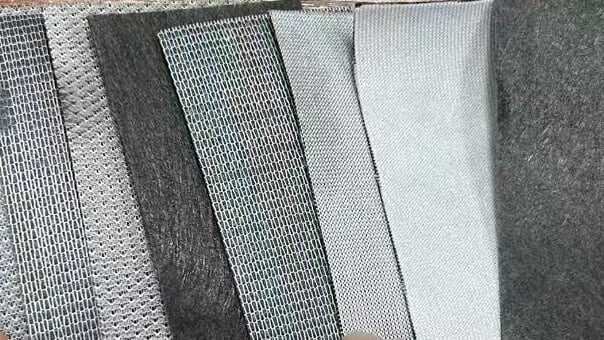
Nonwoven and composite backings should not be ranked by category alone. A needle-punched nonwoven may offer loft or bonding value, while a scrim-reinforced composite may serve a different load path. Identify each layer and test the interfaces.
| Furniture condition | Backing direction to consider first | Why | What to verify |
|---|---|---|---|
| Rounded sofa arms and deep cushions | Controlled-stretch knit | Improves conformability over compound foam shapes | Extension, recovery, seam-hole resistance, and post-installation appearance |
| Dining chair or box cushion | Woven or restrained knit | Supports taut panels and repeatable edges | Dimensional stability, corner fit, tear, and actual sewn seam |
| Office chair with shaped seat pan | Woven for controlled panels; knit for highly contoured designs | The correct choice depends on whether stability or multidirectional compliance dominates | Seat-edge flex, feed behavior, stitch tear, and recovery |
| Healthcare lounge chair | Either, depending on geometry | Cleaning chemistry and sewn-system integrity may matter more than the backing label | Exact disinfectant protocol, adhesion after exposure, seam and corner performance |
| Large unsupported panel | Stable woven or engineered composite | Limits growth, sagging, and pattern distortion | Residual set, dimensional change, and full-size panel trial |
The [ACT coated-fabric guideline] does not establish one universal stretch-and-set minimum because recovery depends strongly on foam density and furniture construction. A backing can pass an extension test and still be a poor match for a cushion if its recovery, orientation, or seam design is wrong.
Action recommendation: Approve the hand feel of vinyl upholstery on the finished laminate over representative foam. Record surface touch, bending stiffness, extension direction, recovery, drape, and appearance after the material has been stretched and released.
How Does Backing Affect Cutting and Sewing?
Backing affects cutting and sewing by controlling how the vinyl lies, feeds, stretches, receives a needle, holds a stitch, and distributes force around the seam.
Knitted vinyl can move or relax during spreading and cutting. The cutting team should mark machine direction and cross direction, and for knitted constructions should also identify wale and course orientation where relevant. Allowing the roll to relax before cutting can reduce the difference between a tensioned roll measurement and a relaxed panel measurement. For complex furniture, pattern direction should be selected deliberately rather than assumed from the roll edge.
Woven vinyl is usually more stable on the cutting table, but the warp and weft directions can behave differently. A needle can cut or displace yarns, especially when the point, size, thread tension, or stitch density is not matched to the construction. Nonwoven vinyl can compress beneath the presser foot and can show fiber pullout or localized tearing, depending on how its web is bonded.
| Issue | Knitted backing | Woven backing | Nonwoven backing |
|---|---|---|---|
| Needle-hole enlargement | Loop deformation and stretch can enlarge holes when needle or tension is excessive. | Usually more restrained, but a needle can sever structural yarns. | Can fuzz, split, or consolidate around the puncture; construction-specific testing is essential. |
| Skipped stitches | Elastic or lofty structures can rise with the needle and affect loop formation. | Usually a stable sewing platform, subject to face drag and stack thickness. | Compressibility and resin bonding can make loop pickup inconsistent. |
| Puckering and uneven feed | High risk when the lower feed stretches the backing while the face drags. | Lower stretch-related puckering risk, but differential feed can still distort panels. | Compression and variable density can create irregular seams. |
| Seam failure | Often appears as stitch-line distortion, tack tear, or seam extension. | May involve yarn displacement, needle cutting, tack tear, or concentrated corner stress. | May involve fiber pullout, seam rupture, or delamination. |
For indoor coated upholstery, the [ACT physical-properties guideline] gives substrate-specific tack-tear minima under ASTM D751: 30 lbf length by 25 lbf width for knit substrates, 25 lbf by 25 lbf for woven substrates, and 35 lbf by 35 lbf for nonwoven or nonwoven-composite substrates. These are guideline acceptance minima, not typical performance rankings and not proof that one backing is universally stronger.
The same guideline lists 3 lbf/in minimum coating adhesion, 50 lbf in each direction for breaking strength, 4 lbf by 4 lbf tear for knit and woven paths, 15 lbf by 15 lbf tear for nonwoven paths, and 25,000 ASTM D2097 flex cycles without appreciable crazing, cracking, whitening, or delamination. These figures separate failure modes that a single abrasion result cannot represent.
[ASTM D1683/D1683M] is relevant to sewn seams in woven fabrics and identifies variables such as thread, seam type, stitch type, and stitch density. For coated vinyl, use it only when the buyer and laboratory agree that the method is applicable, and pair it with ASTM D751 tack-tear or an agreed finished-product seam protocol.
Sewing settings are engineering starting points, not universal standards: trial around 100/16–110/18 needles, Tex 70 thread, and 3.0–4.0 mm stitch length with compound feed or a walking foot. Approve settings on the nominated lot, direction, foam stack, thread, seam, and machine. Short stitches create perforation lines; excessive foot pressure can compact the backing.
Action recommendation: Approve a cut-and-sew trial with production needle, thread, stitch length, foot pressure, feed, seam allowance, piping, and foam. Record whether failure occurs in thread, coating, backing, or adhesive.
Which Backing Should Buyers Choose for Different Furniture Uses?
Backing selection for furniture refers to matching the substrate architecture to the dominant shape, load, cleaning exposure, and appearance requirement of the finished product.
There is no universal knit-versus-woven answer. A rounded sofa with a deep cushion has a different material problem from a dining chair with a taut flat panel. A healthcare chair may prioritize chemical compatibility and cleanable seams. Marine cushions may need weathering evidence that an indoor contract specification does not provide.
| Application | Practical default | Reasoning | Additional evidence to request |
|---|---|---|---|
| Residential sofa and lounge seating | Controlled-stretch knit for contoured parts | Supports rounded arms, soft cushions, and compound foam forms | Recovery, permanent set, seam extension, and mock-up appearance after relaxation |
| Dining chairs and banquettes | Woven or restrained knit | Favors taut panels, clean edges, and controlled attachment zones | Corner trial, tack tear, seam performance, and dimensional stability |
| Office chairs | Woven for stable panels; knit for highly sculpted shells | Repeated edge loading makes shape retention and seam control important | Directional tensile and elongation, seat-edge flex, cleaner compatibility, and sewn seams |
| Hotel furniture | Knit for lounge zones; woven for dining, banquette, and tight panels | Different furniture zones have different geometry and cleaning exposure | Exact cleaning protocol, appearance retention, fire documentation, and production mock-up |
| Medical seating | Choose by geometry, not by a universal backing rule | Knit can fit complex cushions; woven can support taut or rigidly upholstered surfaces | Named disinfectants, concentration, dwell time, exposure cycles, adhesion, and seam results |
| RV and marine seating | Knit for complex interior cushions; woven for taut or highly exposed panels | Shape, vibration, temperature, UV, moisture, and attachment loads all matter | Cold-crack, weathering, mildew, cleaner, salt-water, and applicable vehicle or vessel fire evidence |
| High-traffic commercial seating | Woven as a conservative default for taut, load-bearing upholstery | Supports dimensional control and predictable seams | ACT/ASTM physical-property package, cleaning matrix, flex, adhesion, and full-size mock-up |
For high-traffic coated fabrics, [ACT abrasion guidance] identifies 50,000 Wyzenbeek double rubs using ASTM D4157 with an approved abradant as a screening reference. ACT also warns that high rub counts do not reliably predict increased service life. Use abrasion as one threshold screen and qualify seam, tear, adhesion, flex, cleaning, and assembly behavior separately.
For U.S. upholstered furniture within the applicable scope, [16 CFR Part 1640] adopts the TB 117-2013 approach. The buyer should identify whether evidence covers the vinyl, a component mock-up, or the finished furniture assembly. For vehicle interiors, the applicable [FMVSS No. 302] requirements must be checked separately. Marine and inspected-vessel projects may require a vessel-specific fire test, so a generic “marine vinyl” statement is not enough.
Action recommendation: Write the application, geometry, loading, cleaning chemicals, climate exposure, fire jurisdiction, and attachment method into the RFQ. Select the backing that solves the dominant failure mode, not the fibre name or catalogue weight.
What Causes Backing-Related Failures and How Can Buyers Prevent Them?
Backing-related failure refers to a visible or functional problem caused by the interaction of backing structure, PVC formulation, lamination, thermal history, cutting, sewing, upholstery tension, and use conditions.
| Observed problem | Likely mechanism | How to verify | Prevention |
|---|---|---|---|
| Stiff hand | Dense or resin-saturated backing, excessive adhesive penetration, rigid PVC, or heat history | Compare basis mass, thickness, bending stiffness, cross-section, and tensile-extension curves | Qualify finished-composite hand and choose the lowest rigidity that meets the structural requirement |
| Cut-part shrinkage or edge curl | Residual web tension, unequal thermal contraction, one-sided coating stress, or directional imbalance | Measure panels after conditioning and heat exposure in both directions; record curl radius | Relax rolls, control coating and cooling, reduce web tension, and record pattern direction |
| Seam splitting | Thread rupture, needle damage, coating crack, yarn displacement, tack tear, or delamination | Test the actual seam and classify the failure mode; use ASTM D751 and applicable ASTM D1683 data | Match needle, thread, stitch density, seam allowance, feed, and backing direction |
| Wrinkling after upholstery | Excess extension, poor recovery, inconsistent pattern direction, or foam/backing strain mismatch | Measure extension and recovery and install trial covers on production foam | Use controlled-stretch material, standardize pull sequence, and inspect after relaxation |
| Poor corner fit | Backing too stable for the radius or too extensible for the pattern and recovery requirement | Run identical corner trials in both directions and inspect strain, whitening, and recovery | Use relief cuts, suitable radii, correct orientation, and a geometry-matched backing |
| Long-term delamination | Inadequate initial bond, incompatible adhesive, plasticizer migration, heat, flex, contamination, or incomplete cure | Compare initial and aged peel adhesion; inspect the failure interface after heat, flex, and cleaner exposure | Qualify adhesion after relevant aging and maintain cure, nip pressure, line speed, cooling, and substrate cleanliness |
Thickness and backing weight are not strength tests. The ACT guideline separates coating adhesion, breaking strength, tear, tack tear, and flex because each addresses a different failure mode. A heavier backing may increase mass without improving the actual sewn seam. A softer backing may improve corner fit but create residual set. The correct decision comes from the finished construction, not from one headline attribute.
A peer-reviewed artificial-leather sewing study reported unseamed rupture forces of 1,008.14 N warp and 699.32 N weft for its tested PU sample, versus 630.08 N warp and 452.24 N weft for its tested PVC sample. Seam efficiency across combinations ranged from 34.04% to 95.32%, and the highest result occurred for the tested PVC construction under one direction, needle, and 4 mm stitch condition. [Peer-reviewed artificial-leather sewing study] These results do not establish universal settings; they show why backing, direction, needle, and stitch geometry must be validated together.
For aging and delamination investigations, [peer-reviewed PVC plasticizer-migration research] reports that diffusion increases with temperature. The reported diffusion-coefficient ranges were 10−13 to 10−15 cm²/s at 25 °C, 10−12 to 10−14 cm²/s at 40 °C, and 10−10 to 10−12 cm²/s at 60 °C. These are study-specific material data, not a prediction of furniture service life. They support heat-aged compatibility and adhesion testing when plasticizer migration or adhesive interaction is a concern.
Action recommendation: Approve a representative upholstered mock-up after relaxation, not only a flat swatch or roll certificate. Record backing, direction, sewing settings, foam, seam, cleaning protocol, and aged results in the golden-sample file.
Frequently Asked Questions
A: No. Knitted backing is often useful for rounded and highly contoured furniture because it can provide controlled stretch. Woven backing is often better for taut panels and dimensional stability. The correct choice depends on geometry, loading, recovery, seams, and the complete laminate.
A: Not necessarily. Woven backing can provide a stable sewing platform, but the needle may cut structural yarns if the point and size are unsuitable. Test the actual needle, thread, stitch length, feed method, and seam direction on the nominated material.
A controlled-stretch knit is often a practical starting point for compound curves, but it must demonstrate acceptable recovery, tack tear, flex, and sewn-seam performance. Use a production-foam mock-up before approval.
ACT’s voluntary guideline lists ASTM D751 tack-tear minima of 30 lbf by 25 lbf for knit substrates, 25 lbf by 25 lbf for woven substrates, and 35 lbf by 35 lbf for nonwoven or nonwoven-composite substrates. These are guideline minima, not universal rankings.
No. Basis weight is mass per area, not a direct seam-strength result. Seam behavior also depends on yarn structure, coating adhesion, needle damage, thread, stitch density, seam design, direction, and the failure mode. Require direct sewn-seam or tack-tear testing.
Request backing architecture, fibre content, backing-only GSM, finished mass, thickness method, directional tensile and elongation, tear, coating adhesion, tack tear, flex, abrasion, cleaning compatibility, lot traceability, and a sewn-and-upholstered mock-up using the actual furniture construction.