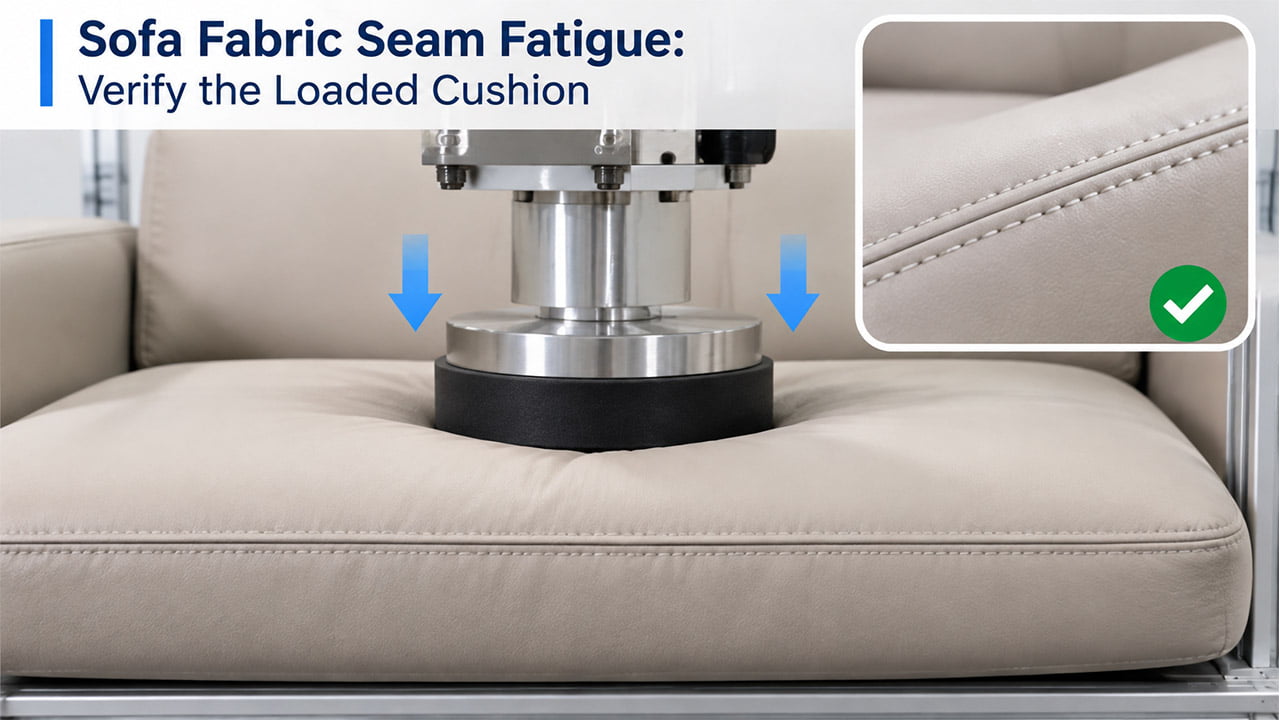
Sofa upholstery seam fatigue is the progressive change at a sewn joint during repeated loading, not simply the force needed to break a fresh specimen. For a broad microfiber-covered cushion, assess the actual seam, cover pattern and insert together under an agreed loading programme. Record where openings or damage develop and whether they remain after unloading. A strong initial coupon result or a smooth new seam does not, by itself, establish acceptable performance in the assembled cushion.
Separate three different seam questions
An initial pucker is an appearance condition present after sewing or fitting. Static seam strength concerns a specified loading test. Fatigue concerns changes during repeated loading. They may interact in a real cover, but the buyer should keep their observations and acceptance requirements separate rather than using one report to answer all three.
For this article, the practical concern is a loaded seat cushion whose seam gradually opens, damages the surrounding material or otherwise departs from the approved condition. A broad loose area away from the seam belongs to a different cushion-fit investigation. Start by mapping the actual defect rather than grouping every wrinkle under “weak stitching.”
Record whether the visible change is thread breakage, enlargement around needle holes, tearing near the stitch line, movement of the joined edges or another condition. These are descriptions to be verified during inspection. Do not assume every seam opening represents yarn slippage, particularly when the material uses a nonwoven substrate.
Define sofa upholstery seam fatigue at the cushion level
Use a drawing to locate the joint relative to the top surface, front edge, corners and insert. Identify material direction on both joined pieces and record the approved seam construction. The position of the seam in the finished cushion is part of the evaluation, not just a drafting detail.
For a microfiber furniture upholstery construction, name the actual material code and backing. Retain the cover pattern and insert specification used for the trial. A different material or cushion geometry should not inherit the result solely because the seam looks similar before loading.
Ask the furniture manufacturer to define the representative loading location, direction, sequence and observation stages. This is an assembly-development task. The article does not prescribe a universal seating load, cycle count or permitted opening for every sofa; the programme must establish those requirements before testing.
| Finding | Next question | Evidence to retain |
|---|---|---|
| Broken thread | Where and at what stage did it occur? | Thread specification and close photographs |
| Enlarged holes | Does damage follow the stitch line or one region? | Before-and-after location map |
| Tear beside the joint | Which layer and edge were involved? | Retained specimen and seam cross-section review |
| Opening only under load | How does it change after unloading? | Defined loaded and recovered observations |
| Damage near a corner | Does the result depend on the assembled geometry? | Pattern, insert and corner construction |
Read the material report without overstating it
The CFFA test-method publication describes CFFA-14 seam strength as a modified tack-tear assessment intended to simulate resistance to seam tearing. That is useful material evidence within its method. It is not a repeated-load test of a complete sofa cushion.
Ask the laboratory which method suits the proposed construction and question. A test for yarn movement in a woven textile should not be applied uncritically to a coated nonwoven material. Likewise, a tensile or tear result on an unsewn strip is not automatically a result for the factory’s finished joint.
Keep the method, specimen orientation, construction, conditioning and reported endpoint attached to the result. If two suppliers provide unlike reports, identify the gap rather than ranking their numbers directly. The objective is comparable evidence for the intended seam, not the largest number on a specification sheet.
Image placeholder: Broad sofa cushion with the front and corner seams identified, alongside close views distinguishing thread breakage, hole enlargement and adjacent-material tearing. Conceptual defect examples only.
Establish the baseline before cyclic loading
Inspect the completed cover before assembly and again after fitting it to the intended insert. Photograph the same named regions. This helps distinguish damage introduced during sewing or installation from changes that occur later in the loading programme. Keep any fitting adjustment in the record.
Measure the reference features using an agreed method and identify the unloaded condition. If the plan also includes inspection under load, define that condition separately. A gap observed under load should not be compared with a recovered reference without labelling the difference.
Retain an accepted reference assembly where available. Check that it behaves as expected under the selected procedure before drawing conclusions about a new candidate. If both reference and candidate behave unexpectedly, review the setup and assumptions rather than immediately rejecting the new material.
Record progression, not just the final photograph
Choose inspection stages in advance with the furniture team. At each stage, record the same seam zones and any observed changes. Distinguish the first appearance of a concern from the final stopping condition. The sequence can help identify where the next controlled development trial should focus.
Use consistent lighting and an appropriate scale in close photographs. Include an overview that shows the defect’s location on the cushion. A tightly cropped image of a torn stitch line without its orientation, loading history or assembly identity is difficult for either the material supplier or cover maker to interpret.
Report all defined outcomes, including appearance, opening, thread condition and material damage where the plan requires them. Do not hide a failed local criterion inside an overall “cover intact” statement. Equally, do not describe an intended reversible movement as failure unless it exceeds the agreed reference or limit.
Isolate the variable before changing the whole seam
If the concern is reproducible, compare a controlled revision against the baseline. Possible development variables include material direction, seam construction, pattern fit or insert geometry, but they should remain hypotheses until tested. Keep the other relevant inputs constant as far as practical.
For example, changing both the insert and seam specification can produce a better result without showing which change mattered. That may be acceptable for a final product decision, but it is weaker evidence for diagnosing the original cause. State whether the trial is intended to select a working assembly or establish a particular mechanism.
Do not assume a thicker thread, shorter stitch or tighter cover necessarily resolves the problem. Those changes need controlled assessment in the intended construction. A revision that improves one seam region but creates damage elsewhere has not met the complete cover requirement.
When considering another candidate in the furniture upholstery range, repeat the relevant comparison on the approved geometry. Avoid a category-wide conclusion such as “all microfiber passes” or “all coated materials split.” The evidence belongs to the tested construction and procedure.
Image placeholder: Baseline and revised cushion seam trials with identical loading-zone maps and staged inspection records, showing that only the identified development variable changed.
Convert the accepted trial into production controls
Freeze the material identity, pattern revision, seam specification, insert and relevant manufacturing procedure. Keep the accepted physical sample and inspection images available to the production and quality teams. An approval that depends on one experienced operator’s undocumented adjustment is difficult to reproduce.
Define which production checks confirm that the approved combination is being made. Include the normal handling and traceability records needed to identify affected covers if a concern appears. The customer and manufacturer should agree the sampling plan rather than copying an arbitrary inspection frequency from another product.
List changes that require review: material construction, backing, direction, seam layout, sewing specification, pattern or insert. Not every change demands the same validation effort, but each should enter the programme’s decision process. Purchasing should not accept a visually similar substitution without the responsible team’s assessment.
Use an evidence-based complaint package
For a returned sofa, retain the damaged joint and apparently sound comparison areas where possible. Record material and cover identities, service history and any repair attempts. Ask the furniture maker to examine the assembly before assigning the issue solely to the roll material or solely to sewing.
To prepare a development enquiry, send Wandaoleather the cushion seam drawing, proposed microfiber construction and repeated-load evaluation brief. Include the observed failure mode and existing test reports so the next sample addresses the specific joint rather than a general strength claim.
Frequently Asked Questions
Does a static seam-strength result prove fatigue resistance?
No. It supports the specified specimen and loading method. Repeated-load behaviour of the assembled cushion requires the separate evaluation agreed for that product.
Is seam fatigue the same as initial puckering?
No. Initial puckering is an appearance condition after sewing or fitting, while fatigue concerns change during repeated loading. Record them separately even when both occur.
Is every seam opening caused by yarn slippage?
No. Inspect the actual construction and failure. Thread breakage, hole enlargement and adjacent-material tearing are different observations, and woven-yarn methods are not automatically suitable for nonwoven substrates.
Should the seam be inspected while loaded or after recovery?
Use the conditions defined in the programme and label them separately. Comparing a loaded gap with an unloaded reference without that distinction can mislead the assessment.
Will tighter stitching always make a sofa seam better?
No. Validate the proposed sewing revision on the intended material and cushion. Do not assume that a denser stitch pattern or tighter cover improves every required outcome.
What should the production approval identify?
Name the material, direction, pattern, seam specification, insert, evaluation procedure and accepted reference. Keep changes to that combination under the agreed review process.