Common Visible Symptoms and Failure Patterns of Cracked PVC Leather
Cracking of automotive PVC upholstery refers to the progressive formation of surface microcracks, embrittlement, peeling, delamination, color fading, and seam-area cracking that develop under combined service stress and aging.
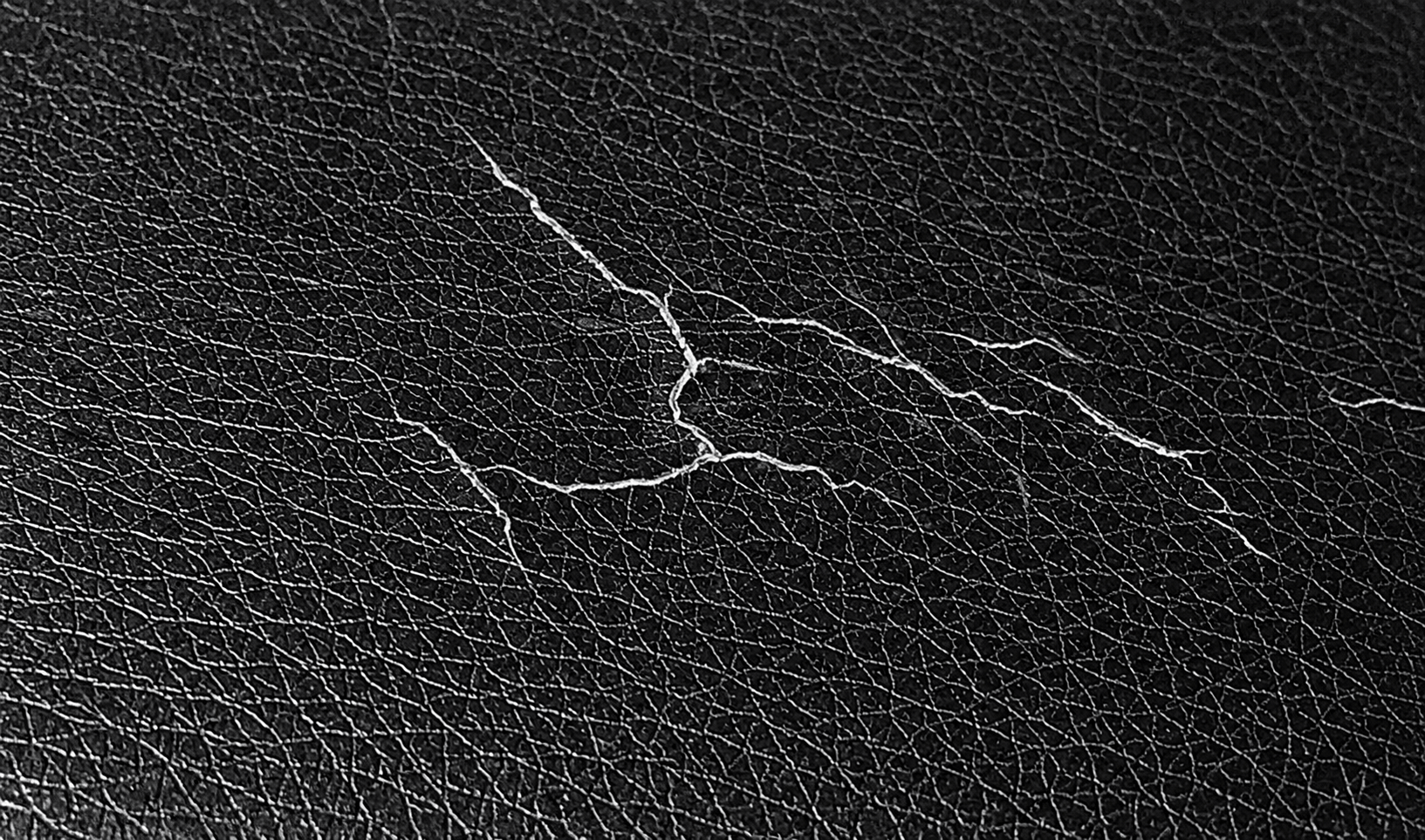
Typical field patterns include fine networks of microcracks that follow emboss peaks or grain valleys, progressive embrittlement that makes the surface feel stiff or chalky, localized peeling of the topcoat, delamination at the PVC–fabric or foam interface, fading or yellowing concentrated on sun-exposed bolsters, and splits that open first at stitch perforations or high-flex fold lines. These are not interchangeable with simple abrasion wear or installation damage.
Verified polymer-degradation literature shows that PVC can degrade by dehydrochlorination, forming conjugated polyenes, and by oxidative chain scission. In weathered material the embrittled surface eventually cracks and can chalk. PMC11053820 Environmental stress cracking itself is defined as a synergistic brittle-failure mechanism that involves tensile stress plus a chemical agent and can occur below the polymer’s nominal strength. Madison Group
Because multiple mechanisms can produce similar surface appearance, a single visual symptom is never diagnostic by itself. Crack mapping must record whether the network follows sun-exposed horizontal surfaces, shaded bolsters, seams, fold lines, or abrasion zones before any formulation conclusion is drawn.
Actionable recommendation: When a cracked seat cover is returned, photograph the entire trim part under standardized lighting, mark crack density and orientation relative to emboss and seams, and retain both failed and shielded areas from the same part for later cross-section and chemical comparison.
PVC Automotive Seat Leather Cracks (Common Root Causes)
PVC seat leather cracks when the material gradually loses its ability to stretch and bend under daily use. Several factors usually work together:
- Plasticizer loss: Plasticizers keep PVC soft and flexible. Heat, sunlight and time make them slowly migrate out or evaporate. Once they leave, the surface becomes hard and brittle.
- Heat and UV aging: High temperatures and ultraviolet light break chemical bonds in the PVC. The surface oxidizes, turns chalky or stiff, and can no longer absorb strain without cracking.
- Repeated flexing and strain: Seats are constantly folded, sat on and rubbed. After the material has already become less flexible, these movements open and grow the cracks—especially at seams, emboss peaks and fold lines.
- Moisture, sweat and chemicals: Humidity, body oils, sunscreen and cleaning agents can extract remaining plasticizer or weaken the bond between the topcoat, PVC skin and fabric backing. This makes delamination or surface cracking more likely.
- Interface weakness: If the topcoat does not stick well to the PVC, or the PVC does not stick well to the fabric/foam, cracks often start at these interfaces rather than in the bulk material.
In short, cracking is rarely caused by one single “bad batch.” It is the combined result of material formulation limits, aging under heat/UV, plasticizer permanence, and the mechanical stress the seat experiences every day.
Distinguishing PVC Cracking from Abrasion, Hydrolysis, Poor Lamination, or Installation Damage
Distinguishing true PVC aging cracks from other damage modes refers to the systematic use of location mapping, cross-sectional microscopy, chemical signatures, and mechanical retention data to separate formulation-driven embrittlement from external wear or assembly defects.
Abrasion typically removes or thins the topcoat first, exposing a smoother or lighter subsurface and often producing directional scuff marks rather than a closed crack network. Hydrolysis or moisture-driven interface failure tends to appear as blistering, whitening, or clean delamination planes rather than through-thickness brittle cracks. Poor lamination or adhesive failure usually shows separation at a discrete interface with little or no surface oxidation signature. Incorrect installation or excessive stretch during sewing concentrates splits at known high-strain geometry and often appears early in service.
A structured evidence chain is required. Map crack morphology and location. Compare failed and retained material from the same trim. Examine the cross-section to determine whether the crack begins in the topcoat, PVC skin, PVC–backing interface, or foam contact zone. Apply FTIR to detect oxidation or dehydrochlorination-related changes and measure plasticizer content or migration between failed and retained regions. Professional automotive environmental-stress-cracking investigations routinely employ microscopy, SEM, FTIR, DSC, TGA, and TMA. Madison Group
ISO 4892 provides the general framework for laboratory light exposure of plastics and reminds users that results must be interpreted in the context of the selected cycle; a xenon or UV pass alone does not prove field immunity. ISO 4892 Flex-resistance methods such as ISO 5402-1 evaluate cracking under repeated flexing of flexible leather and finishes below 3.0 mm thickness, confirming that flex cracking is a recognized, testable mode rather than an automatic material-defect label. ISO 5402-1
Actionable recommendation: Require every warranty or development failure report to state the crack-initiation plane (topcoat, skin, interface, or external damage site) and to include at least one retained-area control specimen before any formulation change is authorized.
Key Physical and Chemical Properties That Predict Cracking Performance
The properties that most strongly predict cracking of PVC seat leather refer to retained ductility and crack resistance after thermal or volatile loss and low-temperature conditioning, rather than unaged tensile strength alone.
Practical ranking places low-temperature crack resistance first, followed by post-aging elongation and flex-crack resistance, plasticizer permanence and emissions, tear strength, coating-to-scrim adhesion, resin/fusion quality, layer geometry, hardness/modulus, and finally VOC/FOG as a chemical-stability screen. Cold-crack methods such as SAE J323 use a nominal 6.35 mm mandrel; one published version conditions samples at 82 ± 2 °C for 24 h then at −34 °C for 4 h before bending and visual examination. SAE J323 itself states that the applicable method and conditions are to be specified by the contracting parties; it does not set a universal automotive acceptance temperature. SAE J323
A published automotive PVC-foam study cited GMW 3010N requirements of tensile strength >35 MPa and elongation 180–215 %, and ISO 13937-2 tear strength >10 kN/m for its construction. Those figures are construction-specific evidence reported in the paper, not independently verified current OEM text. PMC10934881 Coating adhesion is measured by ISO 2411 or ASTM D751 peel procedures; no universal automotive-seat numerical limit appears in the public sources reviewed. VDA 278 characterizes VOC (approximately to n-C25) and FOG/SVOC (approximately n-C14 to n-C32) fractions and is useful for tracking volatile plasticizer behavior, but OEMs set the acceptance limits. VDA 278
Plasticizer chemistry and loading involve clear trade-offs. Peer-reviewed reviews confirm that plasticizer increases flexibility and elongation while decreasing tensile strength and hardness; mechanical and migration behavior depend on chemistry and concentration, not a universal “more is better” rule. PMC7916570 A UV-aging study further showed that accelerated UVA exposure can alter surface-available plasticizer signals in commercial flexible PVC films, confirming that aging itself changes migration behavior. PMC12911472
In a laboratory comparison we ran on retained production skins versus field-returned cracked bolsters from the same color and grain code, post-aging elongation at −30 °C dropped by more than half on the cracked specimens while unaged tensile strength remained within the original specification band. That observation reinforced the ranking above: retained low-temperature ductility, not initial strength, was the clearer predictor.
Actionable recommendation: Lock the material specification around a no-crack result at the program cold-crack temperature after a defined heat or light aging cycle, and require both unaged and post-aging elongation, tear, and peel data rather than relying on as-received tensile numbers alone.
How Environmental and Mechanical Stressors Drive Cracking Mechanisms
The contribution of heat, ultraviolet radiation, humidity, sweat, sunscreen, cleaning chemicals, and repeated flexing to PVC leather cracking refers to the coupled sequence of plasticizer loss, oxidation, dehydrochlorination, chain scission, embrittlement, and interface failure that reduces the material’s ability to accommodate cyclic strain.
Heat accelerates diffusion and volatilization of external plasticizer and can initiate thermal oxidation and eventual HCl elimination. UV drives photodehydrochlorination, photo-oxidation, and surface chain scission; the resulting oxidized, less-ductile surface layer becomes the preferred site for crack initiation. Humidity and condensation facilitate interfacial transport and can weaken coating or fabric adhesion under cyclic swelling and thermal mismatch. Sweat, skin oils, and sunscreen introduce salts, organic acids, and ester-containing fluids that may extract surface additives or soften a susceptible topcoat. Cleaning chemicals and fuel can further alter the lacquer, extract mobile species, or create local microcrazing that later opens under flex. Repeated flexing supplies the tensile–compressive strain that opens and propagates the cracks once elongation has fallen.
A 2026 peer-reviewed study aged three commercial flexible PVC films under ASTM G154-23 using UVA-340 lamps at 0.89 W/(m²·nm) at 340 nm, cycling 8 h UV at 60 °C and 4 h condensation at 50 °C. Cumulative UV dose reached approximately 359 kJ/m² after 7 days and 718 kJ/m² after 14 days. Surface-accessible plasticizer signals changed significantly in a formulation-dependent manner, with short-chain species showing earlier enrichment than heavier DINP/DIDP. PMC12911472 Another study on plasticized PVC artificial leather reported typical plasticizer contents of 40–120 wt% relative to PVC resin and demonstrated that plasticizer migration can impair adhesion between PVC and a surface treatment. PMC9824117
Ozone is ordinarily a secondary concern for the saturated PVC backbone itself; rubber-ozone methods such as ASTM D1149 or ISO 1431-1 should not be used as default proof of PVC-leather durability unless an OEM specification explicitly requires them. Flex-crack methods ISO 32100 and ISO 7854 provide the appropriate coated-fabric frameworks for assessing appearance after repeated folding or crumpling. ISO 32100 ISO 7854
Actionable recommendation: Design the validation matrix as a sequence—baseline properties, environmental exposure (UV/condensation, heat, humidity, chemical contact), then post-exposure flex or cold-crack testing—rather than isolated single-factor passes, and report every result strictly as a laboratory-condition outcome.
Practical Ways to Prevent or Reduce PVC Leather Cracking
Prevention works best when it is built into material selection, processing and vehicle validation, not only after problems appear:
- Choose plasticizers with good permanence: Prefer higher-molecular-weight or more compatible plasticizers that migrate and volatilize more slowly. Balance flexibility against fogging and long-term embrittlement risk.
- Specify post-aging performance, not only as-received strength: Require no-crack results in cold-flex or mandrel tests after defined heat or UV aging. Also demand retained elongation, tear strength and coating adhesion after aging.
- Protect against UV and heat: Use UV stabilizers and suitable topcoats. Design validation sequences that combine light/heat exposure followed by flex or cold-crack testing.
- Control interfaces and lamination: Ensure strong, consistent adhesion between topcoat–PVC and PVC–fabric. Poor bonding is a frequent starting point for peeling and cracking.
- Limit early high-strain damage: Avoid excessive stretch during sewing and installation. High initial residual stress accelerates later cracking.
- Use realistic multi-factor testing: Sequence tests as baseline → environmental exposure (UV/condensation, heat, humidity, chemical contact) → post-exposure flex or cold-crack. Single-factor passes are not enough.
- Track field data internally: Stratify warranty returns by climate, color, seat location and months in service. This builds the real correlation that public data cannot provide.
No single change eliminates all risk, but locking the specification around retained low-temperature ductility after aging, good plasticizer permanence, solid adhesion and realistic combined testing significantly lowers the chance of field cracking.
Real-World Frequency, Service Life, and Climate Influence
Public quantitative data on the real-world frequency of PVC automotive upholstery cracking refer to the absence of any robust, openly available fleet dataset that reports crack-claim rates, median initiation times, or climate-stratified failure percentages for defined seat-cover constructions.
No credible public source supplies both confirmed PVC-seat crack counts and the corresponding vehicle-exposure denominators by climate, model year, and months in service. OEM warranty systems treat seat-trim appearance issues as proprietary. Consequently, laboratory aging results cannot be converted into a universal service-life percentage or years-to-crack figure.
What can be stated is limited and mechanism-based. A severe-solar SAE field-weathering study reported PVC color change up to ΔE = 40 after five years in 95th/99th-percentile severe solar environments; the result documents appearance susceptibility under high solar load but does not quantify cracking rate. SAE 930629 Recent SAE work on aged PVC instrument-panel skin used 110 °C for 400 h followed by mechanical testing at −30 °C, 23 °C, and 85 °C, confirming that post-aging mechanical response is temperature-dependent. SAE 2025-01-8321 ASTM G155 supplies the xenon-arc framework for light, heat, and moisture but expressly does not prescribe a universally correct cycle for every material, which is one reason generic “X hours equals Y years” claims are unreliable. ASTM G155
Climate ranking therefore remains qualitative. Hot–dry/high-UV environments are usually the most critical for exposed skins because solar heat and radiation act together. Cold climates become critical once prior thermal or UV aging has already reduced elongation, especially at seams and emboss valleys. Hot–humid and high-pollution conditions act mainly through combined moisture, chemical residues, cleaning, and mechanical flex rather than through humidity or pollution alone. No public source supplies a PVC-seat field crack percentage for any of these climates.
Actionable recommendation: Build internal quantitative evidence by stratifying warranty and retained-part data by build month, trim code, geography, color, seat location, and months in service, and report cumulative crack incidence at fixed intervals with confidence intervals rather than relying on external marketing claims of service life.
FAQ
A: No. Cracking is usually a system-level interaction of formulation, plasticizer permanence, heat/light/moisture, cyclic strain, abrasion, and interface integrity. Environmental stress cracking can occur below the polymer’s nominal strength when tensile stress and a chemical agent act together.
A: No. UV contributes to photo-oxidation and surface embrittlement, but heat, plasticizer loss, moisture, chemical contact, abrasion, and repeated flexing can independently or jointly drive failure. Location mapping often shows cracks at seams or shaded bolsters where mechanical strain dominates.
A: No. Plasticizer improves flexibility and elongation but reduces hardness and tensile strength; excessive or poorly compatible plasticizer increases migration, fogging, and long-term embrittlement risk. Chemistry, molecular weight, and permanence matter more than simple loading level.
A: No. Topcoats improve abrasion, stain, and UV resistance and may slow additive loss, but they are finite layers that can abrade, craze, lose adhesion, or crack under flex. They do not reverse bulk embrittlement or eliminate strain at seams and emboss peaks.
A: No robust public dataset exists that reports crack-claim rates, median initiation times, or climate-stratified percentages for defined PVC seat constructions. Laboratory results cannot be converted into vehicle service-life percentages without program-specific correlation.
A: No single test is sufficient. The strongest practical package combines post-aging elongation retention, a no-crack cold-flex or mandrel result at the program temperature, tear strength, coating adhesion after heat/humidity aging, and VDA 278 or equivalent emissions data, followed by flex testing after the relevant environmental exposures.