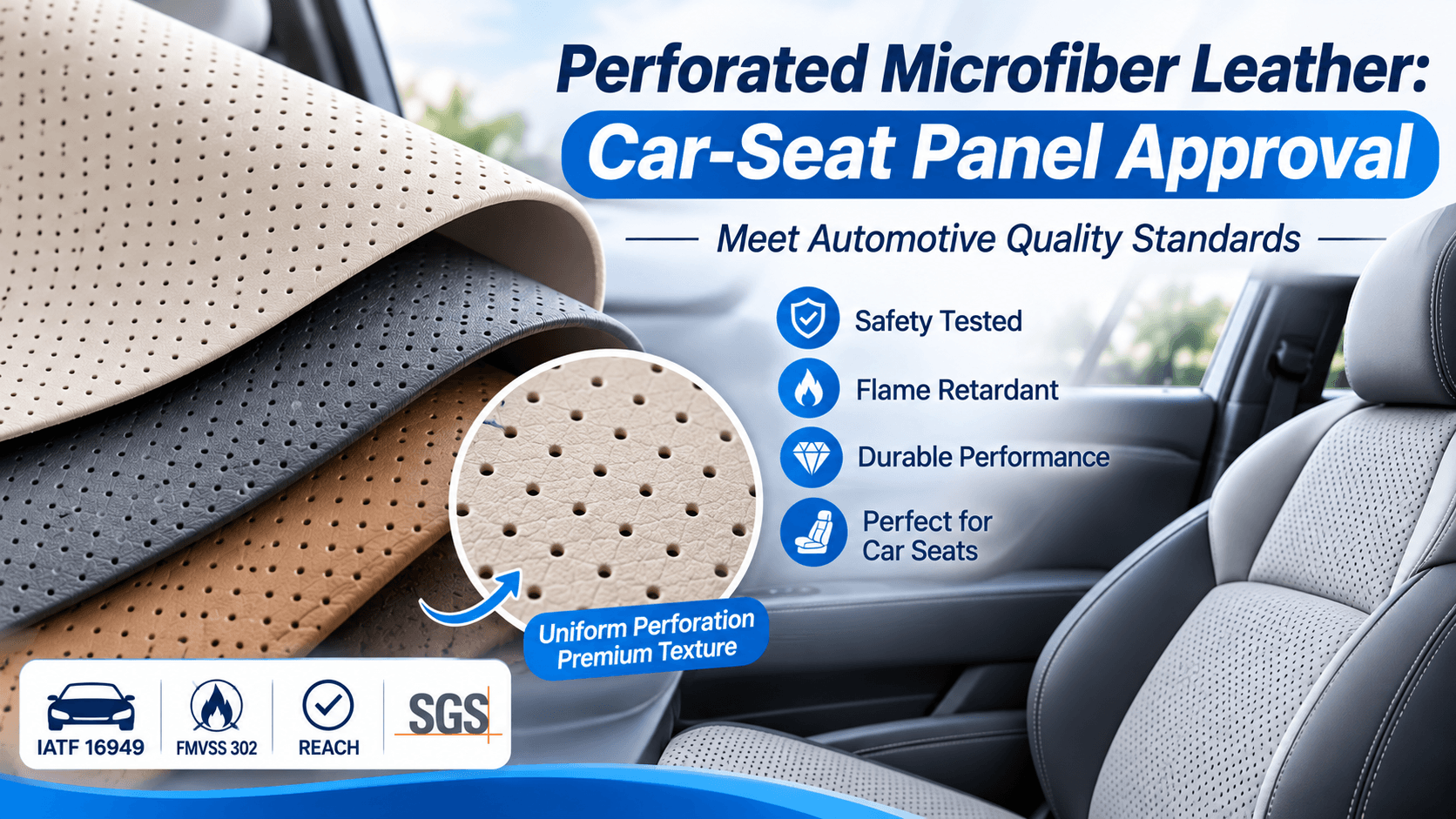
Perforated microfiber leather for a car-seat panel needs approval as a defined hole pattern within a defined laminate. Hole diameter and spacing can describe the geometry, but they do not establish airflow through adhesive and foam or prove active cooling of the finished seat. Evaluate the perforated sheet, the representative bonded panel and the seat-system requirement separately. The useful specification connects appearance, remaining material between holes, alignment and measured performance without treating more visible holes as an automatic improvement.
Specify perforated microfiber leather by panel and pattern
Identify the seat zone, panel outline and intended function. A decorative perforation field and a panel intended to support an engineered ventilation path are not the same purchasing brief. Record whether the holes are specified for appearance, airflow development or another defined requirement.
The microfiber leather for automotive applications page provides the material starting point. Perforation approval follows the identified surface, backing and thickness. A matching colour does not establish that another construction will perforate or behave identically.
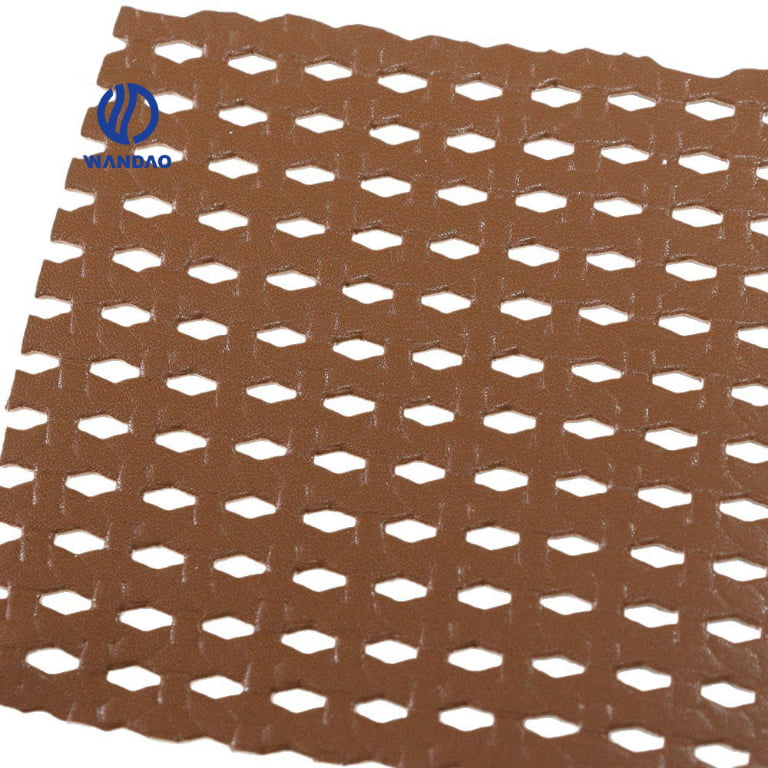
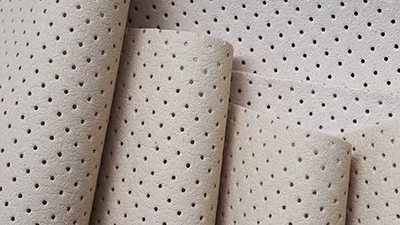
The pattern drawing should identify hole shape, size, pitch, arrangement, orientation and the boundary of the perforated field. Include margins around seams, panel edges and other features as specified by the responsible seat developer. Do not leave those boundaries to an operator interpreting a photograph.
Use open area as geometry, not a cooling rating
For a hypothetical regular square grid of circular holes, geometric open-area fraction is the area of one hole divided by the area of its repeating square cell: πd²/(4p²), where d is hole diameter and p is centre-to-centre pitch. This describes an ideal pattern, not a measured material property.
For example, invented dimensions of 1 mm diameter and 3 mm pitch give approximately 8.7% geometric open area. These values are only a calculation illustration, not a recommended automotive pattern or a Wandao product specification. Edge boundaries, imperfect holes and blocked openings are not represented by that ideal calculation.
Increasing the calculated percentage changes the geometry, but it does not establish the final airflow or comfort result. The remaining bridges of material between holes, the panel build and the downstream flow path still need evaluation. Do not optimise a single percentage without considering the rest of the design.
| Evidence | What it describes | What it does not establish |
|---|---|---|
| Pattern drawing | Nominal hole geometry and location | Actual hole quality or permeability |
| Open-area calculation | Ideal void fraction for a defined repeat | Flow through the bonded seat panel |
| Air-permeability result | Air passage under the specified test conditions | Complete-seat cooling or occupant comfort |
| Seat-system assessment | The defined assembled system and operating condition | Every other seat or occupant scenario |
Inspect actual holes before discussing performance
Compare the produced pattern with the drawing using an agreed measurement approach. Inspect both faces for incomplete openings, loose material, distorted holes, surface damage and pattern drift. These are proposed inspection categories; their acceptance limits should come from the project’s approved design and references.
A hole that looks open from the face may not provide the same passage through the backing. Check whether the operation passes through the intended layers and whether debris remains. Record when perforation occurs relative to lamination, because that sequence defines the specimen being approved.
Include the boundaries of the perforated field in inspection. The transition from perforated to solid material and the relationship to seam lines can matter to component development. A central coupon does not represent every edge condition on a shaped panel.
Where appearance is important, review the pattern on a representative curved or tensioned panel as well as flat. Distortion visible after assembly may not appear on a loose swatch. Keep material direction, cover pattern and assembly conditions recorded so the observation can be investigated.
Measure airflow on the construction named in the claim
ISO 9237:1995 describes fabric air-permeability measurement and includes a broad range of air-permeable textile constructions in its scope. Ask the laboratory whether the selected sheet or laminate and test arrangement are appropriate. Record the method conditions and reported units with the result.
Keep separate records for the perforated sheet and representative laminate. Adhesive coverage, foam and any additional layer belong in the laminate description. If the actual panel includes a local reinforcement, determine whether the test specimen represents that area or a different zone.
For an engineering comparison, hold the hole pattern constant while assessing a defined layer-stack change, or hold the stack constant while comparing patterns. Changing both may be a legitimate design trial, but it cannot isolate why the measured result changed.
Do not compare numbers from different pressure conditions or units as though they were directly equivalent. Request the underlying reports and discuss comparability with the laboratory. A chart headed only “breathability” can conceal several different measurements.
Keep vapour transport and active ventilation separate
Air passage under a pressure difference is not the same measurement as water-vapour transport. Neither, alone, proves that a powered seat system cools an occupant. The finished system includes its airflow path, operating arrangement and occupied condition, which need their own development assessment.
If the project intends a cooling or comfort claim, assign its validation to the responsible seat-system team. The material supplier can support the defined material and laminate evidence without assuming responsibility for an untested whole-system claim.
Check the remaining structure after perforation
Perforation changes the component from the original unperforated sheet. As an engineering consideration, review the material bridges, edge quality and relationship to seams when selecting mechanical assessments. Do not approve the new pattern solely from a strength report for the unperforated construction.
Agree which tests and component trials are relevant to the seat panel. Record hole orientation relative to the tested direction and any assembly tension. If failure occurs, note whether it passes through holes, begins at an edge or occurs elsewhere; the location informs the next design review.
Keep appearance and mechanical acceptance separate. A visually regular pattern may still fail an agreed component requirement, while a mechanically adequate panel may not meet the intended visual standard. Both decisions need explicit criteria rather than one generic pass box.
Do not use this workflow to alter airbag seams, occupant-sensing areas or other safety-related seat features. Such changes require the responsible vehicle or seat engineering process. A material-level perforation trial is not authorization to modify those systems.
The broader automotive upholstery material guide places this pattern-level work alongside other interior requirements. Perforation and airflow evidence do not replace the project’s separate requirements for the complete material or seat.
Separate tooling defects from design limitations
If the specified pattern is acceptable in one trial but irregular in another, compare actual openings and tool records before revising nominal geometry. Incomplete holes or shifted rows may indicate a production deviation rather than a design that needs more open area. Conversely, a consistently produced pattern that misses the agreed component requirement needs a design review, not merely tighter inspection.
Retain representative samples from both outcomes. A single average measurement can hide a local area of incomplete perforation, so locate observations on the panel drawing. This helps the converter investigate the relevant part of the process and prevents the seat team from attributing every flow difference to the material name.
Preserve the approved sequence
If development perforates the cover before bonding but production proposes perforating the bonded stack, review that change explicitly. The resulting opening and affected layers are not described by the face pattern alone. Confirm hole quality, the relevant performance and any effect on the assembly before treating the new sequence as equivalent.
Freeze the pattern, laminate and acceptance scope together
The release package should include the material code, pattern revision, manufacturing sequence, laminate specification, physical reference and relevant reports. Identify which panel zones are covered and which remain outside the approval. This prevents a successful central-panel result from being copied across the seat indiscriminately.
Specify how pattern changes are reviewed. A larger hole, shorter pitch, different arrangement or shifted solid margin can change more than appearance. A new adhesive coverage or foam may leave the hole drawing unchanged while changing the laminate question.
Agree production checks for actual hole quality and pattern position. If multiple perforation tools are used, trace the output to the tool and revision. A drawing alone cannot show whether a tool has produced the approved opening consistently across the supplied panel.
For a focused development request, send Wandao Leather the seat-panel drawing, perforation pattern and proposed layer stack. Include whether the decision concerns appearance, measured airflow or a system requirement, and name the laboratory or engineering acceptance plan where available.
Frequently Asked Questions
Does more open area guarantee a cooler car seat?
No. Open area is a geometric calculation. Airflow through the laminate and the performance of a finished ventilation system require separate evidence.
Can ISO 9237 prove active seat cooling?
No. It addresses fabric air permeability under defined conditions. Cooling or comfort claims need assessment of the relevant complete seat system.
Should the adhesive and foam be included in testing?
Include a representative stack when approving the bonded panel. Keep its result separate from the perforated sheet result and confirm specimen suitability with the laboratory.
Are the example hole dimensions a recommended specification?
No. The 1 mm diameter and 3 mm pitch are invented solely to illustrate a geometric calculation. Select and validate the actual pattern through the seat development process.
Does an unperforated strength report approve a perforated panel?
Not automatically. Review the changed geometry and assess the relevant perforated construction, including its relationship to seams and assembly conditions.
What should trigger reapproval of a perforated panel?
Review changes to material, hole geometry, field boundaries, tooling, perforation sequence, adhesive or foam. Repeat the checks relevant to the changed construction and claim.