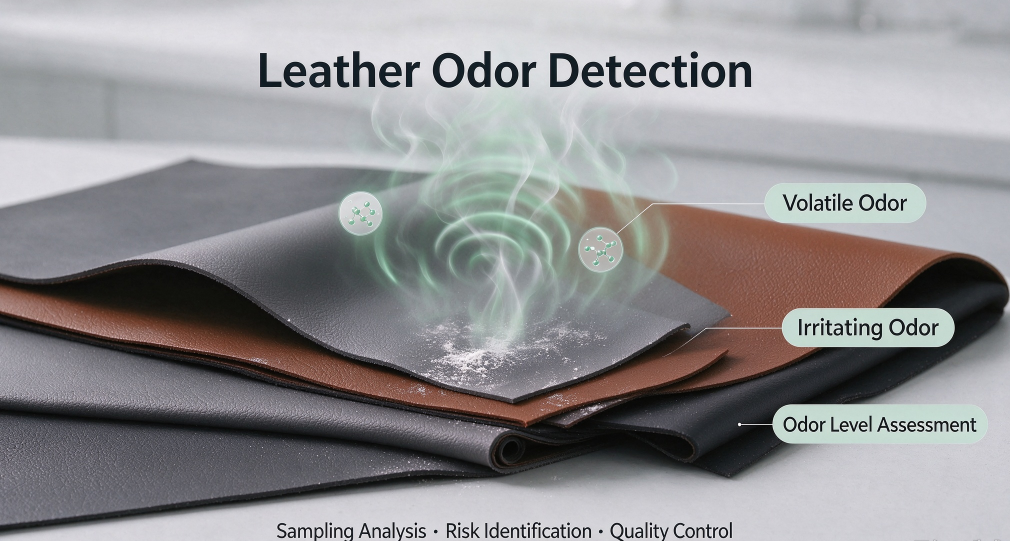
PU leather odor for automotive trim should be evaluated with a defined sensory test and traceable samples, not judged from an opened swatch envelope alone. Agree the customer’s method, exposure condition and acceptance criterion before comparing candidates. Also identify whether the sample is the supplied sheet or a finished laminate containing foam and adhesive. This guide explains how buyers can investigate odor differences between materials, components and lots while keeping odor acceptance separate from emissions, fogging and chemical-safety conclusions.
Define the automotive part before requesting low odor
A door insert and a loose upholstery sheet are different sampling objects. The insert may include the PU material, bonding layers, support and manufacturing treatments. If the complaint concerns the assembled part, record that construction before assigning the smell to the visible surface. A sensory observation can justify investigation without proving which ingredient or component is responsible.
Use the PU leather for automotive specification page to describe the application and proposed construction. Identify the material code, backing, finish, color and relevant processing route. Then ask the vehicle program or component customer which odor requirement applies. A generic request for “automotive grade” does not define the test or acceptance decision.
Clarify the purpose of the submission. Is it an early material comparison, approval of a new laminate or investigation of a production complaint? The sample plan and conclusion should match that purpose. A development swatch may help select candidates, but it should not be relabeled as evidence that every production component meets the program requirement.
Choose a defined PU leather odor evaluation
VDA 270, version 05/2022, addresses odor characteristics of motor-vehicle trim materials under temperature and climate exposure. Its official description includes interior materials and components, as well as parts contacting air supplied to the interior. Use the customer-specified edition and condition with a laboratory competent in the method.
The method reference needs an acceptance requirement alongside it. Ask the customer for the applicable criterion and any program-specific instructions. Do not select a convenient pass limit from an unrelated report. A sensory result describes the tested sample under its stated conditions; the purchasing decision depends on whether that evidence meets the agreed requirement.
A casual smell check can flag a difference worth investigating, but it is not a substitute for controlled evaluation. Do not ask staff to improvise heated-sample exposure or direct sniffing of unknown materials. Have the laboratory handle preparation and sensory assessment through its established procedures, including the necessary controls and safety practices.
Keep odor, emissions and fogging in separate report fields
ISO 12219-1:2021 concerns a whole-vehicle chamber approach for determining VOCs and carbonyl compounds in cabin air. That is an analytical emissions question, not the same output as a trim-material odor assessment. Other parts of the series have their own scopes, so specify the relevant method rather than requesting an unspecified “ISO 12219 pass.”
ISO 6452:2021 addresses fogging characteristics of automotive trim materials, including fog condensate under defined conditions. It should not be presented as an odor score. A satisfactory result for one property does not supply the missing report for another property with a different measurement principle.
| Approval question | Evidence to request | Do not infer |
|---|---|---|
| Is odor acceptable? | Specified sensory method and condition | Chemical identity or emissions compliance |
| What airborne compounds are measured? | Relevant analytical emissions method | Automatic sensory acceptance |
| What condensate forms in the test? | Specified fogging method | An odor rating |
None of these report titles is permission to describe the material as universally safe or non-toxic. This article addresses odor quality control, not a health assessment. Chemical and regulatory questions require their own applicable evidence and qualified review. Keep the conclusion tied to the property actually evaluated rather than turning a favorable sensory observation into a broader claim.
Control the sample history before comparing scores
Record manufacturing date or available production traceability, sampling date, packaging, storage and shipment history. These records help distinguish a material change from a sample-handling difference. If one specimen has been left open while another remains packed, do not quietly treat them as equivalent submissions. Ask the laboratory how the specified procedure handles their condition.
Agree packaging and handling instructions before sending samples. Use the laboratory’s requirements rather than selecting a bag or container by convenience. Record any departure, including contact with other materials or an unexpected delay. A sample that acquires an unrelated odor during preparation can make the subsequent investigation focus on the wrong part of the supply chain.
Do not pre-treat a submission to improve its score unless that treatment is part of the approved production and test basis. Airing, warming or applying a fragrance changes the submitted condition. If a defined manufacturing step is relevant, identify it transparently and test the construction that will actually be supplied. An undocumented workaround does not establish repeatable low-odor production.
Separate a component investigation from lot acceptance
Begin with the complete supplied construction
For acceptance, define the material or component the buyer is purchasing. Record every relevant layer and production revision. If the approved object is a laminate, a report for the face sheet alone leaves a scope gap. Conversely, an assembled-part result may answer the customer’s acceptance question without identifying the contribution of each layer.
Keep a retained reference from the approved construction and maintain its identity. When comparing a new lot, align the test conditions and sample handling. A changed odor result is a reason to review the records; it is not by itself proof that the PU resin, backing or adhesive has changed. The investigation needs evidence connecting the difference to a particular input.
Use component samples for diagnosis
If source attribution is needed, the technical team can plan comparisons of relevant inputs such as the face material, backing, foam or adhesive system. Use traceable material from the same production context where practical. The purpose is to test a hypothesis about the assembly, not to assume that every possible layer contributes equally.
Separating a bonded laminate can alter the specimen. Request appropriate unassembled inputs or a laboratory-approved preparation route rather than peeling layers apart and calling them unchanged components. Label any separated sample honestly. Keep those diagnostic observations distinct from the acceptance result for the complete construction.
Do not add or subtract sensory grades to calculate a laminate result. The assembled material needs its own evaluation where required. Component comparisons may suggest a follow-up experiment, but a favorable set of isolated results should not replace the actual laminate evidence. This is especially important when the manufacturing process is part of the difference under investigation.
Change one input where practical
Prepare controlled alternatives with an identified change and the remaining construction held constant. If the project changes adhesive and backing together, document that as a combined alternative. A successful result can approve the new combination without proving which individual change produced the improvement. Honest attribution makes later substitutions easier to assess.
Read the report as a comparison record
Check the specimen description, method version, selected condition, preparation, dates and reported result against the approved test request. Ask for the supporting sensory records required by the method and the laboratory’s explanation of any deviation or repeat. A certificate showing only a pass word cannot resolve a dispute about whether the right construction was assessed.
When several candidates are compared, have the laboratory apply its controls consistently. Retain the individual sample identities and the basis for the summary result. Do not cherry-pick one favorable assessment while ignoring the report’s agreed calculation or review rule. If the result is unclear or borderline under the customer’s criterion, seek clarification rather than inventing an informal pass.
Separate a normal lot comparison from a complaint investigation. For the latter, preserve the complaint sample’s known history and identify what is unknown. An old installed component and a new packed sheet may both provide useful clues, but they are not matched test objects. The report should explain that limitation instead of attributing every difference to current production.
Close the approval with change-control requirements
Record the approved material or assembly, method, condition, acceptance criterion and report reference. State whether the decision covers a development sample, specified production lots or a particular component revision. Keep unresolved emissions or fogging requirements visible in their own fields; completing odor review does not close those separate tasks.
Agree which substitutions require technical review, including relevant material formulations, backing, bonding components, processing and packaging. Avoid automatically transferring a historical odor approval to a new construction with the same appearance. The scope of requalification should follow the customer’s requirements and the input that changed.
The automotive leather application page can help organize the broader trim brief. For a focused submission, share the component construction and odor-test requirement, with the program’s selected condition, sample-handling instructions and acceptance criterion. This supports a traceable comparison rather than an unqualified promise based on smell alone.
Frequently Asked Questions
How should PU leather odor be evaluated for automotive trim?
Use the customer’s specified sensory method, condition and acceptance criterion with a competent laboratory. Identify the exact sheet or assembled construction and control sample history. A casual swatch check is not equivalent to a defined test.
Does VDA 270 measure VOC concentrations?
No. VDA 270 addresses odor characteristics under specified temperature and climate exposure. Analytical emissions measurements answer a separate question and require the appropriate method and report for the material, component or vehicle being evaluated.
Does low odor prove that PU leather is non-toxic?
No. An odor result does not establish chemical identity, exposure or compliance. Keep sensory acceptance separate from chemical and regulatory assessment, and obtain the applicable evidence for those questions rather than inferring it from smell.
Can a face-sheet report approve the finished laminate?
Not automatically. A laminate may include foam, adhesive and other components absent from the sheet specimen. Define the object being purchased and obtain evidence for that construction when the customer requires assembly-level approval.
Should samples be aired before an odor test?
Follow the specified laboratory preparation and handling instructions. Do not add undocumented airing or other treatment to improve the result. Record the actual manufacturing, packaging and storage history so the submission represents the agreed approval basis.
Can individual layer scores predict the laminate score?
Do not calculate a laminate result by adding or subtracting sensory grades. Component comparisons are diagnostic evidence. The complete construction needs its own evaluation where required, with any preparation differences clearly documented.