PU leather thickness is a starting specification for a jacket, not a prediction of how its collar, cuffs or front opening will behave. Two materials with the same nominal thickness can form different seam stacks because their backing, coating and compressibility differ. For sourcing, approve both a measured material specification and a representative sewn assembly. This guide explains what to request, which jacket details to sample and how to avoid approving a flat swatch that becomes bulky at production seams.
Start with the jacket detail that limits the design
A buyer may like the hand of a large panel yet reject the finished cuff because the edge stands away from the wrist. Another jacket may look clean through the body but feel rigid around the zipper. Neither observation proves that the entire material is too thick. First locate the troublesome construction: a turned edge, overlapping allowance, reinforced closure or intersection between several seams. The development question is whether the proposed material works in that detail without compromising the rest of the garment.
For a fitted style, review the collar stand, cuff closure and front facing early. For a relaxed style, the larger panels and hem may matter more visually, but the closure still needs a separate check. Use the actual design drawing to choose the sample locations. A generic square of doubled material does not reproduce every corner or intersection in a jacket.
The specification fields on our PU leather for clothing page provide a starting point for discussing garment construction. Treat thickness, backing and hand as a coordinated request rather than selecting a number first and expecting the garment factory to compensate for it later.
What a PU leather thickness measurement tells you
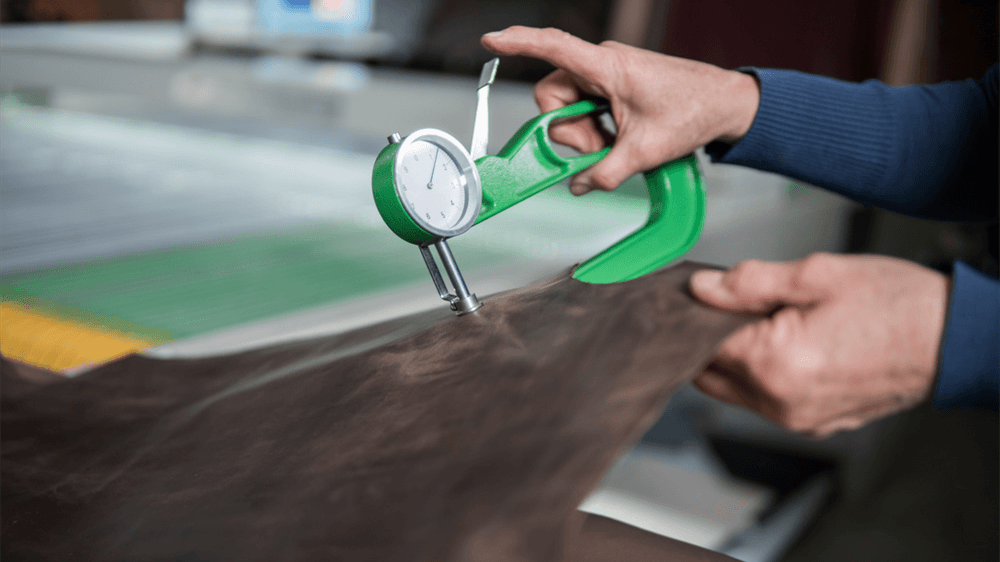
ISO 2286-3:2016 specifies thickness measurement under a specified pressure for rubber- or plastics-coated fabrics. The pressure condition matters when comparing compressible constructions. Ask whether quotations and inspection reports use the same method and conditions; a number without that context is an incomplete comparison. The standard is a measurement method, not a recommendation for the ideal jacket thickness.
Also establish what is being measured. Total composite thickness includes the structure presented to the measuring instrument. A coating thickness describes a different layer-level property. Do not substitute one for the other in a purchase order. If a supplier offers a coating-only value, request its definition and measurement method as a separate field rather than combining it with the total-thickness tolerance.
Mass per unit area is another distinct measurement. ISO 2286-2:2016 covers total mass per unit area and the masses per unit area of coating and substrate. That information can help describe a construction, but it does not turn grams per square metre into a reliable thickness or drape rating. Keep these properties in separate columns on the comparison sheet.
| Requested field | Useful decision | Do not infer |
|---|---|---|
| Total thickness and method | Compare material dimensions consistently | Finished seam bulk or softness |
| Backing identification | Keep the approved construction traceable | Identical behavior across all backings |
| Mass per unit area | Compare material weight | A thickness conversion without evidence |
| Sewn detail sample | Judge the actual cuff, collar or facing | Approval of every other jacket detail |
Why the seam stack needs its own approval
Adding nominal sheet thicknesses can help identify where several layers meet, but the arithmetic is not a finished-assembly measurement. Folding, compression, seam allowance placement, lining and reinforcement change the local construction. Use a layer sketch to identify the stack, then evaluate the sewn result. Record any intervention that makes the sample acceptable, such as a revised allowance layout, because production must reproduce it.
Separate body drape from edge behavior. A hanging panel can reveal the silhouette the designer wants, while a turned edge reveals a different problem. Approving only the softer-looking hanging sample can overlook a thick junction at the cuff. Approving only a tidy edge can overlook an unwanted board-like body. These are complementary development checks, not competing definitions of quality.
Likewise, a thinner candidate is not automatically the better choice. If it requires a different support layer to achieve the design, the finished stack may not become simpler. If a change affects stitch formation or edge appearance, those outcomes need review too. This is an assembly-level purchasing decision, not a contest to buy the lowest millimetre value.
Build a small, representative jacket trial
Freeze the inputs before comparing materials
Give the sample room a short controlled specification: material code, backing, color, roll direction, pattern revision, lining, reinforcement, seam construction and closure components. Identify the intended production machinery and record the sewing setup used. If the operator changes several settings between candidates, record that change; otherwise the comparison may attribute a process improvement to the material.
Keep a flat reference from each candidate alongside its sewn details. Label the face and direction before cutting. Use enough material to make the actual junction, not just the easy straight portion beside it. A cuff sample should include its closure and relevant overlap; a zipper-facing sample should include the transition that creates the largest local stack.
Inspect in the sequence the jacket will experience
First inspect the relaxed sewn detail without pulling it flat. Next open, close and handle it as the design requires. Finally assess it in the intended garment or a representative assembly. This sequence helps distinguish a construction that only looks tidy when held under tension from one that sits correctly in use. Document the condition in each photograph.
The checks should be specific: does the collar turn as intended, does the cuff close without an unwanted step, and does the facing distort the front line? Include wearer comfort and mobility review where relevant to the design. These are proposed development observations; they are not universal pass criteria or a substitute for the brand’s garment testing program.
Agree on the appearance reference
Use the same viewing position, lighting and handling state for candidate comparisons. Retain an approved physical detail rather than relying only on a photograph of a flat swatch. Record which features are acceptable and which are not, especially at the thickest junction. Without this annotation, two teams can interpret the same reference differently during bulk approval.
Separate a material change from a construction change
If the stack is unacceptable, compare controlled alternatives. One trial may retain the material and change the allowance arrangement; another may retain the pattern and compare a different material construction. Do not silently change both and declare thickness to be the cause. The useful outcome is a repeatable combination of material and process, with a clear explanation of what was changed.
Any thinning, pressing, bonding or reinforcement adjustment should be approved by the material and garment teams for the specific construction. Avoid copying a heat or pressure recipe from another PU product. A neat-looking sample made with an undocumented treatment is difficult to reproduce and may introduce other issues that a short visual inspection misses.
For broader fabric and silhouette choices, the clothing leather selection page helps frame the application discussion. Keep this thickness trial focused on the selected jacket details; separate care, colorfastness and other performance requirements remain part of the overall specification.
Turn the approved sample into a usable order specification
The purchase record should identify the material construction, nominal thickness, agreed tolerance, measurement method and approved reference. Add the garment detail revision and any restrictions on substituting backing or reinforcement. A material code alone is insufficient if several constructions can be supplied under a broad commercial description. Request written clarification of what changes require a new approval.
At incoming inspection, compare the measured material with the approved specification and retain lot identification. If the material meets its thickness tolerance but the sewn detail fails, investigate the assembly before changing the tolerance. Conversely, a familiar-looking sample should not override an out-of-spec measurement without a documented disposition. Material acceptance and garment acceptance should remain linked but distinguishable decisions.
For an RFQ, send the jacket drawing and critical seam details with the desired hand, backing preferences, measurement requirements and sample quantity needed for sewing trials. Ask for candidates to be evaluated against the same construction brief, rather than requesting an unsupported universal thickness recommendation.
Frequently Asked Questions
What PU leather thickness is best for a jacket?
There is no single best thickness for every jacket. Choose candidates around the required silhouette and construction, then approve representative cuffs, collars and front facings. Specify the measurement method and tolerance separately from the finished-detail appearance requirements.
Is coating thickness the same as total thickness?
No. Coating thickness concerns a layer, while total thickness concerns the measured composite. Ask the supplier to define each value and its method. Do not use a coating-only number as the total-thickness specification for incoming material.
Can material weight predict seam bulk?
Mass per unit area does not establish finished seam bulk. Backing, layer arrangement, lining, reinforcement and compression also matter. Keep weight as a separate specification and inspect a sewn detail made with the intended production components.
Does ISO 2286-3 specify a jacket thickness limit?
No. ISO 2286-3:2016 describes thickness measurement under specified pressure for coated fabrics. The jacket’s target and tolerance must be agreed for the particular design; the measurement standard does not approve the finished garment.
Should a bulky cuff always be fixed with thinner material?
Not automatically. Check the layer stack, allowance arrangement and reinforcement first. Compare a construction change separately from a material change, then verify closure, appearance and the other garment requirements before approving the revised combination.
What should accompany a thickness quotation?
Request the material and backing identification, total-thickness definition, measurement method, tolerance and a traceable sample. Include the jacket drawing and critical sewn details so the quotation supports a representative trial rather than only a flat-swatch comparison.