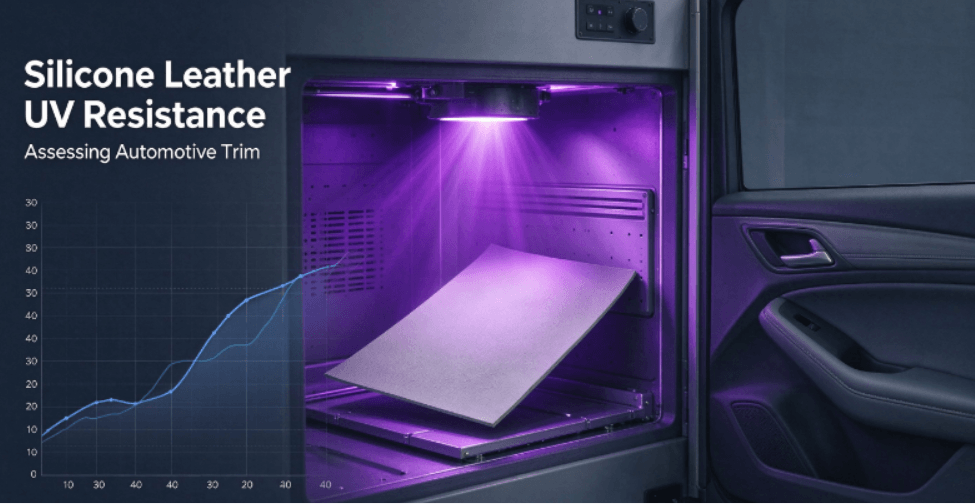
Silicone leather UV resistance for automotive trim should be verified on the specified colour and construction under the customer’s chosen exposure programme. A silicone surface or a report saying “xenon tested” does not establish how the finished trim will retain appearance and function. Define the interior location, exposure method and evaluation criteria first. Then review measured changes without converting laboratory hours into vehicle years or treating an exterior test as an automatic substitute.
Define silicone leather UV resistance for the trim location
“Will it fade in a car?” is a useful starting question, but it leaves the sample brief incomplete. Identify whether the material is for a door insert, seat panel, armrest or another interior component. State the colour, surface finish, backing and planned lamination so that the report can be connected to the actual build.
The silicone leather for automotive selection page links those details to automotive sampling. This article addresses light-exposure evidence for interior trim. It does not approve an exterior application or claim that every material sold as silicone leather has the same construction.
Also define what must remain acceptable. Colour, gloss, visible surface damage and an agreed functional property are separate endpoints. If the buyer cares about more than colour retention, put those requirements in the brief before commissioning exposure.
Start with the applicable automotive interior method
SAE J2412, February 2024 revision specifies operation of a controlled-irradiance xenon-arc apparatus for accelerated exposure of automotive interior trim. Its scope places test duration and relevant evaluation provisions within the automotive manufacturer’s material specifications and requires agreement on deviations such as filter combinations.
The practical consequence is simple: “tested to J2412” is not the entire purchasing requirement. Ask which material specification, exposure requirement and evaluation rule were applied. If the project does not yet have them, resolve that gap with the responsible customer or developer instead of borrowing a duration from an unrelated report.
Do not ask a laboratory to invent a harsher-looking programme just to strengthen marketing language. A test should answer the intended application question. A different lamp, filter or exposure arrangement may answer a different question rather than provide a superior version of the same evidence.
| Report field | What the buyer needs to know | Why it matters |
|---|---|---|
| Method and revision | Exact procedure used and any agreed deviations | A test name alone can hide different conditions |
| Exposure requirement | Duration or dose as specified, with the programme identified | Numbers are meaningful only within the method |
| Specimen | Colour, finish, backing and assembly state | The report must represent the proposed build |
| Evaluation | Measured property, visual review and acceptance rule | Colour retention is not every durability property |
| Disposition | What construction was approved and by whom | A screening result should not become a blanket release |
Keep behind-glass use distinct from exterior weathering
Tell the laboratory that the intended application is inside the vehicle and provide the relevant customer specification. Do not replace its prescribed optical arrangement with an improvised piece of glass. If a particular glazing condition is part of the project question, agree how it should be represented and reported.
An exterior weathering report is not automatically evidence for an interior requirement. Conversely, an interior exposure result should not be used to claim that the material is suitable for an uncovered outdoor seat. Review the actual method and environment being assessed rather than ranking reports by which title sounds more demanding.
This distinction also prevents an unnecessary test programme. The buyer does not need every possible exposure simply because the product is a synthetic leather. Commission what the intended trim application and customer requirements justify, and record the limits of that evidence.
Approve the colour and complete construction being supplied
A report on an unspecified “silicone sample” leaves a traceability gap. Record the material code, colour, grain, matte or gloss reference, backing, thickness and lot. Ask whether the tested specimen was a coating sample, a supplied sheet, a laminate or an actual component.
If the sample is a flat sheet, retain that description. Added adhesive, foam or a carrier is not automatically covered. Have the laboratory and customer determine whether a representative assembly needs separate assessment and how the specimen should be prepared.
Do not assume a colour change leaves all other variables unchanged. A revised finish or construction should be identified even when it carries the same colour name. Similarly, results from one approved sample should not be silently extended to a different backing or supplier formulation.
The broader automotive leather guide helps place this evidence within component selection. Light exposure is one part of a trim approval, not a shortcut around the other requirements that apply to the seat, door panel or armrest.
Choose what to measure before exposure begins
Agree the initial measurements and post-exposure assessment. If colour change is important, define the comparison and calculation method through the customer specification or competent laboratory. Retain an appropriate reference and identify the measurement locations so that the before-and-after decision is reproducible.
If gloss or surface appearance matters, give those properties their own assessment. A colour number does not by itself describe a change in texture, tack or visible cracking. List the relevant observations without claiming that every property must be measured in every project.
Where adhesion or another functional characteristic must be retained, specify how it will be evaluated after exposure. Do not infer retention from a surface that still looks acceptable. Equally, do not interpret a minor colour change as proof of a mechanical failure that was never assessed.
Record the acceptance rule before the test. If the team disagrees after exposure because one person expected colour matching and another expected total appearance retention, the problem may be an incomplete brief rather than an unusable report.
Read exposure time without turning it into service years
ASTM G151-26 cautions against simple acceleration factors translating laboratory exposure into outdoor months or years and discusses the need for material-specific correlation. That is a useful boundary when reviewing durability claims: a laboratory duration is not a universal calendar conversion.
For an interior trim project, do not invent a separate vehicle-life conversion. State the actual programme and measured outcome. If a service-life claim is required, it needs a suitable validation basis beyond the presence of an accelerated-exposure report.
Two samples tested for the same number of hours under different conditions should not be ranked by duration alone. Review the light source, filters, exposure settings, specimen arrangement and endpoint. If these differ, obtain technical advice before treating the results as equivalent.
Likewise, passing a chosen exposure does not prove superiority over every PU, PVC or microfiber construction. A material-family comparison needs matched specimens and a defined decision criterion. The name silicone is not itself comparative test data.
Investigate an unexpected change with controlled comparisons
If a sample changes unexpectedly, first confirm that its identity, preparation and exposure match the request. Review deviations and the reference sample before assuming the visible surface chemistry is responsible. A test that used a different finish or laminate cannot explain the approved construction without further work.
Possible contributors may include a formulation or finish difference, the selected colour, added layers or the exposure configuration. These are engineering hypotheses to investigate, not a diagnosis from one photograph. Ask which comparison would distinguish the likely explanations.
Where practical, compare the candidate and an identified control under the same agreed programme. Keep a record of changes between development rounds. Altering colour, backing, adhesive and exposure settings together may produce a better result while leaving the reason unclear.
If the issue appears only on the finished component, include its geometry and production history in the investigation. Do not assume a flat-material retest will reproduce every aspect of the component. The laboratory should help decide how the question can be assessed without mislabelling a custom trial as a standard procedure.
Turn the result into a controlled purchasing decision
Release the identified construction against the agreed requirement. Keep the report, reference, specimen description and approval scope together. Make clear whether the decision covers initial screening, a supplied sheet or a particular trim assembly.
Define review triggers for changes to colour, surface finish, backing, added layers or another relevant part of the build. A change need not automatically fail, but it should not inherit approval without the responsible technical review.
To prepare suitable samples, send Wandao Leather the interior trim position, colour reference and exposure requirement. Include the planned backing and lamination, the customer method when available, and the properties that must be evaluated after exposure. This creates a clear development task instead of an unsupported request for UV-proof leather.
Frequently Asked Questions
Is silicone leather automatically UV-proof?
No. Verify the specified colour, finish and construction under the relevant exposure programme. The material name alone does not establish a result or a lifetime guarantee.
What is SAE J2412 used for?
It describes controlled-irradiance xenon-arc exposure for automotive interior trim components. The applicable material specification and agreed evaluation requirements are also needed to interpret a result.
Can an exterior weathering test replace an interior requirement?
Not automatically. Review the customer’s specified method and intended environment. A different exposure may answer a different question rather than provide interchangeable evidence.
Does colour retention prove the trim will not peel or crack?
No. Colour is one evaluation endpoint. Surface condition, adhesion or other relevant properties need their own specified assessment when the project requires them.
Can xenon-arc hours be converted directly into vehicle years?
No universal conversion is justified. Report the actual programme and measured changes; a service-life claim requires a separate, appropriate validation basis.
Does a report for one sample cover every silicone leather colour?
No automatic extension should be made. Identify the tested construction and review changes in colour, finish, backing or assembly with the responsible approver before extending the release.