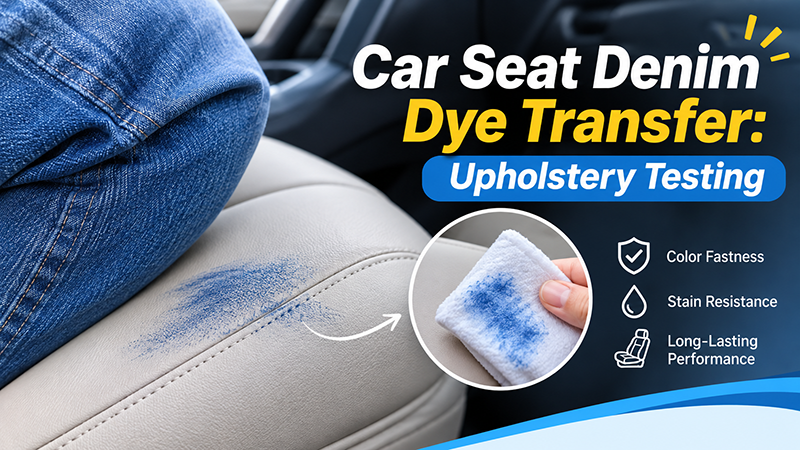
Car seat denim dye transfer should be tested as incoming staining of the upholstery, not confused with colour rubbing out of the seat material. For a light-coloured seat programme, specify the donor material, test method, conditioning and evaluation sequence before comparing candidates. Review both the remaining stain and any change caused by the approved cleaning procedure. A surface that looks clean after an uncontrolled wipe demonstration has not established repeatable resistance for the intended automotive application.
Identify which material is donating the colour
In the purchasing problem addressed here, denim is the donor and the seat surface is the receiver. That direction matters. A report showing that an upholstery material does not readily colour a white rubbing cloth answers a different question from whether a light seat accepts transferred denim colour.
Write the direction explicitly in the test request. Include the seat material code, colour and surface construction. A phrase such as “good crocking” can otherwise be interpreted as an outgoing-colour test when the buyer is concerned about incoming blue staining. Ask the laboratory to confirm the method’s scope before accepting the quotation.
For a proposed silicone automotive upholstery surface, request evidence for the actual candidate rather than a material-family claim. The same discipline applies to other constructions. Do not turn the word “silicone” into an unsupported promise that every denim stain can be removed.
Choose a car seat denim dye transfer method that matches the question
The CFFA test-method publication distinguishes CFFA-70, addressing denim colour transferred to coated fabric by rubbing, from CFFA-7, addressing colour transferred from the coating to another surface. Its denim method also includes a defined cleaning and evaluation sequence. Confirm the applicable edition and customer requirements with the laboratory.
Do not reproduce a few settings from a summary and label an improvised trial as a standard test. The complete selected procedure governs specimen preparation, donor material, apparatus and evaluation. If the customer specifies another method, follow that requirement and identify any agreed deviations in the report.
A standard method provides a reproducible framework; the buyer still needs an acceptance requirement appropriate to the programme. Avoid comparing unrelated ratings without their scales and conditions. A numerical grade is not meaningful if the receiving surface, cleaning sequence or assessment point has changed.
| Question | Test direction or control | Common interpretation error |
|---|---|---|
| Does denim stain the seat? | Defined donor against upholstery receiver | Using only outgoing upholstery crocking data |
| How much stain remains? | Assessment at the specified procedure stage | Mixing before-clean and after-clean grades |
| Did cleaning alter the surface? | Unstained cleaning control | Treating reduced blue colour as the only outcome |
| Does a particular garment create a concern? | Clearly labelled supplementary garment trial | Calling an uncontrolled jeans test standard-compliant |
| Does the candidate meet the programme? | Exact construction and agreed acceptance limits | Extending one result to every colour and finish |
Image placeholder: A labelled denim donor and light upholstery receiver, with separate outgoing-colour and incoming-stain arrows. Conceptual illustration, not a representation of a certified test result.
Keep the donor controlled
Use the donor specified by the selected procedure and retain its identification. If the programme also wants to investigate a real garment associated with a complaint, treat that as a supplementary trial with its own record. Record its known preparation and history rather than assuming every pair of jeans creates the same exposure.
A retail garment can help reproduce a particular observation, but it should not silently replace the prescribed donor in a comparison intended to be standardised. Separate those results in the report. This allows the buyer to learn from the complaint without confusing a diagnostic exercise with the formal acceptance test.
Keep the receiver equally controlled. Test the exact finish and colour under review and identify the material lot or sample source. If the supplied prototype differs from the production-intent construction, state that limitation before the result is used to release a seat programme.
Separate stain removal from surface damage
The evaluation should distinguish residual colour from changes in gloss, texture or surface integrity. These are separate observations. A cleaner might reduce the visible blue mark while leaving an appearance the buyer would reject. Therefore the approval should not be based on a single photograph labelled “clean.”
Alongside the prescribed test sequence, consider an agreed unstained cleaning control when investigating cleaning effects. Compare it with an untouched reference under the same viewing arrangement. This proposed diagnostic control helps separate a cleaner-related change from the staining exposure; it should not be misrepresented as a mandatory addition to every published method.
Use only the procedure specified for laboratory testing or the care process authorised for the actual material. This article is not a consumer stain-removal recipe. Do not recommend stronger solvents, abrasive pads, heat or unapproved chemicals to rescue a failed sample. Such intervention would change the question being tested and could damage the surface.
Define the sequence before seeing the result
Write down when the stained specimen will be evaluated, whether cleaning is part of the selected method and when the post-clean assessment occurs. Keep the procedure’s required stages intact. If additional observations are useful, identify them separately rather than replacing the formal endpoint with a more favourable one.
For development comparisons, retain images at the agreed stages using consistent lighting and framing. Include an unstained reference in the comparison where practical. Do not let automatic camera exposure or a different background become the apparent explanation for a lighter stain.
If a customer requires preconditioning before the dye-transfer assessment, name the exact exposure and recovery conditions. Compare like constructions under that plan. A result on fresh material should not be described as proof of performance after every service exposure, and a conditioned result needs its conditions attached to remain interpretable.
Read a supplier report as an application-specific record
A useful report identifies the method and edition, donor, receiving material, specimen preparation, conditioning, cleaning sequence, rating system and individual results. Ask how the tested sample relates to the proposed production material. A broad certificate without a traceable sample identity provides little help in deciding whether the exact light-coloured seat surface is acceptable.
Keep incoming staining evidence separate from outgoing colourfastness, abrasion and other material requirements. Each may be relevant, but one does not substitute for the others. Within the wider automotive upholstery specification, give each requirement its own acceptance evidence and responsible reviewer.
Do not promote one passing laboratory result as a lifetime stain guarantee. The evidence supports the named test conditions and construction. The article’s purchasing objective is to make the comparison repeatable and the decision traceable, not to predict every garment, exposure or care history a vehicle may encounter.

Use failures to guide the next controlled trial
If residual stain is unacceptable but the cleaning control is unchanged, discuss the receiving-surface candidate and exposure requirement with the supplier. If the control also changes, investigate the compatibility of the cleaning sequence separately. These observations guide the next question; they do not prove a chemical mechanism by themselves.
If results vary across replicates, inspect specimen identity, donor handling and test execution with the laboratory before averaging away the difference. If the material construction changes during development, repeat the relevant approval under the agreed change-control plan. Keep earlier results attached to their original samples rather than transferring them to a revised finish.
For a field complaint, preserve the affected material details, known garment history and cleaning actions. Do not repeatedly treat the seat before evidence is documented. The manufacturer or authorised service team should assess the actual seat and care restrictions; the material investigation should not become an instruction to modify vehicle components.
Turn the test brief into a usable material enquiry
State the seat zone, proposed light colour, surface construction, customer method and acceptance requirement. Include whether the programme is comparing incoming staining, approved cleanability or both. If a specific complaint garment is involved, describe that supplementary investigation separately from the formal qualification request.
To compare material candidates, send Wandaoleather the light-seat colour reference and denim-transfer test brief. Include the specified cleaning sequence and required report scope so sample evaluation targets the actual purchasing decision.
Frequently Asked Questions
Does good upholstery crocking performance prove denim stain resistance?
Not by itself. Outgoing colour from the upholstery and incoming colour from denim are different test directions. Select evidence that addresses the receiver-side staining concern.
Can any pair of jeans be used for a standard test?
No. Follow the donor requirement in the selected method. A particular garment can be used in a separately identified diagnostic trial, but it should not silently replace the specified test material.
Should the buyer assess the sample before or after cleaning?
Follow the selected method’s required sequence and endpoint. Record additional observations separately, and do not compare a before-clean result with an after-clean grade as though they were equivalent.
Why include an unstained cleaning control in an investigation?
It can help distinguish surface changes caused by the cleaning procedure from changes associated with the staining exposure. Treat it as a defined diagnostic comparison alongside the applicable formal method.
Is silicone upholstery automatically immune to denim staining?
No universal immunity is established here. Evaluate the exact surface, colour and construction under the programme’s selected method and acceptance criteria.
Does one passing report guarantee that a seat will never stain?
No. A report supports its named construction and test conditions. It does not predict every garment, exposure or care history encountered in service.