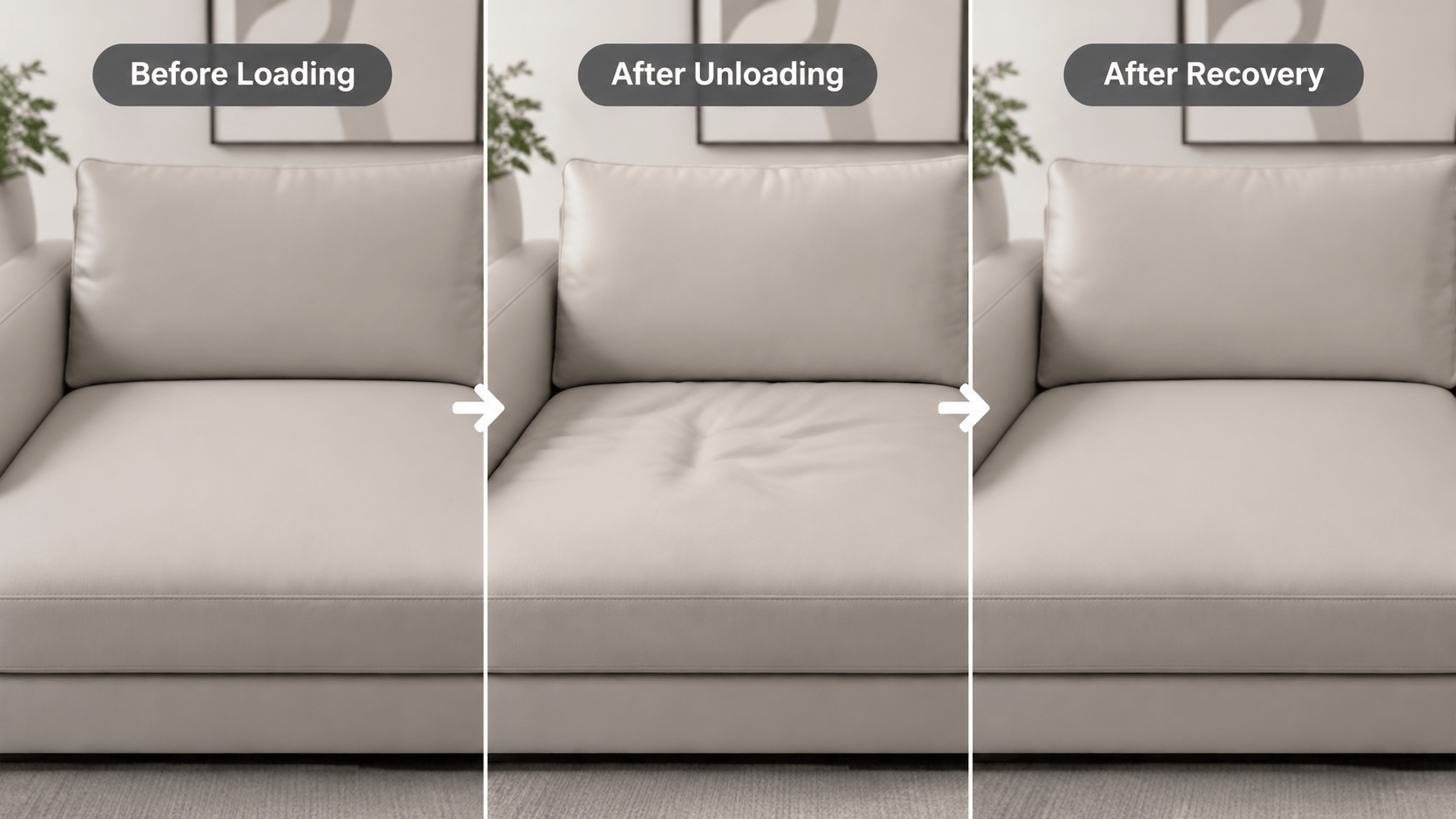
Microfiber leather sofa bagging should be investigated as a cushion-assembly problem before it is labelled permanent material stretch. Broad looseness after sitting can involve the cover, insert, support or their combination. Compare the same construction before loading, immediately afterwards and after an agreed recovery interval. Then use controlled cover-and-insert comparisons to narrow the cause. A tight showroom sample or a single photograph of a used cushion is not enough to decide whether to accept, rework or replace the material.
Describe the symptom without deciding the cause
Start by locating the change. Is it a broad loose area across the seat top, a narrow ripple beside a seam, a depressed insert or movement near an edge? This article concerns broad cushion pooling after use. Local sewing puckers and material wrapping around an armrest need different investigations and should not be combined into one complaint called “stretching.”
Record when the symptom appears and what happens afterwards. Note whether it was present before use, appears immediately after unloading or remains at the agreed inspection time. Include any manual smoothing or cushion adjustment. If one sample is fluffed before photography and another is not, the pictures do not describe the same condition.
Also distinguish an appearance complaint from a measured dimensional change. A loose-looking surface does not, on its own, identify which component changed. Ask the furniture maker to document the cover pattern, insert construction and support arrangement. That record establishes what is being compared before a material supplier is asked to explain the result.
Why microfiber leather sofa bagging needs assembly evidence
The ACT coated-fabric physical properties guideline does not set a universal minimum for stretch and set. It explains that recovery is affected by furniture construction and fabrication, including foam-related factors, and recommends consultation with both material and furniture suppliers.
For buyers considering microfiber furniture upholstery, the practical implication is to approve the intended cover-and-cushion combination. A material family name does not define its behaviour on every cushion. Record the exact construction and orientation, then evaluate it on the assembly for which it is being purchased.
The workflow below is a proposed engineering investigation, not a published universal sofa acceptance test. The manufacturer and buyer should agree the loading, observations and limits before using it for a purchasing decision. Laboratory tests can support the investigation, but their results must retain their own scope.
Establish a repeatable baseline
Identify each cushion, cover and insert separately. Record relevant dimensions using the same measurement procedure, and photograph the unoccupied assembly from fixed positions. Check that the cushion is installed according to the furniture maker’s procedure. An improperly positioned insert or a different support arrangement would introduce an avoidable comparison error.
Agree the observation zones and the language used to rate them. For example, distinguish central pooling from front-edge displacement and seam movement. Use annotated photographs or agreed dimensional references rather than an undefined instruction such as “must look tight.” The approved design may intentionally have some ease; the acceptance record should say what is intended.
Keep the sample’s history. Prior loading, storage, cleaning and assembly adjustments can affect interpretation. A newly made cover on a used insert is not automatically comparable with an untouched reference cushion. If the investigation involves returned furniture, retain that history and label any uncertainty instead of treating every component as equivalent.
Use a crossed cover-and-insert comparison
Where the designs are compatible and the manufacturer approves the procedure, compare a reference cover and candidate cover with a reference insert and candidate insert. This creates four combinations rather than a simple comparison of two entirely different cushions. Keep the support, installation method and observation sequence consistent.
| Combination | Purpose | Interpretation boundary |
|---|---|---|
| Reference cover + reference insert | Confirm the baseline result | A changed baseline may indicate a wider setup issue |
| Candidate cover + reference insert | Look for a cover-associated difference | Pattern, material and sewing may still need separation |
| Reference cover + candidate insert | Look for an insert-associated difference | Insert geometry and construction remain relevant |
| Candidate cover + candidate insert | Evaluate the intended production pairing | An interaction may not appear in either isolated comparison |
Use enough repeat observations to check that the result is reproducible under the agreed plan. If the issue follows the candidate cover across inserts, investigate the cover-related variables next. If it follows the insert, examine that side of the assembly. If it appears only in one pairing, preserve the interaction as a finding rather than forcing a single-component explanation.
This comparison is not conclusive by itself. Covers may differ in pattern or prior history, and inserts may differ in geometry as well as material. Record those differences and narrow them in subsequent trials. The benefit is a more disciplined next question, not permission to announce a root cause after one swap.
Measure recovery under agreed conditions
Have the furniture team define a representative and safe loading procedure. Record load location, duration, repetitions and relevant environmental conditions. A casual sit test by different people may help identify a concern, but it should not become the sole basis for comparing suppliers or rejecting a production batch.
Inspect immediately after unloading and at the pre-agreed recovery interval or intervals. Record the actual times. Do not select a favourable time after seeing the results, and do not describe a change as permanent solely because it remains immediately after unloading. If the test is too short to support that conclusion, report only what was observed.
Keep any smoothing, repositioning or routine maintenance step explicit. The buyer may choose to evaluate both untouched recovery and the result after an approved care action, but those are different outcomes. A sample should not receive an unrecorded intervention that the reference sample did not receive.
Separate the next checks by the observed pattern
If the effect appears cover-associated, review pattern dimensions, orientation, sewing and material identity. Where a material test is appropriate, ask the laboratory to select a method for the specific dimensional-response question. Do not substitute a high abrasion result for evidence about broad-cushion recovery; it answers another question.
If the effect appears insert-associated, review insert dimensions and construction with the furniture manufacturer. Compare the support condition as well. A visible depression should be investigated before changing the cover pattern to conceal it. The corrective action should address the demonstrated issue rather than simply making the surface look tighter for inspection.
If the result depends on the pairing, develop the combination together. Do not assume that more padding or a smaller cover is a universal fix. Either change can alter other aspects of fit and appearance. Keep the original reference, change a controlled variable and repeat the agreed evaluation before approving the revision.
For alternative constructions in the furniture material range, request a comparable trial rather than a blanket “anti-bagging” promise. The meaningful purchasing statement is that a named combination met a defined acceptance procedure, not that a whole material category will remain taut in all furniture.
Image placeholder: Four labelled cover-and-insert trial combinations arranged beside the same support fixture, with separate component identifiers and an appearance observation sheet.
Turn the finding into an acceptance decision
Agree whether the tested condition matches the approved reference, requires a controlled revision or needs further investigation. Record the appearance at the specified time, not just a general pass statement. If the evidence is inconclusive, identify the next variable to isolate and keep the affected approval open.
A production release should identify the material construction, cover drawing, insert specification and support arrangement that were accepted. Include the observation procedure and the permitted appearance reference. This prevents a later argument in which purchasing assumes approval covers all cushions while development intended it for one particular design.
For complaints, preserve the affected component identities and avoid reworking every item before evidence is collected. Segregate the relevant samples through the normal quality process and compare them with retained references. Any decision about broader stock should follow the actual traceability and findings, not a guess based on one photograph.
To discuss a material comparison, send Wandaoleather the cushion construction, cover details and timed appearance observations. Include what remained constant during the trial and which component changes are under consideration. That information supports a more useful review than the word “sagging” alone.
Frequently Asked Questions
Does pooling after sitting prove permanent material stretch?
No. It is an observed appearance change, not a cause diagnosis. Record recovery and compare the cover, insert and support before attributing the result to permanent dimensional change.
Is bagging the same as seam puckering?
No. Broad looseness across a cushion and local ripples beside a seam are different symptoms. Locate and record them separately so the investigation does not apply a sewing correction to an unrelated cushion issue.
What recovery time should be used?
Agree the observation intervals with the furniture manufacturer and buyer before the trial. This article does not establish a universal interval; report the actual times and conditions used.
Why swap covers and inserts during development?
Compatible, controlled comparisons can help show whether a difference follows the cover, the insert or one particular pairing. They guide further investigation but do not by themselves prove a single root cause.
Will a tighter cover necessarily solve the problem?
No. A pattern change can affect other aspects of fit and appearance. Validate any revision on the intended assembly rather than using additional tension as a universal remedy.
What should be named in the final approval?
Identify the material, cover revision, insert and support combination, together with the loading and observation procedure and accepted appearance reference. The approval should remain specific to that recorded construction.