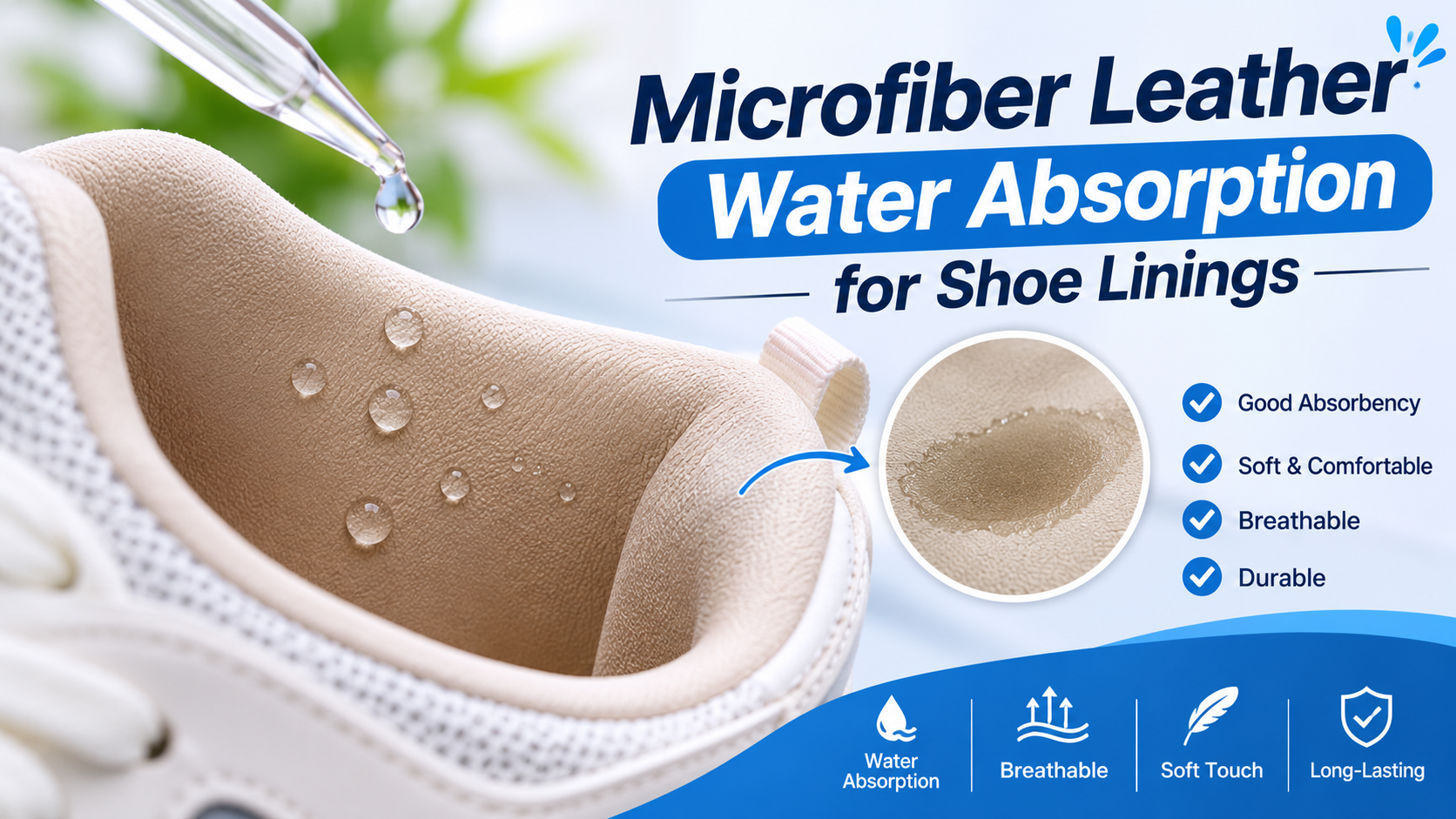
Microfiber leather water absorption for shoe linings should be evaluated together with the release of retained liquid under defined drying conditions. A high uptake result alone does not tell a buyer whether the lining will be ready for the next wear period. Specify the component, liquid exposure and drying assessment separately from water-vapour tests. Then compare the candidate lining and relevant assembly using an agreed procedure, without turning a laboratory mass change into a guaranteed dry-foot or comfort claim.
Define microfiber leather water absorption as a liquid-contact question
This guide addresses a lining that becomes wet through a defined liquid exposure and the way it subsequently dries. It does not repeat a general breathability comparison. The purchasing task is to decide whether a candidate handles the agreed wetting-and-drying sequence acceptably for its position in the shoe.
The microfiber leather for shoes selection page provides the construction starting point. Identify the lining code, finish, thickness, backing and intended position. Do not substitute an ordinary microfiber cloth result for evidence about a coated footwear material.
Clarify whether the component is a quarter lining, tongue lining, insock covering or something else. These names affect both the real assembly and the choice of method. A report that says only “shoe material” may not provide enough information to judge relevance.
Keep liquid uptake, vapour uptake and transmission apart
Liquid-contact assessment concerns what happens when the specimen meets liquid under the defined procedure. A vapour-absorption assessment concerns moisture taken up from a vapour environment. Vapour permeability concerns passage through the specimen. The word “absorbent” alone does not identify which result a supplier is offering.
ISO 17699:2003 addresses water-vapour permeability and absorption for footwear uppers and linings. It should not be cited as though it measures liquid-water uptake or drying after a soak. Keep its results in the separate vapour portion of the material brief.
| Question | Required evidence description | Invalid shortcut |
|---|---|---|
| How much liquid is retained after exposure? | Liquid, exposure and post-exposure handling | Substituting a vapour result |
| How much is released during drying? | Drying conditions, interval and calculation basis | Assuming higher uptake means faster drying |
| How does vapour pass through? | Relevant permeability method and specimen | Using a wet mass measurement |
| How does the shoe feel in use? | Appropriate finished-shoe assessment | Guaranteeing comfort from one material number |
The distinction matters when comparing quotations. One supplier may report a percentage of initial specimen mass, another a quantity per area and a third a vapour property. Preserve the original units and definitions until the laboratory confirms whether any comparison or conversion is valid.
Select the method by component, not by a familiar number
ISO 22649:2016 provides static and dynamic water-absorption and desorption methods for insoles and insocks. That component scope matters. It is not automatically a general quarter-lining method simply because both materials are used inside shoes.
If the candidate is genuinely being assessed as an insock component, discuss the applicable procedure with the laboratory. If the task concerns a different lining position, ask for an appropriate method or a clearly documented development procedure. An adapted assessment should be identified as adapted, not presented as an unchanged standard result.
The test request should describe the decision: comparing liquid retention, evaluating drying under a specified environment or investigating changes after repeated wetting. A laboratory can select a more defensible approach when it knows the question instead of receiving only an unexplained standard designation.
Do not use ordinary water exposure as evidence of every effect associated with perspiration. If the project needs a defined artificial-perspiration assessment, specify that separately with qualified testing support. The liquid identity is part of the evidence, not an interchangeable detail.
Control the mass measurements before ranking materials
A wet specimen can carry liquid on its surface as well as within its structure. The selected method’s removal of excess liquid, timing and weighing procedure therefore matter. Do not compare casually blotted samples with specimens prepared by a controlled laboratory procedure.
Record the initial conditioning and mass basis. Include specimen dimensions, identity and which face or edges were exposed as required by the procedure. A small cut coupon may offer a different exposed-edge relationship from a large finished panel; note that limitation when interpreting a development comparison.
For a project-specific drying comparison, have the laboratory define the environment, support, orientation and observation intervals. Record whether the specimen is free-standing or part of a bonded assembly. Do not accelerate drying with an undocumented heat source and compare it with an ambient result.
Keep raw observations with the calculated result. If a percentage is reported, state its denominator. “Percentage of absorbed water released” and “percentage mass loss relative to the original dry specimen” describe different calculations. A number without that definition is not a usable purchasing specification.
Use a profile rather than a single isolated endpoint
Where the development question concerns drying over time, an agreed sequence of observations can be more informative than one final reading. It can show whether candidates differ during the interval relevant to the project. This is a proposed comparison approach, not a universal schedule or a claim that one interval predicts every use pattern.
Retain an untreated reference and record any physical change after exposure. A specimen may lose retained liquid while developing an unacceptable appearance or handling change. The drying number should not hide another failure included in the lining specification.
Compare the lining with the assembly it will join
A loose sheet is useful for screening. The relevant shoe position may also include adhesive, foam, reinforcement and an outer upper. As an engineering consideration, these layers can change exposed surfaces and drying paths. Describe them before extending a sheet result to the complete component.
Prepare representative assemblies using recorded layer order and bonding details. Ask the laboratory which procedure can assess them appropriately. If the assembly falls outside a standard specimen arrangement, report the development comparison transparently rather than attaching the standard number without qualification.
Compare like with like. Holding the lining constant while changing the assembly can investigate construction effects. Holding the assembly constant while changing the lining can support material selection. A comparison that changes both is a system trial, and its conclusion should be framed accordingly.
The broader synthetic leather selection guidance for footwear helps connect this moisture task to the full shoe brief. Liquid uptake does not establish rubbing, flex, bonding or other required performance. Keep the approval package complete without treating every property as the same moisture claim.
Interpret high uptake and fast release against the actual objective
Do not rank candidates by maximum absorption alone. If the development concern is retained dampness, the release behaviour and relevant assembly are part of the decision. If the concern is a different liquid-contact function, define that function explicitly before choosing the preferred result.
Likewise, a low uptake reading does not automatically mean the shoe is waterproof or comfortable. It describes the specimen under its exposure procedure. Water entry into a finished shoe and wearer experience require different evidence.
Where repeated use matters, agree whether repeated wetting-and-drying cycles are needed and what is inspected between them. Do not convert a chosen laboratory cycle count into a service-life claim. Use the sequence to answer the specified development question and retain the observed changes.
If candidates show similar laboratory results but different wear feedback, investigate the whole-shoe build and trial conditions. Socks, fit, activity and environment belong to a wear assessment. A material mass measurement cannot identify every contributor to a wearer’s description of dampness.
Report an unresolved result honestly
If specimen handling or drying conditions differed between candidates, repeat the comparison under a controlled arrangement before choosing a winner. Keep the earlier observations as exploratory work, not approval evidence. This is more informative than averaging results that answer different questions into a single moisture score.
Write a liquid-contact requirement the supplier can act on
State the component, construction, liquid, method or procedure revision, specimen arrangement, reported units and acceptance rule. Identify whether approval concerns the sheet or assembly. If the target is still under development, describe it as a comparison objective rather than inventing a pass threshold.
Retain the approved material and build record with the report. Review changes to finish, backing, thickness, bonding or added layers for their relevance to the assessment. A familiar material name should not allow an unrecorded construction change to inherit the old result.
For a focused sample request, send Wandao Leather the lining position and liquid-contact problem you need to investigate. Include the proposed assembly, current reference and laboratory procedure where available. This makes the request more useful than asking only for “highly absorbent microfiber.”
Frequently Asked Questions
Is liquid-water absorption the same as breathability?
No. Liquid uptake, vapour absorption and vapour transmission are different assessments. Name the property, method and specimen before comparing supplier results.
Does higher absorption always make a better shoe lining?
No. Judge uptake together with the relevant release behaviour, assembly and project objective. One absorption value does not establish wearer comfort.
Can ISO 22649 be used as a general lining claim?
Its stated scope is insoles and insocks. For another lining position, confirm a suitable procedure with the laboratory and identify any adaptation explicitly.
Why does removal of surface water matter?
Residual surface liquid can affect the measured wet mass. Follow the selected procedure’s handling and timing so results are comparable rather than dependent on casual blotting.
Does a fast-drying swatch prove the complete shoe dries quickly?
No. Evaluate the relevant assembly and, where required, the finished shoe. Adhesive, foam, reinforcement and the surrounding construction are not represented by every loose-sheet test.
Does a water test cover perspiration resistance?
Not automatically. The test liquid and assessment purpose must match the claim. Specify any required perspiration-related evaluation separately with the laboratory.