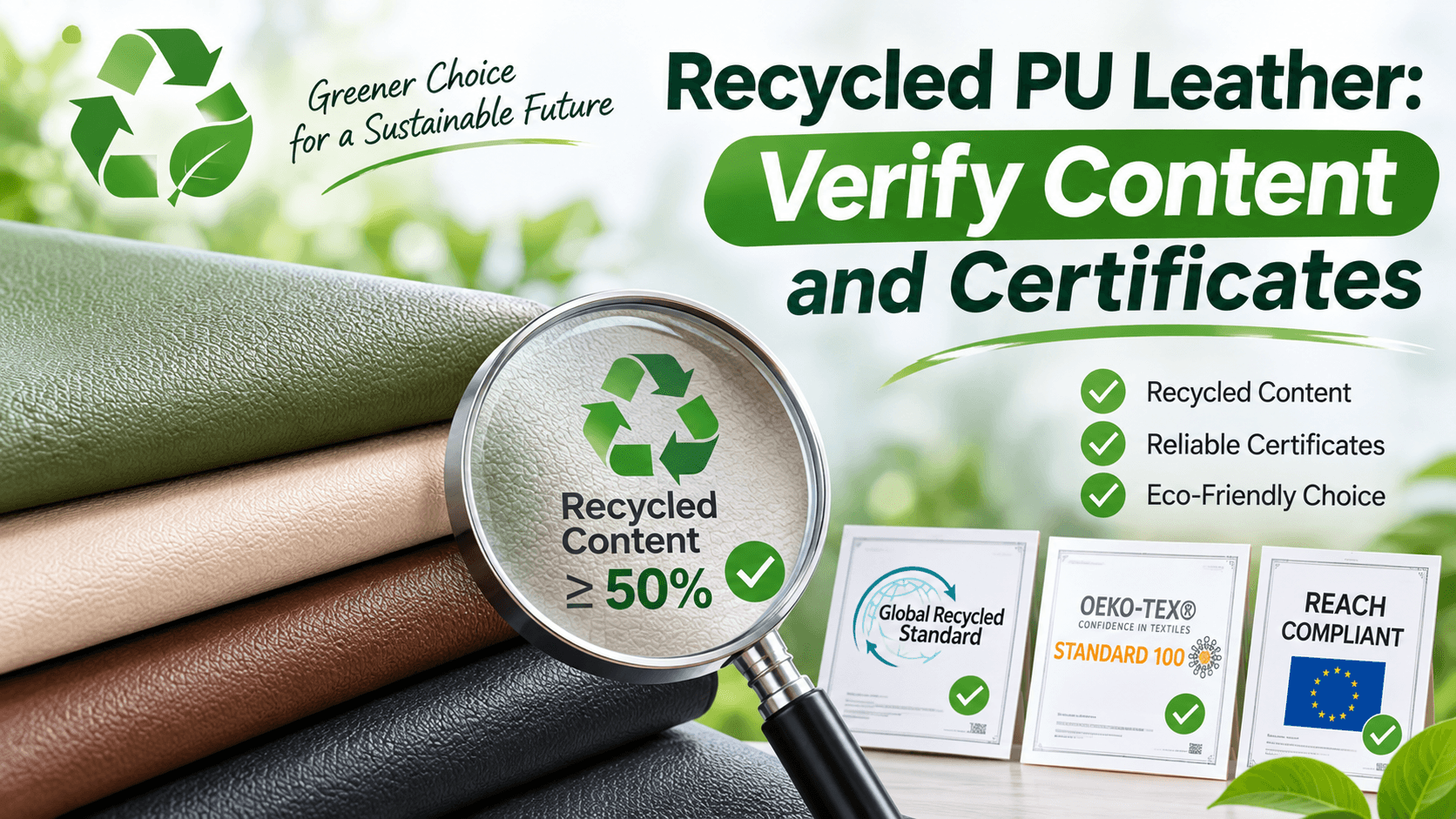
Recycled PU leather should be purchased against a defined composition claim, not a percentage detached from its denominator. Ask whether recycled content applies to the textile backing, the polyurethane system or the complete supplied composite, then obtain the records supporting that exact claim. A certificate for a supplier is not the same evidence as a verified shipment. Keep content verification separate from durability, recyclability and broader environmental claims, each of which needs its own appropriate basis.
Define what recycled PU leather means in the quotation
The first question is simple: which material is recycled? A quotation may describe recycled polyester in a backing while the face coating remains a separate component. Calling the entire construction “recycled PU” can obscure that distinction. Request a layer description before comparing percentages or premiums.
The PU leather material selection page explains the commercial construction discussion around surface, backing and processing needs. This guide adds a purchasing evidence framework; it does not state that Wandao Leather holds a particular recycled-content certification or that every listed construction is available with recycled inputs.
Define the unit being bought: an unfinished backing, a finished coated roll, a laminated panel or a complete bag. A percentage valid for one unit should not be copied to another after additional components are included. Write the claim boundary into the request for quotation.
Check the denominator before comparing percentages
For a straightforward physical-content calculation, the relevant ratio is verified recycled material present within the defined product boundary divided by the total mass within that same boundary. Component percentages must be weighted by component mass; they cannot simply be averaged.
Consider an invented example, not a Wandao product specification. Suppose a backing makes up 60% of a finished composite’s mass and half of that backing is verified recycled material. If every other component has zero recycled content, the whole-composite result is 0.60 × 0.50 = 0.30, or 30%. It is not 50%.
| Hypothetical component | Share of composite mass | Recycled fraction within component |
|---|---|---|
| Backing | 60% | 50% |
| All other components together | 40% | 0% |
| Whole composite | 100% | 30% by the stated calculation |
The arithmetic does not prove the inputs. Request the controlled bill of materials, component-mass basis and evidence supporting each recycled fraction. A tidy spreadsheet cannot compensate for an unsupported supplier declaration or a mismatch between the calculation and delivered construction.
Distinguish this physical-content illustration from any allocation or accounting claim proposed by a supplier. Ask which system authorizes that accounting and what wording it permits. Do not silently treat an allocated feedstock percentage as the same statement as physically incorporated recycled content.

Request evidence that follows the actual order
Ask for the exact article code, construction revision, recycled-input identity and relevant production or shipment references. Identify whether the input is described as pre-consumer or post-consumer and obtain the applicable supporting records. Do not assume every factory offcut automatically qualifies under a particular scheme.
Textile Exchange’s RCS and GRS overview describes third-party verification of recycled materials and their chain of custody. That is useful context for selecting evidence, but the name of a scheme is not enough to establish the content of a particular roll.
Separate scope evidence from transaction evidence. Check the relevant certified organisation, site, activities and product information, then connect the order to the applicable transaction documentation. A company presentation containing a certification logo should not close that review.
Use Textile Exchange’s certificate-authentication routes to check scope and transaction documents, and refer unresolved questions to the issuing certification body. Compare returned details with the documents and order rather than merely confirming that a certificate number exists.
Build a reconciliation trail the buyer can follow
A practical order file links the purchase description, supplier article, certificate references where applicable, invoice, delivery and lot identification. If the commercial name differs from the certified product description, obtain a documented explanation. Similar wording is not a substitute for a traceable mapping.
Resolve quantity, date or organisation mismatches before using the evidence in a claim. An administrative correction may be straightforward, but until it is resolved the buyer should not assume what the document was intended to cover. Keep the corrected record with the order.
Account for the current standards transition
As checked in October 2026, Textile Exchange states that the Materials Matter Standard becomes effective on December 31, 2026, with mandatory Tier 4 transition from December 31, 2027. Its transition information also identifies later claims-and-labels deadlines. Check the applicable policy for the organisation’s supply-chain role and claim date.
Do not interpret this timeline as an instruction to reject every existing RCS or GRS document immediately, or as permission to use a future label now. Ask the certification body which current requirements govern the transaction and proposed claim. The contract should identify the required evidence at the relevant delivery and communication dates.
A long-running sourcing programme may cross a transition date between development and shipment. Assign responsibility for monitoring the applicable documentation and label requirements. The approved material sample and the approved claim wording are related records, but they are not the same approval.
Keep content verification separate from performance approval
Recycled-content evidence does not answer whether the construction meets a bag’s fold, seam, appearance or other requirements. Compare candidate materials against the same intended-use specification, using representative samples. Avoid assuming either better or worse durability from the recycled label alone.
For bag projects, the synthetic leather selection guide provides the application context. Confirm the actual surface, backing, thickness and assembly behaviour while the sourcing team verifies the content trail. Neither workstream should be allowed to stand in for the other.
Similarly, recycled content does not establish that the finished composite is recyclable in the buyer’s market. That question concerns the complete construction and a relevant recovery route. A verified input claim should not expand into a disposal claim without separate evidence.
Do not infer a quantified carbon reduction, chemical-safety conclusion or blanket environmental benefit from the content percentage alone. If the project requires one of those claims, define a separate assessment with qualified support. This keeps a useful, narrow claim from becoming misleading through added marketing language.
Choose wording that matches the verified boundary
Prepare the proposed wording before artwork or product pages are finalised. State the material or component, the percentage basis and the scope of any certification claim. A component-qualified statement and a whole-product statement are different promises to the reader.
For internal comparison, write “backing content claim under review” when that is all the evidence supports. Do not shorten it to “certified recycled leather” in a spreadsheet that later feeds sales copy. Internal shorthand can become an external claim surprisingly easily.
Any public certification mark or scheme-specific wording should follow the applicable claim and approval requirements. A valid calculation is not, by itself, permission to use a logo. Keep the approved wording revision and the evidence owner visible in the release file.

Do not use a composition test as a shortcut to origin
Identifying a polymer in a specimen is a different question from documenting where its feedstock came from. Ask the laboratory what its analytical result can establish, and keep provenance evidence in the supply-chain record. A test report naming polyester or polyurethane should not be relabelled as proof of a recycled percentage unless the report and validated method genuinely support that conclusion.
Release the material and claim with separate checkpoints
Before order release, confirm that the quotation, composition worksheet and sample describe the same construction. Before accepting claim-bearing goods, reconcile the required shipment documentation. Before publishing wording, verify that the evidence and applicable scheme rules support that exact statement.
Define changes that reopen the calculation or verification: a different backing weight, changed coating build, new recycled-input source, additional lamination or changed supplier site. A whole-composite percentage can change even when the recycled fraction within the backing remains constant.
Where evidence is missing, specify what is pending and avoid presenting the claim as approved. The appropriate outcome may be a conditional sourcing decision rather than rejection of an otherwise promising sample. Keep that condition explicit so production urgency does not silently override the evidence review.
For a focused material request, send Wandao Leather the application, target construction and recycled-content evidence requirement. Ask which options and documentation can be confirmed for the project rather than assuming certification or availability from a general material description.
Frequently Asked Questions
Does a recycled backing make the whole PU leather equally recycled?
No. The backing’s recycled fraction must be considered against its share of the complete product mass. State clearly whether the claim applies to the backing or the whole supplied composite.
Is the 30% example a Wandao product claim?
No. It is invented arithmetic illustrating a denominator issue. Actual content requires verified component information and a calculation for the specific supplied construction.
Is a supplier’s scope certificate enough for an order?
It is not the same as transaction-specific evidence. Verify the relevant scope and connect the order to the applicable transaction records, resolving mismatches with the issuing certification body.
Does recycled content prove the material is recyclable?
No. Recycled input and end-of-life recyclability are different claims. The latter needs evidence for the complete construction and relevant recovery route.
Can a recycled-content percentage predict durability?
No. Assess the actual material and component against the intended-use requirements. Keep performance approval separate from content and chain-of-custody verification.
Should the standards transition be checked before shipment?
Yes. Confirm the applicable requirements for the organisation, transaction and claim date with the certification body. Do not assume development-stage wording remains valid through a later transition.