
PU leather blocking is unwanted sticking between surfaces in contact, and it should not be diagnosed as hydrolysis from appearance alone. For packed jackets, record which surfaces touched, how the garment was folded and what happened during separation. Then compare the material with the actual garment and packaging arrangement. A blocking test can support material selection, but its conditions are not universal storage instructions or proof that every finished jacket will unpack without damage.
Recognise PU leather blocking before choosing a remedy
A jacket that sticks when unfolded may show several different symptoms: temporary resistance to separation, a change in sheen, transferred residue or coating pulled from the opposite panel. Record these separately. The word “sticky” is useful as an initial complaint but too broad to guide a material or packaging decision.
The PU leather for clothing selection page connects finish, backing and drape with the garment construction. Add the packing arrangement to that brief. A material approved on a hanging sample may encounter different contact conditions when jackets are folded and compressed for shipment.
First decide whether the task is qualifying a new material, investigating a shipment or changing packaging. Each needs a different comparison. Do not begin by applying a household treatment to the affected surface; that can alter the evidence before the supplier or laboratory has examined it.
Separate the observation from the suspected cause
| Observation | Useful next record | What it does not prove |
|---|---|---|
| Two panels resist separation | Contact faces, separation behaviour and visible damage | Hydrolysis or a particular chemical cause |
| Residue appears near a label or seam | Location relative to adhesives and construction details | That the whole PU sheet is defective |
| Sheen changes without residue | Lighting, surface texture and paired contact area | The same mechanism as coating transfer |
| Coating lifts when opened | Both mating surfaces and the separation path | Whether the initial cause was sticking or weak adhesion |
Possible explanations include contact-related surface adhesion, material degradation or contamination from another part of the garment. These are engineering hypotheses. A sticky area beside a label is a reason to inspect the label system; it is not proof that its adhesive caused the problem.
Likewise, do not use “hydrolysis” as a synonym for every damaged PU surface. Confirming a degradation mechanism may require a laboratory investigation with comparison material and process history. A photograph of two stuck panels cannot establish the chemistry responsible.
Use blocking standards for their actual purpose
ISO 5978:2023 specifies assessment of blocking resistance for coated-fabric sheets held in contact under defined temperature, time and pressure. Those variables explain why a report must include its test conditions. A result detached from them does not tell the buyer what was challenged.
ASTM D751-26 includes an elevated-temperature blocking procedure among its coated-fabric methods. Ask for the exact section and specimen details, not a certificate that says only “D751 passed.” Have the laboratory confirm the method’s suitability for the garment material.
Do not turn a laboratory temperature into a recommended wardrobe, warehouse or shipping temperature. Nor should a short exposure be translated into a number of months of storage without a validated basis. The buyer’s packing and logistics conditions remain a separate development question.
The public method summaries establish scope; they are not a complete test recipe. Commission the controlled procedure from a competent laboratory and agree the acceptance requirement before the test. This avoids choosing the most favourable interpretation after seeing the result.
Map the real contacts inside the package
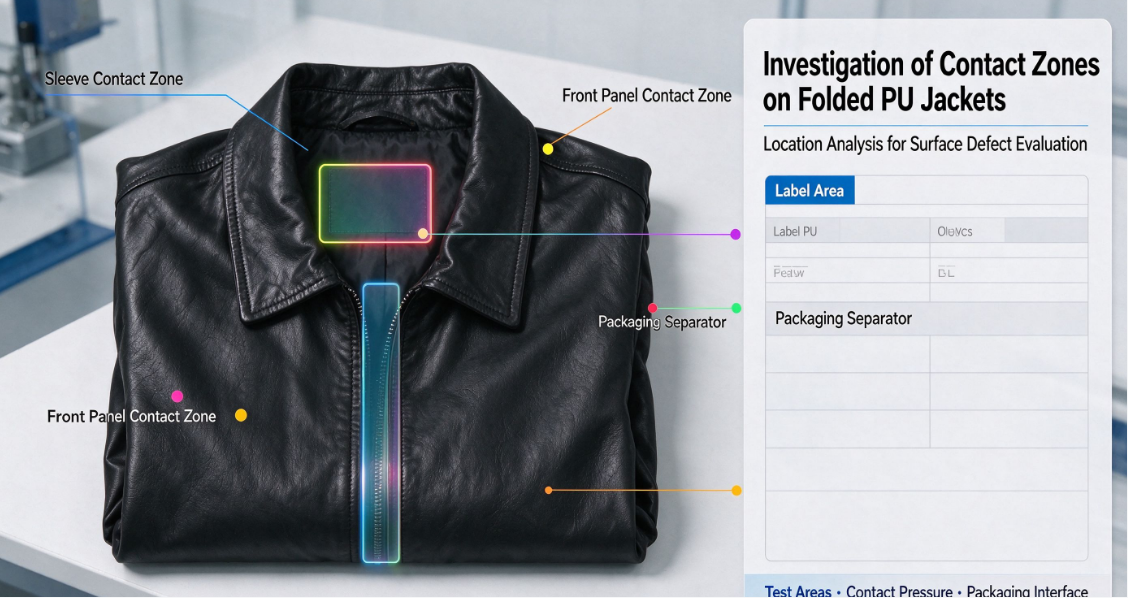
Lay out the intended fold and identify what touches what. Depending on the design, the PU face may contact another PU face, lining, print, label, trim or packing material. A material-to-material test does not automatically represent all of those pairs.
Record the garment size and packing format used for the trial. Include the number and arrangement of garments where relevant to the agreed assessment, but do not prescribe a universal stacking quantity. The goal is to represent the project’s packing arrangement, not invent a generic test for every jacket.
Keep the packaging components identifiable. If a separator is changed, retain its description and sample. A recommendation to “add tissue” is incomplete until the selected material has been checked with the actual finish and garment. A separator that changes transfer or appearance is not an acceptable solution simply because it reduces direct contact.
Use the broader clothing leather guide when defining the application, but freeze the particular garment and packing details for the trial. The visible PU surface is only one part of this approval decision.
Preserve useful evidence from a sticking complaint
Before separating every affected area, photograph the package and note where the sticking occurs. Keep representative unopened or undisturbed samples when practical and follow the responsible quality team’s handling instructions. Record which surfaces were paired so that damage on one can be compared with marks on the other.
Document known production and storage history without filling gaps with guesses. Useful records include lot, manufacturing date, finishing or assembly revision, packing date and any available logistics information. If the temperature history is unknown, say so; do not reverse-engineer it from the appearance of the damage.
Avoid cleaning, dusting, heating or applying solvents to the only available evidence. If a remediation trial is later authorised, retain an untreated comparison first and record the treatment. Otherwise, a changed surface can make the original complaint harder to investigate.
Separate stock containment from diagnosis. The quality team may need to hold the affected lot while evidence is reviewed, but that does not establish whether the eventual corrective action belongs to the material, assembly or packaging process.
Run a comparison that isolates the decision
For new-material qualification, compare traceable candidates under the same agreed blocking procedure. Then trial the shortlisted construction in representative jackets and packaging. Keep laboratory material screening and the project packing assessment as separate records, even when both inform the release decision.
For a complaint, compare the affected build with an identified reference. If changing the separator, hold the jacket construction constant. If changing the PU finish, keep the packing arrangement controlled where practical. Document any unavoidable differences so that the result is not attributed to the wrong change.
Assess more than whether the panels can be opened. The project may also need an agreed review of transfer, coating damage, imprinting or gloss change. Define the observation timing and lighting with the team conducting the assessment rather than deciding after unpacking which marks count.
A successful trial supports the specific change tested. It does not show that all colours, finishes, garment sizes or packaging formats will behave identically. Decide which variants need additional review based on the construction differences and the intended product range.
Escalate persistent or ambiguous damage appropriately
If sticking is accompanied by residue, widespread surface change or coating separation, ask a qualified laboratory what examination can distinguish the suspected mechanisms. Provide the affected material, a traceable reference and known assembly components. Do not select an analytical test merely because it produces a detailed-looking certificate.
The investigation should answer a specific question: whether the residue differs from the original surface, whether damage follows an adhesive-treated region, or whether the same effect can be reproduced in a controlled contact comparison. These questions help determine the next sample or test, rather than assuming a chemical diagnosis in advance.
Do not disguise a persistent problem with an unverified finishing or packing aid and release the lot on appearance alone. Any proposed remedy needs its own approval for the garment’s appearance, handling and applicable requirements. This article does not prescribe a consumer repair treatment.
Write a packing approval that production can repeat
Keep the approved PU code, surface reference, garment build, fold arrangement, contact materials and verification record together. Assign responsibility for reviewing changes to finishing, labels, adhesives or packaging. A new component should not inherit approval solely because the garment retains the same style number.
Specify supplier-confirmed handling and storage instructions separately from test conditions. If the project needs limits that are not yet supported, identify that evidence gap before bulk release. A narrow, documented approval is more useful than a broad claim that the material will never stick.
For sample development, send Wandao Leather the jacket design, PU reference and intended packing arrangement. Include the contact pair causing concern and any customer-specified test. This directs the discussion toward a reproducible garment outcome rather than an undefined request for a non-sticky surface.
Frequently Asked Questions
What is PU leather blocking?
It is unwanted adhesion between contacting surfaces. Record the contact arrangement and whether separation causes residue, appearance change or coating damage instead of relying only on the word sticky.
Does sticking prove the PU has hydrolysed?
No. Sticking is an observation, not a chemical diagnosis. Other material, assembly or contamination issues may need investigation, and a laboratory may be required to distinguish the mechanisms.
Does a blocking test define a safe jacket storage temperature?
No. The result applies to its specified temperature, time, pressure and specimen. Do not convert those conditions into general garment storage instructions or a storage-life promise.
Should packaging separators be tested with the jacket?
Yes, when they are part of the proposed packing solution. Check the actual contact pair and relevant appearance outcomes rather than assuming any separator will be compatible with every PU finish.
Can a sheet-level pass approve all packed garments?
Not automatically. Finished garments introduce folds, labels, trims and other contact materials. Assess the representative garment and packing arrangement separately where those factors matter.
What evidence should be kept from a sticking complaint?
Keep paired-surface photographs, material and lot identity, packing details, known storage history and untreated comparison samples where practical. Record unknowns and avoid altering all affected material before investigation.