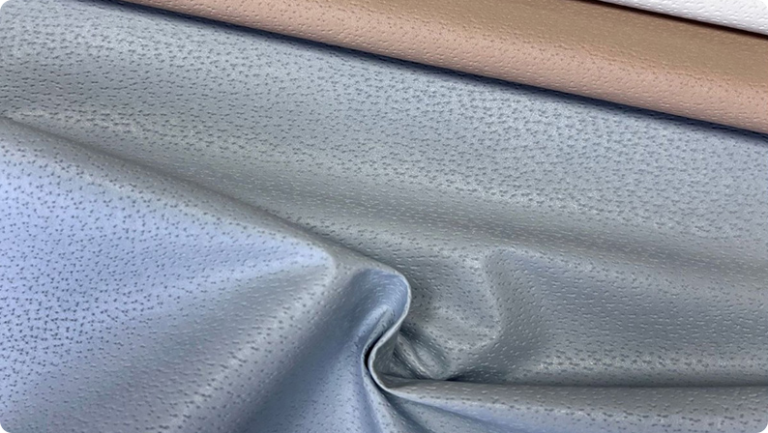
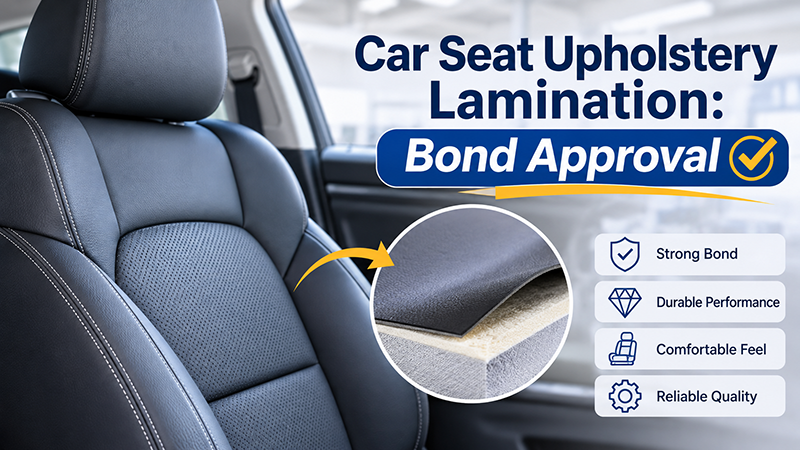
Car seat upholstery lamination should be approved as a defined face-material, foam and optional scrim construction, not by an unexplained “bond strength” number. Identify the interface being tested, use a method suitable for that construction and record where separation occurs before and after customer-specified conditioning. Coating adhesion within a PU face material is a different question from the bond to an added foam layer. Both may matter, but neither alone approves the finished seat.
Draw the stack before requesting a test
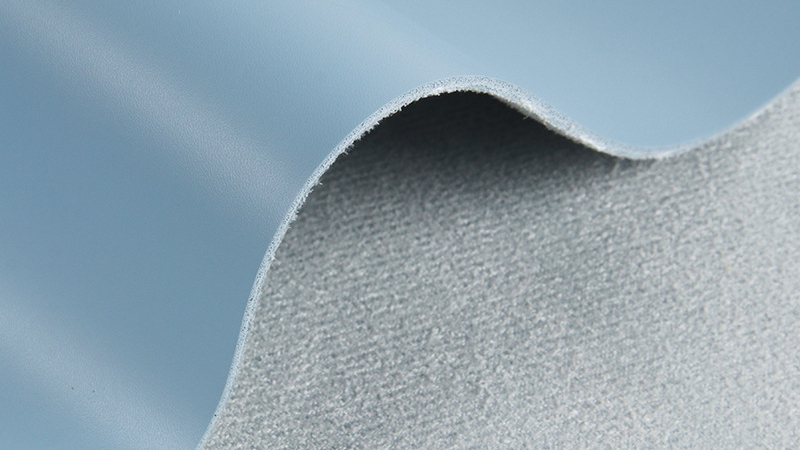
Ask the converter to identify each layer in order: the coated face material, its own backing, any added foam and any separate support layer. The exact construction varies, so do not use a generic diagram as the production specification. Assign material codes and revisions to the actual proposed components.
State who supplies the unlaminated face material and who performs the conversion. If a buyer receives a finished laminate, the release record still needs to identify the inputs and responsible process. Otherwise a complaint described as “PU peeling” may be sent to the wrong party without establishing whether the separation is in the face material or the added laminate.
For a proposed PU automotive upholstery material, provide the downstream lamination requirement at sampling. Approval of a roll as an unlaminated face does not automatically approve every foam, adhesive or conversion process that might later be combined with it.
Separate the interfaces in car seat upholstery lamination
| Observed separation | Question being investigated | What not to conclude automatically |
|---|---|---|
| Coating from its original backing | Adhesion within the face material | That the added foam bond was measured |
| Face backing from added foam | Bond at the conversion interface | That the face coating itself failed |
| Tearing inside foam | Cohesive failure within that layer | That the complete laminate is approved |
| Separate scrim or support-layer separation | Performance of that specific interface | That another interface has the same result |
| Mixed separation | Changing fracture path during the test | That one average force explains every failure |
ISO 2411:2024 addresses coating adhesion strength of coated fabrics. It is relevant when that is the interface under investigation. Do not relabel a coating-adhesion report as proof of an independently added foam bond without demonstrating that the test actually addressed that bond.
Make the intended peel path clear in the laboratory request and include the layer drawing. If specimen preparation reveals a different fracture path, have the laboratory report it. A test result becomes much more useful when the buyer knows what separated and can compare the tested construction with the delivered one.
Select a method, then agree the acceptance criteria
ASTM D903 covers comparative peel or stripping characteristics of adhesive bonds under defined specimen and test conditions. A laboratory can assess whether that method, a customer method or another procedure is appropriate for the proposed laminate. The method name alone does not supply an automotive programme’s pass limit.
Record specimen preparation, direction, width, test arrangement, speed, conditioning and reporting units as required by the selected procedure. A value without those details is difficult to compare. Do not turn a supplier’s number into a universal N/mm requirement or combine reports made with different arrangements as if their results were interchangeable.
Agree how results will be summarised and how failure modes will be recorded. Ask for individual observations and representative fracture photographs, not only a final average. If the contract requires a particular report format or sampling plan, put that requirement in the test order before specimens are prepared.
Read cohesive foam failure carefully
If separation travels through the foam, record it as a different observation from clean separation at an interface. It can indicate that the tested path was limited by the foam locally, but it is not a direct measurement of every other bond in the stack. Avoid reporting it simply as “adhesion passed” without the customer’s acceptance rule.
The buyer should review the measured result and the failure mode together. A foam tear after conditioning raises different questions from an unchanged interface separation. Ask whether the tested failure is permitted by the programme and whether the laminate still meets the other required properties. Do not infer finished-seat durability from fracture appearance alone.
Where a result is ambiguous, preserve specimens and consult the converter and laboratory. Possible explanations should remain hypotheses until the investigation supports them. Material identity, specimen preparation and test arrangement should be checked before attributing the change to a particular adhesive or foam chemistry.
Compare baseline and conditioned material without changing the question
Use the customer-approved exposure plan rather than a generic label such as “after ageing.” Identify the conditions, duration, sequence and recovery before testing. Keep baseline and conditioned specimens comparable in construction and sampling location. Otherwise a difference may reflect a changed input as well as the intended exposure.
For example, a baseline sample from one conversion run and a conditioned sample from another cannot isolate conditioning by themselves. Record both identities and either use a more controlled comparison or acknowledge the limitation. The goal is to understand a defined construction, not merely to generate two numbers for a table.
Include the visual observations required by the programme alongside the mechanical result. Record blistering, edge lift or other specified changes by location rather than compressing all observations into a single bond figure. A mechanically acceptable coupon and an unacceptable visible panel are separate findings that require a coordinated disposition.
Use a production trial to check spatial consistency
A small development piece is useful, but the release plan should address the production process that will supply the order. Agree where specimens will be taken from the converted material and how their locations will be identified. Select a sampling plan with the converter and customer; do not invent a universal number of tests per roll.
Keep records linking face-material rolls, foam batches, any additional layer and the conversion run. Retain the relevant process specification under the converter’s control. If a result changes, those records allow an investigation to focus on the affected inputs and run rather than assuming the entire material family is unsuitable.
This article does not provide flame-lamination settings, adhesive recipes or field repair instructions. Conversion should remain with qualified manufacturers using their approved equipment, controls and procedures. A purchasing request for stronger bonding is not authority to improvise a process or modify a seat assembly.
Validate the converted panel in its intended cover
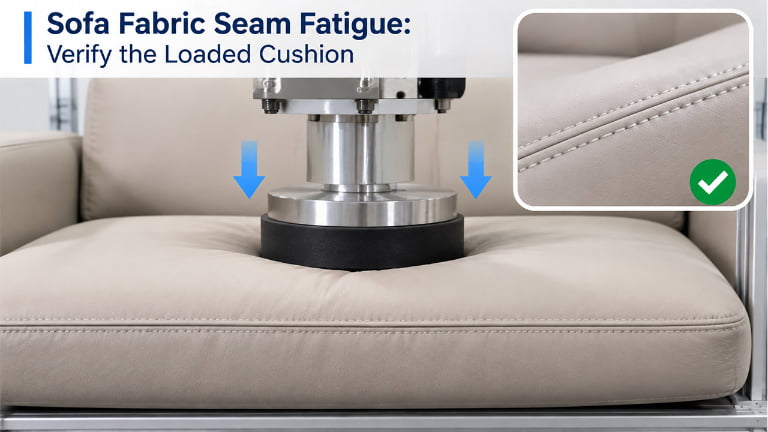
After the material-level plan passes, have the responsible seat manufacturer evaluate production-representative covers. Keep the intended seams, quilting or other approved processing in the trial where relevant. A flat laminate result does not show every consequence of manufacturing and fitting a shaped cover.
The broader automotive upholstery material brief should identify the actual seat zone and the design authority’s requirements. Laminate selection must not bypass approval for safety-relevant interfaces or changes to the seat. Do not treat a favourable peel result as permission to revise airbag-related seams, occupant-sensing arrangements or other controlled features.
Keep the scope of each sign-off explicit. Material quality may release a particular laminate specification, while the seat programme owns the assembly decision. When those responsibilities are documented, a supplier report supports the programme without being overstated as a certificate for the entire vehicle seat.
Write a purchase specification that can survive a complaint
Name the layer stack, exact material codes, converter, approved process revision, test method, conditioning, acceptance criteria and permitted failure modes. Add traceability and change-notification requirements. A future foam, backing, adhesive or process substitution should enter the agreed review route rather than inherit the original approval automatically.
For a nonconformance, preserve the actual separation evidence and affected identifiers. Compare the delivered stack with the approved one, then review test conditions. This approach gives both sides a concrete technical question and avoids a dispute based only on the phrase “weak glue.”
To prepare a sampling discussion, send Wandaoleather the seat-cover layer drawing and the laminate test requirement. Include whether the face material is supplied separately or as part of a converted stack, and identify the interface the programme needs to validate.
Frequently Asked Questions
Is coating adhesion the same as foam-laminate bond strength?
No. Coating adhesion concerns the coating and its substrate, while an added foam laminate introduces another interface. Identify the layer stack and test the interface relevant to the purchasing requirement.
Does foam tearing mean the laminate automatically passes?
No. Record the cohesive failure and measured result, then apply the customer’s acceptance criteria. Foam tearing does not establish every bond property or approve the finished seat.
What peel-strength limit should every automotive laminate meet?
This article sets no universal limit. Use the programme’s agreed requirement with a suitable method, specified conditions and defined failure-mode reporting.
Can baseline and aged results from different constructions be compared directly?
They cannot isolate the effect of conditioning alone. Keep specimen construction and sampling comparable, or clearly report the changed inputs and the limitation of the comparison.
Does a successful coupon test approve the assembled seat cover?
No. The responsible manufacturer must still validate the converted material in the intended cover and seat programme. Material-level evidence has a narrower scope than assembly approval.
What changes require a laminate review?
Follow the programme’s change-control rules for the face material, backing, foam, additional layers, bonding inputs or conversion process. Do not assume a visually similar replacement is technically equivalent.